
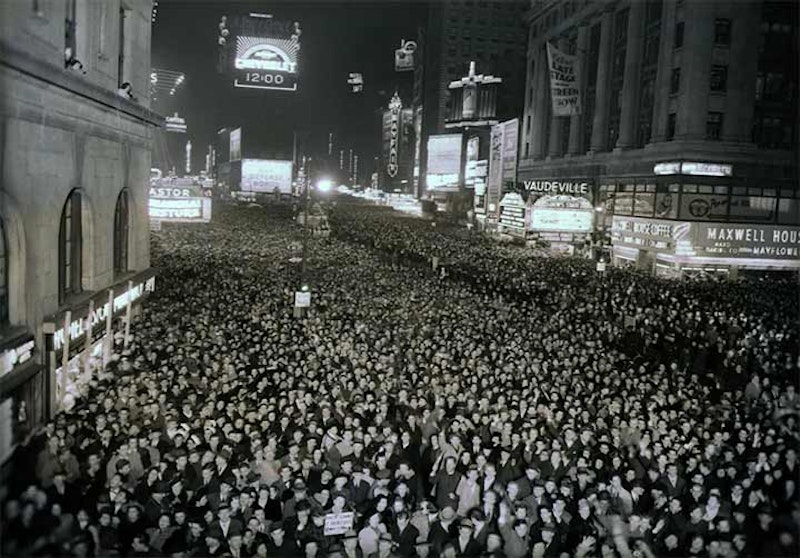
Times Square never lives up to its “Crossroads of the World” moniker more than on New Year’s Eve, when, for the past 119 years, throngs (never including me) have assembled to watch the Times Square New Year’s Eve ball drop. The famous crystal orb slowly falls down a pole during the last minute of the old year, reaching the bottom and lighting up the moment the new year arrives.
The “time ball” tradition originated in Greenwich, England, in 1833. A ball would drop down a pole on the Greenwich Royal Observatory at one p.m. each day to allow ship captains in nearby waters to precisely gauge their chronometers. Another such device in New York City could formerly be found atop the Seaman’s Church Institute; when that building was demolished, its tower, along with its now non-functioning time ball, were moved to the South Street Seaport at Pearl and Fulton Streets. It was under renovation last time I was there, but it will be revealed again, soon, I presume.
Oscar Hammerstein got the ball rolling, so to speak, on Times Square’s ascension to the entertainment capital of New York in 1895, when he built the massive Olympia Theater at W. 44th St. and Times Square, joining a couple of smaller theaters.
Times Square, which sees millions of spectators file into the “bow tie” created by the intersection of 7th Ave. and Broadway between W. 42nd and 47th Sts., has been the “Great White Way” since 1904, when New York Times owner Adolph Ochs began hosting fireworks displays to ring in the New Year, to promote the newspaper’s new headquarters at the Times Tower. The illuminated “ball drop” from the tower was inaugurated in 1907.
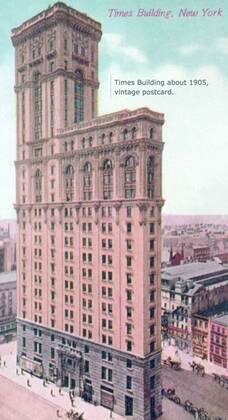
The Times Tower, now known as One Times Square, became the permanent home of the illuminated New Year’s Eve ball when metalworker Jacob Starr fashioned a 700-pound sphere made of iron and wood, five feet in diameter and featuring a hundred 25-watt incandescent bulbs. Starr’s studio, Artkraft Strass, was the manufacturer of all the various Times Square illuminated Times Tower spheres used on New Year’s Eve for most of the 20th century. By contrast, the current ball manufactured by Waterford Crystal is 12 feet in diameter, weighs 11,875 pounds, and is covered with 2688 Waterford crystal triangles that are handmade in Ireland. In 1907 as now, the ball is gradually lowered down a flagpole heavy enough to accommodate it, reaching the bottom at midnight on January 1.
Since 2009, the illuminated ball has hovered 470 feet above the street atop One Times Square—visible all year round—only moving from its perch and dropping slowly downward at 11:59 p.m. on December 31. The One Times Square building itself has changed over the years, with the Times moving out in 1913 for larger offices on W. 43rd St., and then, in 2007, the “New Times Tower” on 8th Ave. and W. 41st St. The old tower, stripped of its original Beaux-Arts architectural elements, has been the home of large illuminated ads in recent years, as well as the “news zipper” with the daily headlines, since the 1920s.
Revelers arrive during the early afternoon in areas designated for public gathering by the NYPD within Times Square. The ball is raised and illuminated around six p.m., and a half-hour later, balloons, “2026” masks, scarves, etc., are distributed to the crowd. (There are no public restrooms in the area and many in the crowd resort to diapers or Depends.) In past years, entertainment began around 6:45 p.m. and culminated with the worldwide “New Year’s Rockin’ Eve” show beginning at eight, which features major musical acts in both Times Square and Hollywood, broadcast on video screens.
When the ball has dropped at the stroke of midnight, 3000 pounds of confetti will rain down. The show goes on no matter what the weather, even in snow and rain storms. On Wednesday night, the weather is expected to be seasonably chilly, in the 30s. I’ll be watching on TV, drink in hand, in a warm apartment with some close friends around.
—Kevin Walsh is the webmaster of the award-winning website Forgotten NY, and the author of the books Forgotten New York (HarperCollins, 2006) and also, with the Greater Astoria Historical Society, Forgotten Queens (Arcadia, 2013)