
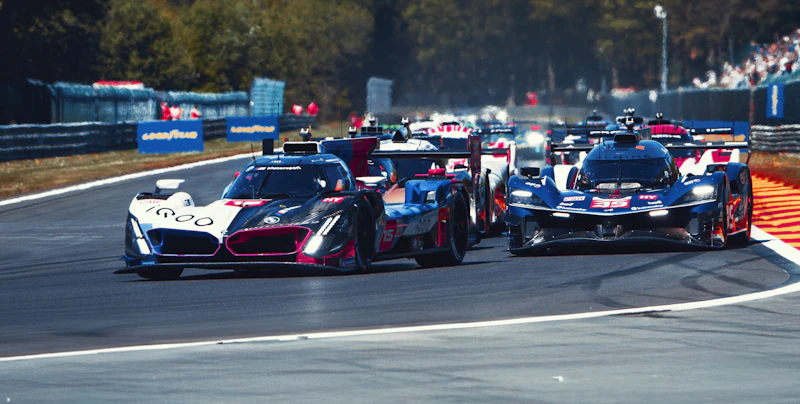
The strangest conversation that recurs in the world of motorsports is the discussion about “on-track product.” People who even casually follow F1 will hear the commentators and news outlets bring it up with regards to driving styles, rules, and, most of all, technical regulations. The 2026 season for the FIA’s top category has been marred by a massive overhaul in how power in the cars is distributed, where the cars running at full boost are getting half their horsepower from a hybrid unit. It led to bizarre ways to drive, from lifting early on the straights when the car should be going full speed, or early downshifts and energy gathering on turns. This boost-recharge sequence has led to overtakes, often with one driver grabbing the lead into one corner before the previous leader snatches it back on the next. The racing isn’t so much a test of raw speed, so much as management. Some drivers compared it to playing Mario Kart.
On the one hand, pushing for the betterment of the “on-track product” in motorsports (i.e. how entertaining it is to watch at home on TV or social media highlights) is trying to fit a square peg in a round hole. Motorsports, by that definition, has always been boring. Most of the greats—from Fangio to Schumacher—were dominant in their era to the point of boredom, with the occasional exception of Prost and Senna stupidly running into each other. All the Hamilton-Rosberg rivalry did was make viewers forget that, in the mid-2010s, the Mercedes cars were lapping seconds faster than the entire field. The appeal of motorsports has more to do with the appeal of the machines themselves—how they scream to life, how they cling to the ground, or throw themselves apart—and not the Hollywood overtakes. On the other hand, it’s funny that drivers from the supposed top tier (at least from a financial standpoint, it’s quantifiably so) are complaining about hybrid power and energy management when that’s already a key part of the two most interesting racing series in the world right now: IMSA and WEC.
These cross-Atlantic cousin endurance racing series (with a codified rules partnership enabling cars that meet both series’ regulations to compete at each other’s respective crown jewels, the Daytona 24 and 24 Hours of Le Mans) are defined by their balance of performance (“BoP”) regs, which allows for the governing body to require cars to add or lose weight so as to make sure all the vehicles running in class are as fairly matched as possible. This often seems unfair to the likes of Team Penske, who’ve dominated IMSA the last few years with their Porsche 963 factory effort. Although, it can’t be that unfair if they keep winning more often than not even after getting hit with BoP.
Moreover, endurance racing is all about management, and the current top classes of prototypes in IMSA and WEC (GTP and Hypercar, respectively) require massively delicate, consistent, and skillful control of harvesting and deploying hybrid power; the sound of the hybrid system spinning and spooling under breaking has become as signature to the current era of endurance racing as hard and fast wheel-to-wheel action has.
Multi-class racing is always going to feature more overtaking than single-class events, by nature of slower road-familiar sports cars will get constantly lapped by space-age prototypes. But under the current rulesets, IMSA and WEC have struck a great balance in allowing the cars to be on even enough footing to race each other hard. Take IMSA’s recent sprint around Laguna Seca, where Laurin Heinrich, in his customer 963, was able to spend the last six minutes of the race hounding down seasoned veteran Earl Bamber in a factory Cadillac, ultimately snatching a spectacular win for JDC-Miller MotorSports. Or, there was last weekend’s 6 Hours of Spa, where the final dozen minutes of the race featured four cars in lockstep for podium positions, as Kevin Magnussen used his struggling BMW M Hybrid V8 to hold back Antonio Fuoco in the Ferrari 499P and Kamui Kobayashi in his Toyota GR010, long enough both for Magnussen’s sister car, the #20 BMW, to run away with the win, and also allow Tom Gamble in the Aston Martin Valkyrie, with its ghastly V12 chewing up the straights, catch up to the lead pack and nearly get in the mix for a podium place. I think it’s silly to complain about “on-track product” in motorsports, and also the wrong time to do it.