
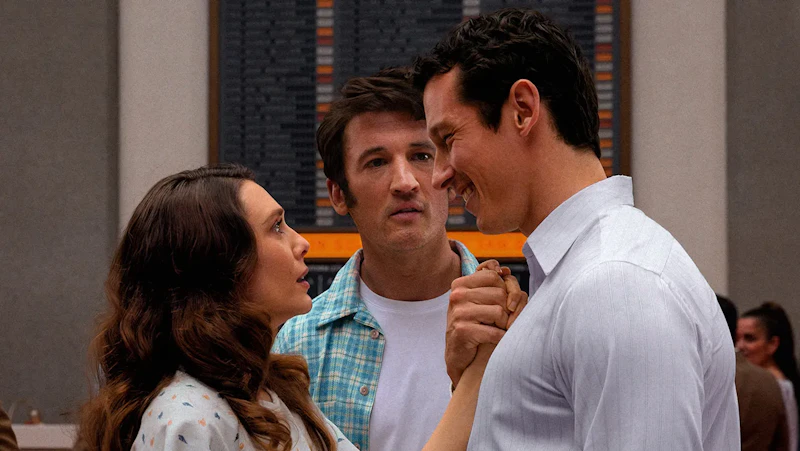
On a flight to Florida, I watched Eternity. It’s a romantic comedy in which the principals are, mostly, dead. We’re introduced to Joan (Elizabeth Olsen) and Larry (Miles Teller), a married couple of 65 years, shortly before he dies, knowing she’s terminally ill. He awakens in an afterlife way station, where souls choose how to spend eternity, with help from “afterlife coordinators.” After some disorientation, Larry prepares for Joan’s arrival and their new life together, with bodies restored to when they were at peak happiness.
Upon arrival, though, Joan faces a conundrum. Her first husband, Luke (Callum Turner), killed in the Korean War two years after their wedding, has been waiting for her all these years, taking a job as a bartender at the way station rather than going on alone. Complicating matters, there are innumerable possible eternities on offer, catering to various environmental, cultural, professional, culinary or sexual preferences: Beach World, Mountain World, Space World, Cowboy World, Catholic World, Smokers World, and so on, with Marxist World and Man-Free World both noted as unavailable due to high demand.
Crucially, though, once a soul’s made a choice, trying to switch to another eternity or undo the decision results in banishment to a dark void (though whether one suffers there, or ceases to exist, isn’t elucidated). Given Joan’s atypical situation, however, administrators permit her to sample a couple of eternities before a final decision. Ironically, my flight ended with the movie not quite over, though Wikipedia confirmed the evident outcome.
I found Eternity entertaining, despite—or perhaps because of—its derivativeness from Albert Brooks’ 1991 Defending Your Life. Contrived cosmic rules that may be broken—as when Brooks long ago jumped on some prohibited tram to be with his love—are a staple of afterlife films. Why must people make an irreversible decision amid Eternity’s tacky existential options? Because the plot requires it. Similarly, why are there red doors whereby one might exit an eternity, pursued by a police force of dubious capability?
I wouldn’t recommend the film to anyone suffering from apeirophobia, a fear of eternity, infinity, or endless repetition, and other forms of existential dread. The options facing Joan and her husbands hold no promise of ongoing growth and novelty, which Martin Gardner persuasively proclaimed essential to any afterlife’s desirability. Eternity depicts an oppressive social order, even if some of its functionaries are capable of compassion. Its demand for decisions of infinite consequence, particularly based on scant information, is inherently brutal, and in one of the better scenes Joan understandably asks if this is hell.
In Florida, my family and I worked as moderators at an academic-quiz competition for middle- and elementary-school students. One of the questions I read to fifth-graders had the answer, “Austrian school of economics,” but the kids didn’t get it, not recognizing the names of Friedrich Hayek and Carl Menger. Anarcho-capitalists might console themselves that Ludwig von Mises and Murray Rothbard would get greater traction with the younger generation, but I doubt that’s true. My guess is that a “Libertarian World” along the lines of the afterlives sold in Eternity wouldn’t have many takers.
In a free moment, I came across a Substack note mentioning the digital library JSTOR, where I didn’t know setting up an account is free. Once there, I found “Independent Voices,” a collection of “alternative press newspapers, magazines and journals.” This had categories including “Campus Underground” and “Little Magazines,” but I was drawn to the one titled “Right-Wing,” which noted the Cold War led to “an active right-wing press that represented the views of conservative organizations and individuals and provided a response to the threat of growing liberalism and the ‘New Left’ movement.”
The featured publications are far-right and crazy. However, one of them, a newsletter called Yesterday-Today-Tomorrow, evocatively argued that the afterlife draws souls of both humans and aliens, stating in 1966: “Always new spirits come into existence in the spirit world from the deceased men’s souls who lived on our or other planets in the universe; their souls become new spirits or they are only episodes in other spirits who dwelt in men’s souls.” That strikes me as having greater world-building potential than Eternity.
