
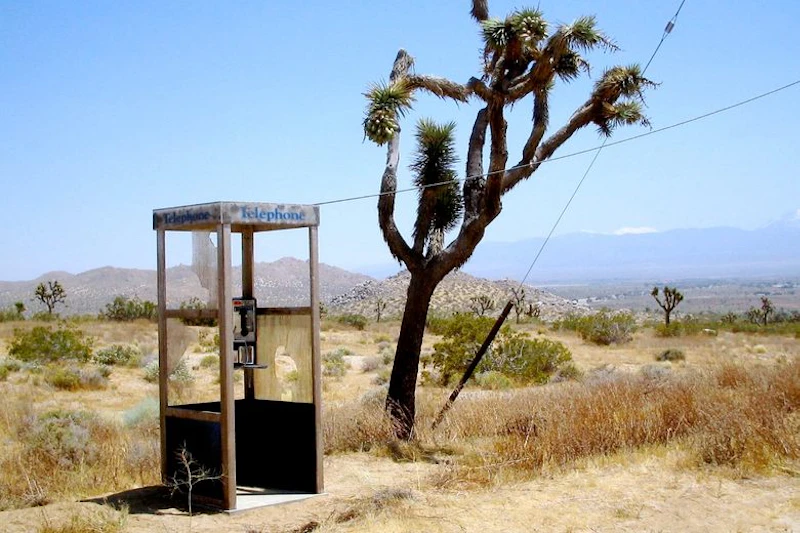
Growing up in Jackson, Michigan, I was always about 20 years behind any cultural phenomena. The teen girls there still hairspray like it’s the late-1970s. I missed the underground Mojave Phone Booth mythos—I just heard about the booth itself from a recent The Why Files “Campfire Stories” episode, which led me to the book Adventures With the Mojave Phone Booth by Godfrey “Doc” Daniels.
I’d moved out to the Southwest, Arizona and southern California, where this chronicle takes place, at around that time frame, 1997-2000. If I’d only known Daniels, even as a friend of a friend in Phoenix, and he’d invited me along on a quest to find a mythic phone book out in the middle of the Mojave Desert, I would’ve gone. I think. Instead, I missed even the Booth’s rise into mainstream fame on national tv, references in popular indie rock songs and tv shows for decades. (Most recent appearance, coincidentally in Barbara Byar's novel, In The Desert, the cover of which features a man and a woman embracing in a phone booth in the middle of the Mojave Desert.)
Daniels is the person who made all this happen. I want to call him Godfrey, since that’s what everyone else in the book calls him. The “Doc” seems to be an honorific. Which he seems to have honored himself. To understand what kind of person Daniels is/was, picture that he was going to Burning Man back in the 1990s, and already felt that it was ruined.
But he’s uniquely qualified to tell this tale, as well as be in it: An English major, he was active in the “zine” culture of the 1990s, and was an early owner of one of the first eclectic websites on the internet as it was taking off. Daniels heard about the phone booth in the Mojave Desert in another person’s zine, and became obsessed, calling that phone number multiple times a day. Then someone answered. That made the obsession bloom.
And, being in Phoenix, the booth was within a medium day’s drive:
The bare sight of a phone booth in the desert could not have appeared before happier eyes than mine...
The Mojave Phone Booth was real.
I mean, really real. It existed, truly existed, in space and in time. You could touch it (I did). It had shape (that of a phone booth). It had size (ditto). It was in reality just as I had envisioned it: a solitary communications outpost along a chain of telephone poles in a landscape dotted with Joshua trees. Dust raised by the van’s tires glittered in beams from the van’s headlamps through bullet hole that pocked the Booth’s frame. From the desert floor thousands of fragments that once formed the Booth’s glass panes reflected light back to us in sparkles. The whole scene was so beautiful as to be almost otherworldly.
Daniels chronicled his and his oddball friends’ pilgrimages to the Booth on his new website (DeuceOfClubs.com), which is where the Mojave Phone Booth craze took off. Having published the number, people from Japan and Europe started calling it, so that the booth was ringing almost constantly. Daniels never expected the Booth’s popularity to get that big—no one did—and this incident seems to be the first time something went “viral.”
Daniels gives a spoiler early on in his book: The Booth gets destroyed by the National Park Service. In this, Daniels assumes that everyone reading his book already knows what happens. He wanted to give his official narrative because of how the Booth myth took off. Some people blame him for the Booth’s demise, something he scoffs at while also seeming to be hurt by. Despite his and the Booth’s fame, Daniels—as seen in the book—always had a distrust of the media, and avoided many opportunities for interviews. He was burned by many he did give.
Other people stepped in to speak about the Booth, and therefore the Booth Myth has many tendrils and half-truths and untruths which Daniels, 18 years later, decided to lay to rest. The result, Adventure With The Mojave Phone Booth, is a glorious mess—Daniels can put words together, and is obsessed with recording all his phone conversations and squirreling away all manner of junk to be used later (or not). And he turns out to be a good researcher, finding obscure articles about the Booth and the Mojave Desert, and about the Mojave National Preserve. He gives good footnotes. Even unto giving funny asides, à la David Foster Wallace. The book is—amazingly but maybe inevitably—self-published: Daniels financed it with a Kickstarter campaign, and sells it via Amazon. If I were to teach a MFA lever CNF class, I’d assign this book.
The other big cultural shift which happened in this time period was that the land changed jurisdiction, from being “managed” by the Bureau of Land Management (which is kind of a Forest Service for federally-owned desert-ish land) to becoming part of the Mojave National Preserve, part of the National Park Service system.
The Mojave National Preserve destroyed the Booth. For which Daniels is bitter to this day. He particularly blames the Park Superintendent at the time, though some of his reports from the field show some less than happy Park Law Enforcement Officers. The Park/Preserve tried to put the blame on Pacific Bell, though Daniels’ research shows that that’s not true. Pacific Bell is content, amazingly, to keep their phone booth in the middle of the desert operational. It was probably originally installed for truck drivers when there were more operational cinder mines there. And, the family who still lives out there at the time of this Booth Adventure does use it, though overall traffic is way down. In a funny note, Daniels tracks down an Pacific Bell memo from that time, which, given the uptick in use from everyone calling it, says that the company has no plans to shut the phone down.
Even though I had long expected this piece of bad news, it was still tough to believe and even tougher to take. The mysterious warning letter had been for real and now the Mojave Phone Booth was gone. The colosseum in Rome couldn’t have contained the number of monkey balls that sucked.
I’m glad no one was there to see my face as I read the news of the Booth’s destruction. I probably wore the expression of a man who’s just received news of a social disease, or an intestinal parasite, or a property tax hike. I like to tell people I have only one feeling but that science has not yet identified it. Whatever my one feeling is, this was a direct strike on it. It felt like an ice cream headache in my heart.
At this point it’s hard to write anything more about how/why the Mojave Phone Booth became so popular. It’s one of those things that you either latch on to immediately, or it just seems weird. Or, peoples’ enthusiasm seems weird. Either finding and visiting something that’s slipped through normal society and become a Monument makes you feel joy, or not. It takes an oddball. The same personality that would find Burning Man fascinating. Though Daniels’ book is such a great ethnography in itself that I think English majors—or at least composition teachers—everywhere would appreciate it. You can visit Daniels’ retro website DeuceOfClubs.com to get a feel for the Booth there. You might track down at least one documentary about the Booth, as well as old news profiles of it, like on NBC Nightly News.
What remains to be seen is if this was a unique phenomenon. Seems like the Mojave Phone Booth craze could have only happened at that time. But who knows: planking was viral for a while. I wonder if there are other monuments to weirdness—what in ethnographies are called “artifacts”—which have slipped through the Bureaucracy and grown past their original purpose. Artifacts which could maybe unite us oddballs in another outpouring of oddball joy.