
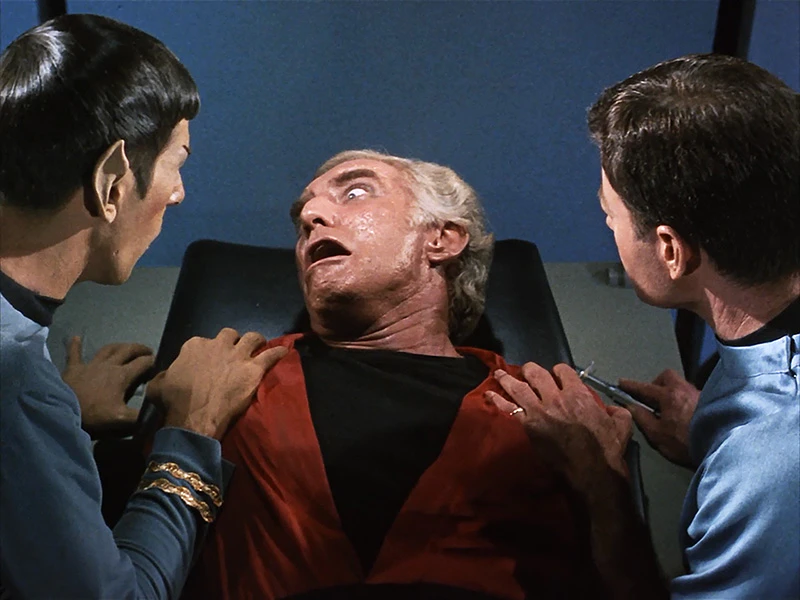
There was an original Star Trek episode called “Dagger of the Mind” in which Captain Kirk and the crew meet a man whose mind was erased. The man, a stowaway on The Enterprise and escapee from a penal colony, is homicidally violent and is restrained. Doctor McCoy suspects foul play, so they investigate. This leads to the discovery that the evil colony director is programming the inmates with his own thoughts. The escaped man says something like, “Empty… so empty… so terrible to be so empty!” This is a feeling I live with, one that’s come and gone repeatedly through the years.
Of all the mental torture possible for the artist, the lack of an idea is the worst. One feels no enthusiasm for anything; there’s only a deadness. Where do ideas come from? Bartók, the great Hungarian composer, told the story of being in such an empty state in 1902. He was unable to work and felt he’d reached the end of his compositional road. He attended a concert of the Budapest Philharmonic. By chance, Richard Strauss’ tone poem Thus Spake Zarathustra was on the program. He said that when he heard the unresolved ending of the work—the basses in C and the high strings and woodwinds in B—he had a eureka moment. “I was aroused as by a flash of lightning… It contained the seeds for a new life. I started composing again.”
In 1975 Brian Eno and Peter Schmidt developed a system called Oblique Strategies, which uses index cards to approach creative deadlock from different angles. Typical cards say: “Use an old idea,” “Ask your body,” “Try faking it!,” “Honour thy error as a hidden intention,” or “Work at a different speed.” The problem with this system is that when one’s in a state of idea-lessness, the words sound empty. What’s an old idea? What’s to be faked? What’s an error? Without the spark of enthusiasm, these are meaningless concepts. Perhaps this system would generate ideas in a corporate environment, where ideas are disposable and have an expiration date, but for the artist searching after truth they’re hollow.
There’s a scene in Hitchcock’s Rear Window where Lisa Fremont (Grace Kelly), hearing the songwriter at work in his studio, asks her boyfriend Jeff (Jimmy Stewart) where the composer gets such inspiration. He replies, “He gets it from the landlady once a month.” It’s true: deadlines and external demand help a person to think.
The ancient Greeks believed in the Muses and would invoke them before any creative endeavor. Homer takes no credit for The Iliad, whose first line, in Fitzgerald’s translation, is “Anger be now your song, Immortal One!” He saw himself as a vessel, not a creator. Any artist has had that feeling on finishing a work.
Does inspiration exist? If so, it suggests metaphysical realities that modern man may be loath to accept. Robert Musil, the author of The Man Without Qualities, in Freudian allegiance to his times, wrote that inspiration was simply a misunderstanding of the workings of the subconscious: that the mind is working even if we’re unaware of it.
Consider as well that Bartók and the Dutch composer Louis Andriessen have said that composers always write the same piece of music. This suggests that we’re like strands of DNA, each having a unique idea to share, but one that we can’t escape because it’s integral to our being. Maybe, but the artist still requires the illusion that he or she is starting out again from scratch.
The lowest form of creative activity is the ideologically-inspired idea. This results when one aligns with an established system of thought and expresses adherence to a set of preconceived ideas, whether political, sexual, identity-driven, race-driven, or otherwise. It’s soapbox nonsense, unworthy of a thinking person.