
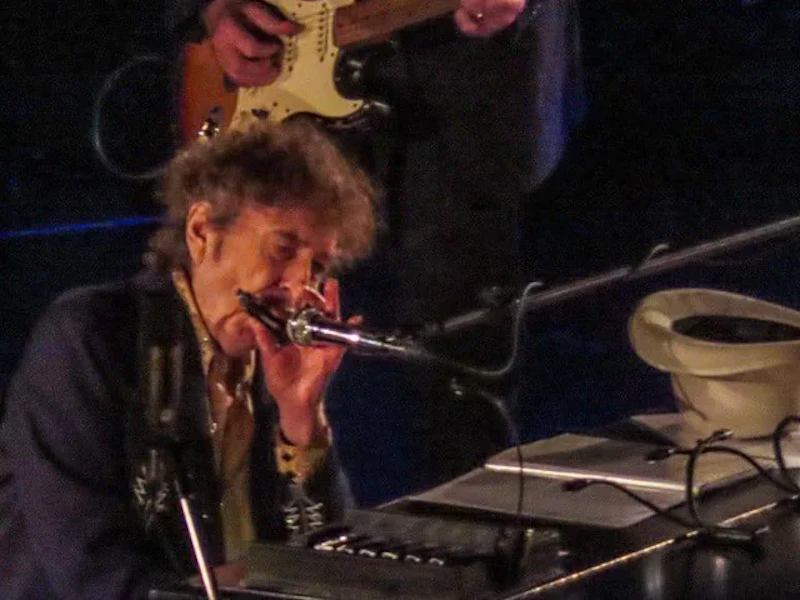
Bob Dylan turned 85 last Sunday, and as expected social media was clogged with birthday wishes (a lot of the encomiums included gratuitous personal reminiscences, as if anyone cared), almost all of them showing an image of Dylan before he turned 30. I was surprised, since that contradicts the glowing notices he elicits, especially in the past 15 years, for his “never-ending” string of concerts.
The Wall Street Journal’s James B. Meigs was notably enthusiastic in his May 21st column, “Bob Dylan Does It on His Own Terms,” saying he’s seen Dylan three times in the past two years, which judging by his words, enriched his soul. (Meigs doesn’t say whether he attended any pre-1978 shows, but given his shaky summary of Dylan’s career, I suspect not.) He writes: “A shameless crowd-pleaser Mr. Dylan is not. He mostly stays half-hidden behind his piano and doesn’t allow venues to project close-up video images. He expects the audiences to listen… Bob Dylan refuses to be locked in a nostalgic jukebox. And that’s only one of the many boxes this musical Houdini has wriggled out of.”
I don’t mean to ridicule Meigs—who’s had a long and prolific career in journalism (Popular Mechanics, Slate, Commentary and The City Journal)—but I wish he wasn’t so slapdash with the facts of Dylan’s prime years (1962-1976 in my opinion). On the off-chance younger people read his column they wouldn’t have found accountable information. (Just his description of the atrocious 2024 biopic A Complete Unknown as “fine” made my ears wiggle.) The headline—which reflects Meigs’ column accurately—is off-kilter: Dylan has always “done it on his own terms,” whether in recording studios or at concerts when he’d fiddle with his lyrics, which happened, say, in 1964 at his Halloween show at NYC’s Philharmonic Hall, and on the European leg of his 1966 tour, when he turned the earlier acoustic song “I Don’t Believe You” on its head. (Meigs erroneously says Dylan began such fooling around in the 1970s.)
He did the same in 1971 at George Harrison’s Bangla Desh benefit concert, with beautiful countrified versions of “Love Minus Zero/No Limit” and “A Hard Rain’s A-Gonna Fall.” Meigs gets in trouble when writing about Dylan’s early Greenwich Village days: “In an era when polished singers like Joan Baez and the Kingston Trio defined folk music for many, Mr. Dylan’s searing vocals took getting used to.” Never mind the omission of artists like Phil Ochs, Fred Neil and Dave Van Ronk, Dylan’s vocals on his pre-Bringing It All Back Home albums weren’t “searing”: many of his self-penned songs were extraordinary, but as shown by the quiet but devastating “North Country Blues” they didn’t encourage listeners to do the Peppermint Twist.
When Dylan released Nashville Skyline (1969), it was shrugged off as a diversion by fans who, taken aback by the excellent John Wesley Harding (late-December, 1967, with zero publicity) were still excited by his return after his motorcycle “accident” in 1966. (His voluminous catalog of songs recorded with The Band in ’67 were—with the exception of numbers like “The Mighty Quinn,” “You Ain’t Goin’ Nowhere” and “Nothing Was Delivered” sent to Manfred Mann and The Byrds for cover versions—still mostly a secret, unless you got a scratchy, barely audible copy of the bootleg The Great White Wonder, which started circulating in 1969.) It was 1970’s Self Portrait that caused such a ruckus with critics (notably Greil Marcus, who went on to write several very good books about Dylan), leading some to declare, “Dylan should’ve called it quits in 1966.”
That wasn’t me: I liked New Morning, Planet Waves, Blood On the Tracks and parts of Desire (save the silly “Joey”) but Street-Legal left me cold, and then the gospel phase, starting with Slow Train Coming, left me cold. I stopped buying his records, except for the compilations that began with Biograph in 1985. A number of fans stayed on the train—including my older brother Doug, who raved about every new Dylan record; he died in 1999, but I’ve no doubt he would’ve gone nuts over 2020’s Rough and Rowdy Ways—and were contentious about if you cared to debate, which I didn’t.
Anyway, Meigs is typical of the true believers (and I wonder if that cohort is limited to fans over 60) and good for them. If music makes you happy, there’s no dispute.
—Follow Russ Smith on Twitter: @MUGGER2023