
It’s likely that in the past five decades I’ve read, or skimmed, the essays of 85-year-old Roger Rosenblatt, one of those lifelong, properly-credentialed journalists who worked or published in all the right places (The New Republic, The Washington Post, Time, PBS’ NewsHour), was a Fullbright Scholar, won two Polk Awards, taught at Harvard and has published over 20 books. I can’t remember a single article he wrote, which isn’t especially damning, although some work by the likes of Richard Ben Cramer, Michael Kinsley, William Safire, Dorothy Rabinowitz, Matt Labash, Camille Paglia and Susan Orlean have stuck with me.
That aside, I read—all the way through; no congratulatory red, white and blue balloons necessary—his recent “Guest Essay” in The New York Times on the topic of small talk. I’m not sure if Rosenblatt was facetious with the column, but suspect he wasn’t, given his age and manners acquired as a feted “Acela Corridor” (and previously “Metroliner”) club member.
He writes: “People with whom you make small talk are made aware that for at least one moment in their lives, they have a safe home with you, a place where they are welcome just as they are. They do not need to earn your attention. They receive it simply by existing.” It does sound like parody, and the words “safe home” puzzled me (in fairness, perhaps inserted by a Times editor looking for something, anything, to do), and if serious, is condescending—perhaps unintentionally, although you can bet four bits that in his heyday Rosenblatt regularly invoked the plight, or success, of “ordinary” Americans. What the hell, the guy’s an octogenarian and rates a measure of respect, simply for still writing. And, if you wade through the mush, several good points stand out.
One of the “tips” I tried to impart to my younger son Booker, who’s worked in the financial industry for eight years, is that it’s key, when meeting a client for the first time—either with the intention of hooking the person on an investment, or just a pro forma meet-and-great that’s put in your back pocket—to spend at least 15 minutes of schmoozy foreplay discussing sports. (Booker’s a born talker, like his paternal grandmother, so this was already second-nature to him.) Like his dad, Booker’s a one-sport guy, baseball—he could make your ears do flip-flops with analytical analyses of MLB players—but both of us are conversant, just by reading or glancing at headlines, in the major sports stories of the day. “Jeez, the Ravens better step it up,” or “It’s just not a Bruins kind of year.”
I still natter on with small talk almost every day, but with no illusions, like Rosenblatt, that I’m doing the person, usually a stranger, a favor. Sometimes it just spills out, like when I’m at a pharmacy and compliment the cashier on her earrings or ask a guy what age he was when he committed to a couple of dramatic tattoos. Won’t fib, that banter makes friends, useful in future encounters in the third-world swamp known as CVS. But I also enjoy the interaction, and once the recipient overlooks that our ages are about 40 years apart, I think the fleeting chit-chat is mutually appreciated. Ain’t it nice to be nice! As I’ve noted, my mom could talk to anyone for four straight hours (while my dad, a stoic New Englander, was a man of few words; in fact, my best friends as a kid never heard dad say more than two words, although he always shook their hands, on the very rare occasion that school buddies were allowed in our messy house), usually about nothing in particular, but more substantive than “How about that heat?”
In the mid-1960s she skipped the topic of Vietnam, since she was a dove and even then politics could kill a conversation. My second oldest brother Jeff and I had that gene—unlike my other three brothers who labored at small talk—and years ago, when he was at an airport, he whittled away time by giving me a ring and we’d blab about baseball, politics, journalism, books and movies. He passed away in 2012 and sometimes I read a Times or Wall Street Journal article and reach for the phone. That’s not uncommon, and it happens less and less frequently as the calendar flips over, but the memory continues to give me sustenance.
One more weird Rosenblatt paragraph: “Small talk connects you to those who need it, even if they’re unaware that they need it. You feel better for making them feel better. Sometimes I look at a throng of strangers, and want to take the smallest hand, and make talk so small, you can hardly hear it. Yet the din roars through the world.”
Come again? Maybe this is mean, but is the still-sentient Rosenblatt auditioning for the role of Micawber or Falstaff at his local dinner theater?
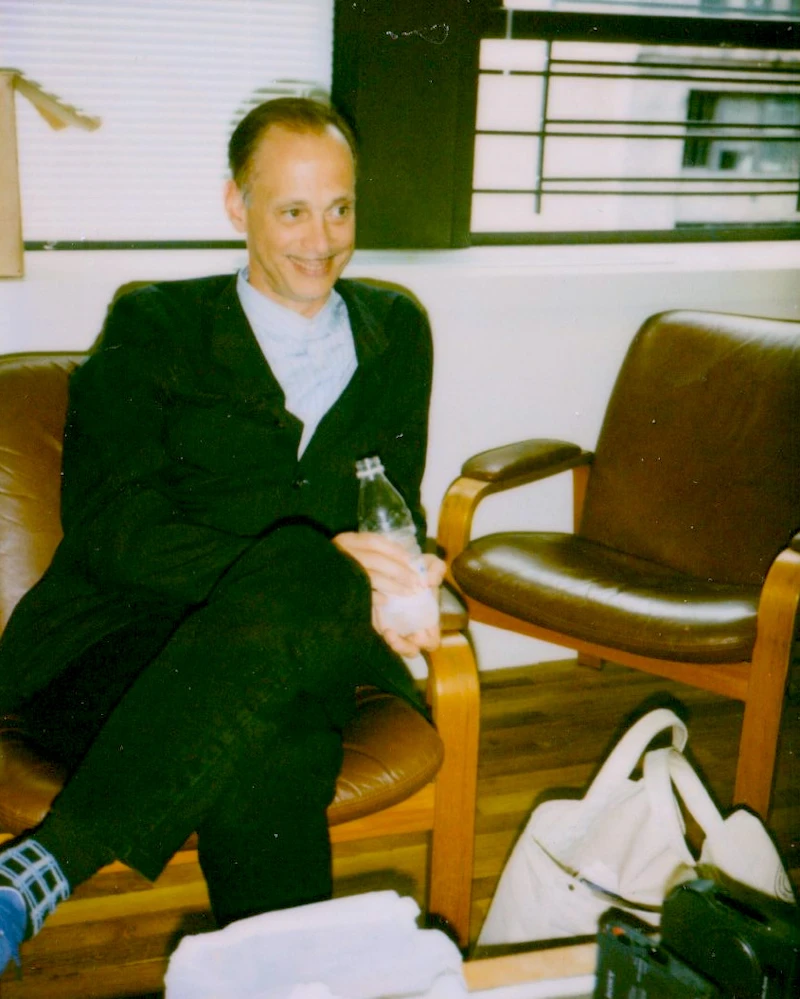
The accompanying photo is of John Waters in my New York Press office. One day while in NYC he stopped by for an hour or so to catch up with the many Baltimore transplants who worked at the paper. There was small talk, but of such a ribald, off-the-record and side-splitting strain that I wish I’d transcribed it. What a time capsule from the fetishized 1990s.
Take a look at the clues to figure out the year: The History Channel is launched; Colin Ferguson is convicted of six counts of murder in LIRR shooting; WrestleMania XI is held in Hartford; Pocahontas and Toy Story are released; Madison Cawthorn is born and Rose Kennedy dies; World Book Day is first celebrated (or ignored); Logan Paul is born and Shannon Hoon dies; Stanley Elkin’s Mrs. Ted Bliss, Jane Smiley’s Moo, Nick Hornby’s High Fidelity and Terrence McNally’s Master Class are published; Seamus Heaney wins the Noble Prize for Literature; and Carol Shields takes the Fiction Pulitzer Prize.
—Follow Russ Smith on Twitter: @MUGGER2023