
If only the Olympics were a safe place where politics politely checked itself at the door. But throughout history the Games haven’t been shielded from the world’s division, and the 2026 Winter Olympics in Milan and Cortina were no exception. A Ukrainian sled racer was disqualified for wearing a helmet memorializing victims of the Russian invasion, skier Hunter Hess flashed “L” signs after being called a loser by Trump, stating that you can both be proud of Team USA and embarrassed by its leadership, and queer figure skater Amber Glenn was attacked online as “too woke” by the Magaverse.
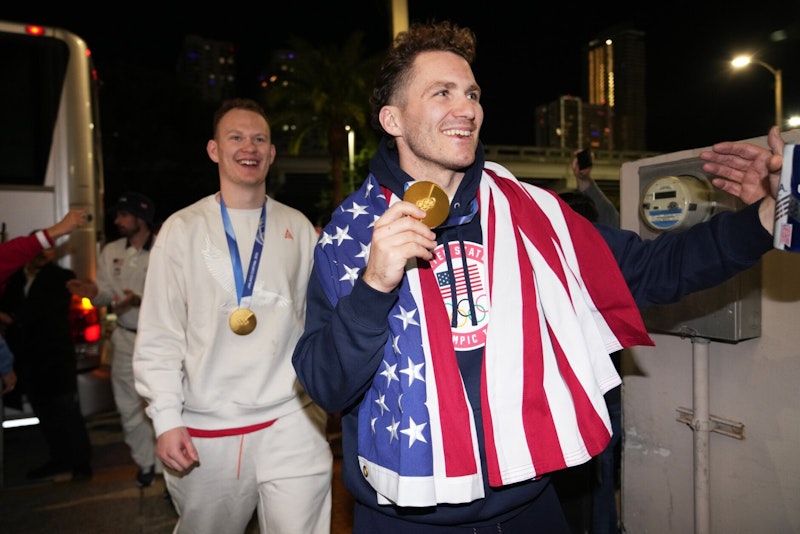
One story that got a lot of political traction occurred after the U.S. men’s hockey team beat Canada 2–1 in overtime to win its first Olympic gold since the Miracle on Ice. It should’ve been a simple sports headline, the kind that unites a country for at least a news cycle, especially after the team honored their teammate Johnny Gaudreau who died after being struck by a drunk driver and the team skated with his jersey and brought his kids into the ice.
But we didn’t even see those images the next day, they were lost to the coverage of FBI Director Kash Patel drinking beer and celebrating with the team and President Donald Trump calling the locker room to invite them to the White House for The State of the Union. During the call Trump joked that he “would have to invite the woman’s team too” or risk impeachment. There was much laughter in the room. Online, the reaction was less amused. The U.S. women had just won gold themselves, and many critics felt the tone mocked and diminished their achievement. Within hours, clips and secondhand accounts ricocheted across social media, reframing the moment even as news of Trump’s continued involvement in the Epstein files escalated with new accusations revealed.
The women’s team ultimately declined the State of the Union invitation, citing prior academic and professional commitments. That decision, routine in another era, became fodder for debate: scheduling conflict or statement? Did the men’s attendance signal endorsement? Should athletes even have to answer those questions in the middle of an Olympic glow?
Individual athletes found themselves pulled into the crosscurrent whether they sought it or not. Jack Hughes, who scored the overtime winner, was quickly embraced by commentators eager to cast him as a symbol of patriotic resurgence. The reality’s more mundane. Hughes has generally kept his political views private and is known more for his playmaking than ideology. His mother, who is a consulting coach for the women’s team, issued a statement that refused to engage.
Figure skating brought another flashpoint. Amber Glenn, open about being queer, spoke about wanting young athletes to feel safe and seen. Her visibility was celebrated by many as a milestone in a sport long shaped by rigid expectations. It also triggered a wave of online hostility. Glenn later described some of the abuse as disturbing and called for stronger protections for athletes navigating social media. Some conservative voices accused athletes like Glenn of politicizing the Games simply by discussing LGBTQ issues. Progressive commentators countered that existing openly isn’t a political act: of the 49 total out LGBTQ+ athletes at the games, 11 medals were won by 19 of them.
Glenn’s teammate Alysa Liu captured gold in women’s singles, a comeback story worthy of prominent Olympic coverage. Instead, even her triumph was swept into arguments about national identity and what representation means in a polarized America as the Magaverse saw her piercing and unique hairstyle and immediately labeled her “woke” though she said nothing controversial at the Olympics and was respectful to the flag.
Controversy extended beyond the rink. Freeskier Hunter Hess drew backlash after expressing that representing the United States felt meaningful only when national policies aligned with his values. MAGA-aligned influencers framed his remarks as ungrateful. Supporters argued that loving a country and critiquing it are not mutually exclusive.
The 1936 Berlin Olympics were a propaganda stage. The raised fists of Tommie Smith and John Carlos at the 1968 Mexico City Olympics remain one of the most enduring images in sports history. What’s different now is the speed and saturation. A locker room joke becomes a culture war skirmish before the medals even make it home on planes.
Milan hosted with pageantry and pride. For many international viewers, the American fixation on White House invitations and athletes’ identities seemed distant from the joy on the slopes. Yet for U.S. audiences, the politics traveled with the speed of a triple lutz. And so goes the paradox at the heart of the Olympics. Athletes compete as individuals, but are draped in national symbols. The flag on a jersey is an honor and a canvas. In a polarized age, people project onto it their hopes, frustrations, and grievances.
In 2026, the medals were real. The skating programs were exquisite. The hockey final was unforgettable, however the men’s gold felt tarnished when followed so quickly by the locker room casual misogyny of the President, who was no doubt trying to distract from recent news of a potential DOJ Epstein files coverup of sexual assault allegations against him by a then-13-year-old.
The Olympics don’t exist in a vacuum. It’s a global stage, and stages attract speeches, statements, and scrutiny. In 1980, the U.S and many other countries boycotted the Moscow Olympics and in 1984, Eastern Bloc countries boycotted the L.A. Olympics. After Russia was banned from competing at these Olympics due to Ukraine, this year, one wonders how the 2028 summer Olympics in L.A. will be impacted by politics. Fans tune in for the sports, but inevitably witness messaging about what its athletes represent.