
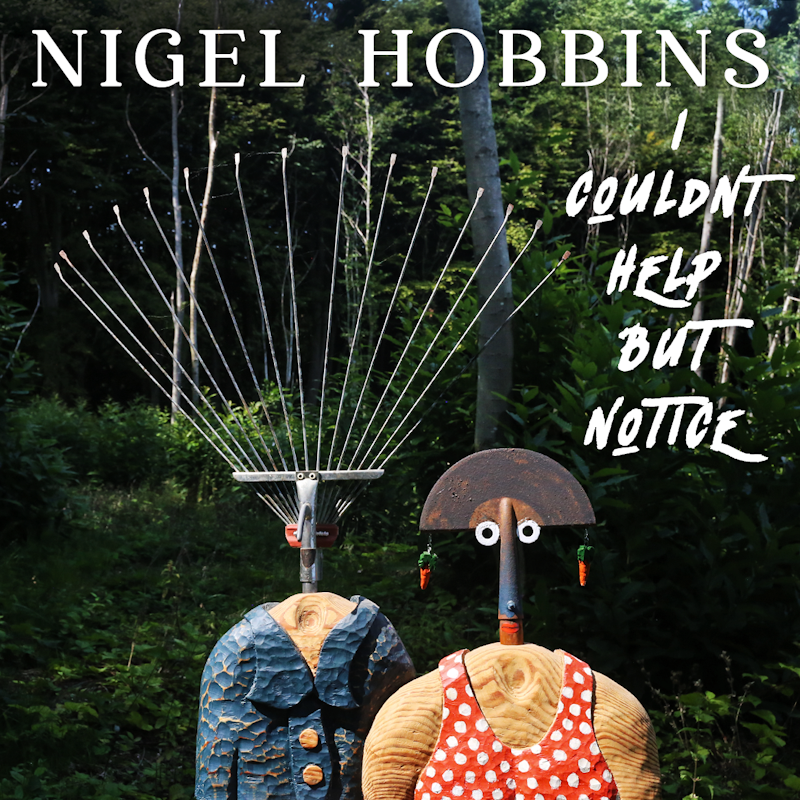
I’m listening to Nigel Hobbins’ latest musical offering, I Couldn’t Help But Notice. I’ve written about Hobbins before. He’s a Kent musician who, to my mind, embodies the lyrical spirit of this ancient corner of the British Isles. He lives in Whitstable, on the North Kent coast, but was born and brought up in Challock, on the North Downs, about half way between London and Dover. There’s a pub there, called the Halfway House, where Hobbins’ gran used to sell posies to travelers stopping off on their journey. She trained her kids to find the flowers, and used to send them off on expeditionary jaunts to gather them.
Flowers are important in Hobbins’ music. There are at least three songs with flowers in the title: Canterbury Bell, Michaelmas Daisy and Oops-A-Daisy, from his latest album. All are instrumentals. A simple tune is enough. Sensual experience without the burden of language.
“Oops-a-daisy” might also refer to a small calamity as experienced by a child, but we’ll leave that to one side for the moment. The point is there’s something rooted about Hobbins’ music. Something of the earth. It’s as if these tunes are like the flowers that thrive in the landscape of the county he grew up in and, rather than write them down, Hobbins has simply popped into the woods to gather them, as his ancestors did before.
The name “Kent” is Celtic in origin and is said to be the oldest recorded name still in use in England, first recorded by Greek geographer, Pytheas of Massalia, in 320 BC. It’s commonly known as the Garden of England because of its abundance of orchards and hop gardens. The county produces tree-grown fruits, such as apples, pears and cherries, as well as strawberries and hazelnuts. Distinctive hop-drying buildings, called oast houses, dot the landscape. Closer to London there are numerous market gardens. One of the consequences is that there’s a large gypsy and traveler population. Traditionally people would travel down from London for the season, moving from farm to farm as the different crops became ready for harvest.
It’s the most English of counties. Unlike the rest of the country, it was never conquered by the Normans. Kent’s motto is “Invicta.” which means “unconquered.” It’s been the scene of a number of uprisings, including the Peasant’s Revolt of 1381, and the Battle of Bossenden Wood in 1838, said to be the last armed uprising on British soil. It’s a measure of Kent’s rebellious streak that Tom Paine lived and worked here. He was married to Mary Lambert, in the parish church of St Peter’s in Sandwich, in 1759.
Hobbins is as deeply rooted as his songs, most of which were written in the converted pig styes in the back garden of the house that his father built. He also carves wood, paints, grows food, makes beers, wines, pickles and jams, and sees to his own maintenance. He’s as adept at building and carpentry as he is at playing the guitar. He gets this from his dad, who was a builder by trade.
Listen to one of Hobbins’ songs and you’ll hear the strain of Englishness that pervades them. Take the first song on the album, Start the Day. It’s a plucky number, half-strummed, half-picked, with a mandolin accompaniment. Unmistakeably English. This is before Hobbins’ voice comes in with his broad Kent accent.
The lyrics are simple, local and universal. We’re given three alternative starts to the day: on a snowy morning, listening to the radio, or in front of a log stove making breakfast. Each is given an accompanying tag. On a snowy morning we are “blinded by the light.” Listening to the radio news we’re “sad and demoralised.” But the last verse is the best:
I got the log stove alight
Put the kettle on.
Boiled egg, tea and toast,
Cooking and heating in one.
Oh what a wholesome way,
I tied my boot laces tight.
That’s the way to start the day
With the simple things in life.
This is what I love about Hobbins’ work. It’s down-to-earth, ordinary, yet it lifts your spirits to hear it.
I said that that these tunes are almost like wild flowers that Hobbins has discovered in the countryside. That’s a nice little analogy, but really it’s more complicated. Start the Day involves sophisticated picking and strumming to create the tune. It was written in lockdown, he tells me, when he had no access to a band. He had to play all the parts himself, hence the intricate guitar picking.
This celebration of local culture continues into the next song, “Family of Stones.” You can imagine this is what Hobbins did next, after tying his boot laces and eating his breakfast in the last song: going for a walk “at the edge of Ellenden Woods, where there’s a fine view of the Swale.”
The song describes a group of stones that were placed there as a memorial to a family, but it also acts as an excuse to stop for a moment, to breathe the air and to take in the sights. He spends a moment to observe the trees and their cultivation, showing off his knowledge of the arboreal arts, before offering a hope for the future:
May this view still be discovered by walkers free to roam,
Here to rest and take refreshment for those who tread the woodland path,
It’s a place of simple beauty with echoes in the past...
The next song memorializes a moment in a park in Canterbury many years ago, when Hobbins watched two Blackbirds fighting. It’s called “Blackbird Bundle.” The “bundle” part of the title refers to the word they used as kids to describe a fight in the playground. They would shout “bundle” and everyone would gather round to watch the boys knock the hell out of each other. It was the same with the blackbirds. People gathered in a circle to watch. The words are like a magical evocation, bringing this passing moment to life again.
The next song, “Honey,” tell us how traditional Hobbins is. It’s about courtship, in the old fashioned sense.
Honey, (honey, honey)
Will you take a walk with me?
Honey, (honey, honey)
Will you step out with me?
Who uses phrases like that these days? Hobbins does. It’s a refreshing return to traditional values, and to the inherent shyness of courting lovers, who needed to take the process in pre-determined steps. It offers us a gorgeous alternative to the current values of our Ruling Class with their privilege, their sense of entitlement and their abuse of all that is sacred and meaningful in the human heart.
The next song, “Do Buildings Have Off Days Like You Or Me,” is playful and practical at the same time. It’s a nonsense song on one level, imagining the buildings as living beings, singing to themselves. On another it recounts Hobbins’ own maintenance skills, reminding us what we have to do to keep our homes in tip-top condition.
“Jimbo Jig” and “Oops-A-Daisy” are instrumentals. “Jimbo” refers to his son, James. It’s the result of an obligation. He’d already written a song about his other son, Dan, so this one is making amends, making sure he’s leaving no one out.
“Full Circle of the Buzzard “is the only song not located in Kent. It’s from a poem by Maldwyn J Bowden and describes the flight of a buzzard over the hills of Wales.
“Dance In The Light Of The Moon” makes me laugh every time. It’s like a jolly Music Hall number, sung with an obvious chuckle, but with the most depressing lyrics:
Down ‘ere on Earth things aren’t going every well
Calamity after calamity
What with global warming, pandemics and wars
And governments showing little sanity.
And the wealthy wash their hands of the world’s problems
Why engage in all this doom and gloom?
So they invest their billions in space travel
To stake their claim on the Moon.
Meanwhile the song also provides its own solution. I’ll leave you to find out what it is.
I’ve talked about Hobbins’ Englishness, his celebration of English culture and identity, but we have to make clear this isn’t in some narrow political sense. It’s much more archaic and rooted than that. It’s not exclusionary. It is welcoming, warm, rich and abundant, like the landscape.
Currently here in Kent we’re plagued by a group who spend an inordinate amount of time going from town to town putting up cheap, Chinese-made Union Jack flags and George Crosses. They’re funded by some outside force. This isn’t done out of pride or celebration. It’s for reasons of intimidation. It’s a measure of how much pride they have in the flags that they don’t even know which way up the Union Jack is supposed to go, and often fly them upside down. The whole of Kent is covered in these tattered remnants of their nocturnal activities.
They turned up in Whitstable, but their flags were removed within a day. The community got together to get rid of them. They call themselves Flag-Crusaders. We call them Flag-Shaggers.
The two last songs on the album are very political. “Trouble Ahead” describes the uncertain world we’re moving into, while “Trickledown Blues” describes the ideology of neo-liberalism and its promise that, if the wealthy are made wealthier, then the proceeds will trickle down to the rest of us. It’s not been the case. The wealthy got wealthier by taking the wealth from the rest of us. They never were wealth creators. They were always wealth extractors.
My only objection to this song is that its target is too narrow. “Don’t trust the Tories,” it says. But it’s not just the Tories who are doing this to us. It’s the Labour Party too, and the Liberal Democrats, who were in bed with the Tories for a number of years. It’s Republicans and Democrats as well.
On this basis I’ve decided to add a verse of my own:
Labour are no better they’re just corporate whores
Working hard for the billionaire’s cause
We try to vote but it’s all just a sham
Most politicians are Tories
Looking for the next best scam
It’s not as good as one of Hobbins’ verses, but you get the idea.