
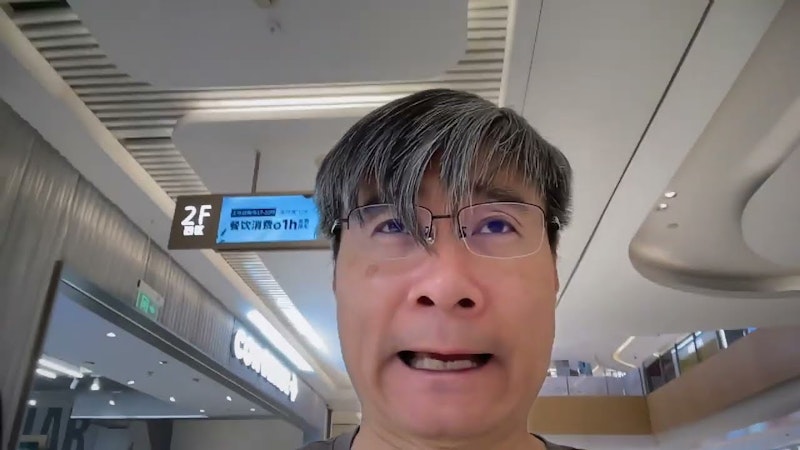
If you haven't encountered "Professor" Jiang Xueqin yet, you will. Beijing high school history teacher turned YouTube phenomenon, his channel Predictive History has made him arguably the most viral political commentator today—millions of views, whiteboard geopolitics, and an accuracy rate that his followers have taken to calling him 'China's Nostradamus.' He called Trump's 2024 reelection. He predicted the U.S.-Iran escalation. In March 2026, his forecast reel reads more like a briefing document than an analysis.
Which raises the question nobody in his comments section is eager to ask: who is this man? Start with the title. He’s not a professor. The credential that floats beneath his name across YouTube thumbnails, interview chyrons, and media writeups is a fiction of accumulation—a B.A. in English Literature, dressed up by association with institutions impressive enough to launder the implication. Yale as an undergraduate. A researcher at Harvard GSE, not faculty. A Fellow of the Royal Society of Arts—a British membership club where the fellowship isn’t especially difficult to obtain. In almost any other context, attaching "Professor" to this CV would be considered dishonest. In the world of viral geopolitics commentary, apparently no one checks.
Then there’s the biography itself, which on inspection develops some alarming fault lines. Jiang presents as the cosmopolitan bridge-builder—the "Canadian-Chinese" intellectual translating China for Western audiences with dry wit, an advisor to Chinese schools on teaching creativity within the CCP's education system. The irony of that last item is rich enough on its own. But the biography has a chapter his more enthusiastic followers rarely seem to reach.
In 2002, Jiang Xueqin was expelled from China. He was, by the account that follows him through the public record, doing what journalists are supposed to do—covering workers, documenting grievances, telling stories the Party preferred untold—and for that, he was removed from the country entirely.
This isn’t a minor biographical footnote. It’s the central question that every interview, every viral forecast, every "Canada-China" framing somehow sidesteps: how does a man expelled from the People's Republic of China for politically inconvenient journalism end up living and working in Beijing, producing content that maps with uncanny precision onto CCP strategic messaging, for an audience of millions of Westerners?
The answer that requires the least imagination is also the one that gets asked the least. To live and work in Beijing today, as a foreign national with Jiang's history, is not something the CCP permits by accident or oversight. The Chinese state knows who’s inside its borders. It decides who stays. For a man with an expulsion order related to political journalism to be not merely tolerated but apparently thriving in the capital—running a production, building a platform, advising on education policy—requires one of two explanations: either the CCP operates with a level of administrative forgiveness and institutional amnesia entirely inconsistent with its known character, or an arrangement was reached. Readers can weigh those options for themselves. Suspending disbelief entirely, however, requires a kind of motivated credulity that should be named.
His content rewards this scrutiny. Jiang's framework—game theory, historical cycles, civilizational decline—is intellectually coherent enough to seem rigorous and accessible enough to travel. But the conclusions land with suspicious consistency: U.S. institutional collapse, Western elite civil war, Chinese strategic patience vindicated, Iranian resilience underestimated. His Gaza commentary invokes ritual sacrifice analogies that demoralize rather than inform. His Trump war forecasts prime his audience for American failure. There’s a throughline, and it runs in one direction. Taken individually, these are provocative readings. Taken together, they map almost perfectly onto the narrative architecture of CCP soft power. Not propaganda, but a steady, sophisticated drip of civilizational pessimism aimed squarely at Western audiences, engineered to make them feel that American decline isn’t a possibility but a foregone conclusion, that resistance is not noble but naive.
This is the ideological payload beneath the friendly schoolteacher shtick. The message, repeated across hundreds of videos, is not merely that the U.S. is failing—it’s that the failure is deserved, structural, irreversible. That Western institutions are beyond reform, and American power was always a racket.
Then there are the numbers. His viral surges remain unexplained by conventional platform logic. China has a documented, decades-long history of bot networks, coordinated inauthentic behavior, and state media amplification. The infrastructure exists; it’s been used before. The obvious question is why it couldn't be producing identical results on a channel whose content serves Beijing's interests so neatly. The CIA has faced these accusations for years. The standard is apparently lower when the arrow points the other way.
Back to where we started: a man wearing an academic title he never earned, an expulsion on his record, and a Beijing address, delivering a message of American irreversibility to millions of Westerners who find his forecasts incredibly honest. Maybe he’s simply a sharp analyst who made his peace with the country that once threw him out. Or maybe one of the most viral political commentators is exactly what a careful look at his biography suggests—and no one wants to look.