
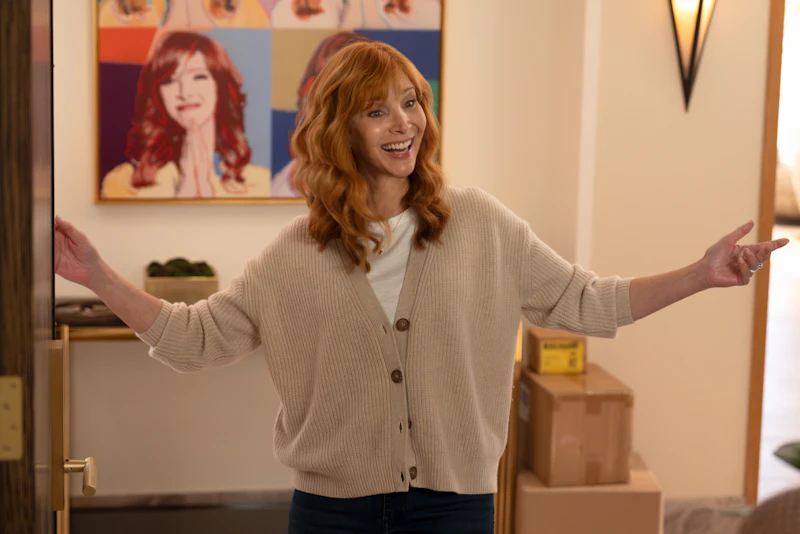
Had The Comeback been renewed after its first season aired in 2005, it likely would’ve earned the same cultural legacy of other HBO comedies of the same era. The Comeback had a premise that specifically worked for a single season. The meta story of the former sitcom star Valerie Cherish could be seen as a loose parallel to that of its star, Lisa Kudrow, who hadn’t broken out in the way that her Friends co-stars did. The Comeback aimed to show how vain and self-absorbed celebrities are, and not in the humorously self-aware way that Curb Your Enthusiasm or The Larry Sanders Show did; Kudrow and co-creator Michael Patrick King reveled in their depiction of former A-listers willing to become buffoons in order to hang on to any remnants of relevancy.
The Comeback never would’ve succeeded if it had become a real comeback vehicle for Kudrow, or if the character of Valerie earned any success in her attempted resurgence. The show’s cancellation allowed it to linger on lists of “cancelled too soon” hidden gems, which resulted in a surprising continuation nine years later. The second season aired at the same moment in which television had seemingly adopted a policy of presenting relics of the past as something new; The Comeback offered an equally damning sentiment on how Valerie would collapse her personal life, marriage, and self-respect for the sake of chasing a new trend.
Outside of a few small revisions to acknowledge the changing media landscape, The Comeback could’ve returned in its original form and appeared to be just as relevant. The best decision made by King and Kudrow with the latest, and presumably final, season is to chip away at the environment that allowed someone like Valerie to flourish. In 2026, there’s not a need to make another abrasive attack on the type of blisteringly unconscious narcissists who are celebrated and mocked at the same time. Rather, the third chapter of The Comeback is an indictment of the audience, the industry, and popular culture as a whole.
The funniest joke within the premiere of The Comeback isn’t a specific gag, but a subtle acknowledgment of the 11 years that’ve passed since the show was last on the air. Like many of her peers in the industry, Valerie’s career has been preserved in its previous state; winning awards didn’t grant her any new opportunities, and personal scandals didn’t cost her any work. The only way that Valerie could manipulate her reputation, either for good or for ill, would be to get involved in a situation that’d result in inflammatory headlines.
The circumstances in which her latest “comeback” is mounted revolve around the most topical issues of the moment, with AI the most significant area of focus. Like many of her fellow stars, Valerie hijacked the legitimate sentiments of those in the 2023 labor movement for the sake of an improved image, but it did little for her career because she’s worked in an industry where hypocrisy’s in abundance. The notion that a faded star, whose only value is nostalgia, would be offered an appealing new starring role would be ridiculous if it wasn’t for a catch; the reveal is that Valerie’s latest star vehicle is a sitcom written entirely by AI, which would supposedly contradict her previous statements in support of writers.
The Comeback is unique among Hollywood satires because it isn’t interested in portraying its protagonist as a monster. Much of Valerie’s initial involvement in the AI-related show is a result of ignorance, given that her generation has never adjusted to the rapid rate in which new technologies are applied. The point in which Valerie is made aware of the controversy is when she can’t possibly back out, even if it was for the sake of saving face; the result is a depiction of the ethical compromises that desperate people make when they feel they’ve been denied opportunities. Defenders of AI would often say that they view it as merely a tool, but it's more often than not a device used purely for personal gain.
Since each season of The Comeback is a time capsule for the trends of its era, the third season has adopted a new visual style that’s reflective of streaming quality concerns. The first season had a novel depiction to shoot on early digital video, which had a grainy quality that looked more like Inland Empire than Sex in the City. The new season has a more consistent, unfettered look that’s reflective of the malaise of streaming content, in which it’s impossible to tell what medium it’s intended to be. The “real” shots, Valerie’s documentary, her social media videos, and footage from the show she’s made all look the same, which is a clever way to show how her reality has collapsed on itself.
Kudrow’s performance has become her defining role, but The Comeback has a robust supporting cast. While Robert Michael Morris, who played Valerie’s flamboyant hairdresser Mickey, passed away in 2017, her company in the third season is composed of smug millennials desperate to explain that everything on social media is permanent. The most sly piece of casting is Andrew Scott’s role as Brandon Wallick, the AI-friendly studio executive who’s offered Valerie her latest gig. To hire one of the most interesting, charismatic British character actors to play the embodiment of America’s creative dearth is another instance of The Comeback’s collapsed reality; the show needed idiosyncrasies like this, because to simply replicate reality would be too depressing.