

The Voynich manuscript is a cipher—there’s no doubt about that, because if it wasn’t, it wouldn’t be full of musings from aliens and it wouldn’t hold the secrets of the Holy Grail. A 15th-century manuscript, carbon dated and composed of authentic materials, it has baffled and survived every attempt to decode it, including by experts armed with AI algorithms. There are people who specialize in it, and have built their entire careers around (not) deciphering its meaning. It’s still very much alive: the most recent “blockbuster” findings about it aren’t even 10 years old. I found out about it this morning, and this is the secret. It isn’t a fraud. It’s the real thing.
The problem is right there in my sentence. What does it mean to be “the real thing”? It means that it is the monastic equivalent, in a vastly significant context, of Jack Torrence (in The Shining) going crazy and writing “all work and no play makes Jack a dull boy” a thousand times, over and over, instead of giving us his planned Great American Novel. It’s a record of a mind at its breaking point, generating gibberish that makes a disturbing amount of sense if you know how to listen.
Imagine the times that monk was living in. The Catholic Church was a lethal and totalitarian force. More crucially, the dogmas of the Catholic Church had displaced femininity onto a single sacramental figure, the Virgin Mary, who procreated without sex. The power to give birth, the power to generate life, had been mystified and reinterpreted as a patriarchal boon. The old, lunar cults of matriarchal power were all but extinct, and whatever truth they contained had migrated to the fringes of mystical exaltation: autobiographical works by writers like Hildegard of Bingen and Margery Kempe, who wrote female narratives of divine transfiguration at a theological altitude where nobody was comfortable challenging them. Beyond that, the secrets of sex and procreation were quietly transferred to the alchemists and secret-searchers of the age: “magi” who still believed in the occult pathways to power, wherever they might be found.
One of those magi was the author of the Voynich Manuscript; he had a vision of divine generativity as a female domain, and it drove him mad. This isn’t some cheeky Wiccan hypothesis; it’s borne out by the actual document at every possible level. To understand the manuscript, inevitably, we have to get into the weeds—the nature of the “art” in the book, the language it’s written in, and the reasons why it’s outfoxed everyone who tries to interpret it. Let’s start with a single word: the true name of God. That’s where the cold case gets warm again.
There’s a haunting character in the manuscript; it’s known as the “gallows,” because it sort of resembles a hanging gallery, in the same way that the Big Dipper sort of resembles a cup. I just use “LL” to represent it, and with that in mind, here’s the complete word that the author uses for God: oLLo8g. It’s not awe-inspiring, but that’s what it means, and that’s exactly how he uses it—everywhere. He uses it to name the five central astrological figures at the center of his hand-drawn cosmos. He uses it to name the space between that ring of elder gods and the next, more far-flung ring of star chandlers in his private zodiac.
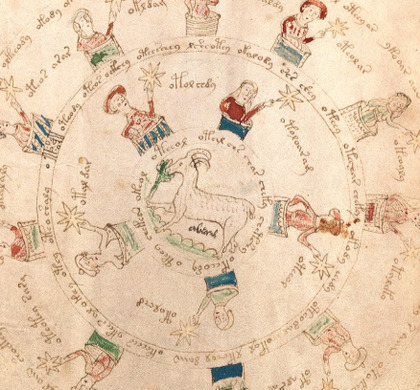
He invents fictitious, oddly sexual root structures and names them oLLo8g. He recites “ollo8g” in triplicate when transcribing his prayers. The “o” is probably what it looks like: a vowel sound. The “8” is weirder—it’s an abbreviated pronoun, and its meaning depends on where it appears. It’s active at the beginning of words: “He.” At the end of a word, it’s attributive: “of Him” or “by His will,” something along those lines. And the “g,” which only appears at the end of words, is a monkish form of shorthand that denotes Latinate inflections (suffixes) at the end of a word—it was a real pain to write every Latin conjugation for audiences who got the basic point, and monks didn’t bother. Instead, they wrote, “and after this follows the conjugation,” and our narrator is no exception.
This is a tantalizing start, and it’s plausible to expect that every word in the manuscript can be unlocked with “oLLo8g” as a master key, but it can’t. In that sense, the Voynich Manuscript isn’t a “cipher”—the author isn’t substituting one set of symbols for another to hide his true intentions. His true intentions are all over every page, but beyond a general comprehension of their thematic linkages, they’re permanently illegible to us because they were part of a private system that meant something to him alone.
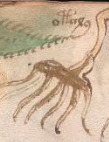
To understand that system, we have to look at his drawings. In the figure above, he has marked a taproot with “oLLo8g,” specifically because it goes from the One to the Many, subdividing like the tines of a rake as it ramifies. But in the most famous, most indecent, and most striking images in the text, he departs from the zodiac and botany to draw pictures of naked women bathing in amniotic pools of green and blue fluid. I hope that what I just wrote strikes you as ridiculous, because it is ridiculous, and forgetting that’s the first step towards misreading the text. The closest thing to a depiction of a man is a solemn red dot, which is alchemical shorthand for the solar “male principle” that emerges, and conquers, during gestation as the Greeks and Romans imagined it.
There are two particularly important images that the manuscript features showing these mis-named “nymphs” bathing together. The first one shows them in a string of 10; this refers to the classical period of pregnancy, which was estimated at exactly 10 lunar months. The second is more complex, and shows what appears, at first glance, to be 12 figures. This doesn’t correspond, however, to a traditional group of 12 (such as the figures of the zodiac). It’s another group of 10: five couples, with two identical female figures intertwined in each one, plus a “starting point” and a finished human being. The five couples refer to Galen’s scheme for the “ensoulment” of a human being: that is, the process through which an embryo supposedly acquires the higher cognitive faculties and motivations we understand as human. What fascinated the author is the fact that all this happens during pregnancy; as modern readers, our best response to this is probably, “Well, except for all the scientific errors, that’s true.” It’s not as meaningful, in isolation, as the author imagines, but that’s only because they hypostasize it to mean something fundamental about the entire universe. By any standard, it is part of the irreducible miracle of human life on Earth.
This doesn’t mean, however, that the Voynich Manuscript is limited but useful—or that it was ever useful, even in the 1400s—on the subjects of pregnancy, astrology or botany. Many of the plants, to say nothing of the strange, saw-toothed towers that the author occasionally doodled down the page’s left-hand side exist only in the author’s imagination; furthermore, they were not required to break the news that pregnancy exists to the world of Northern Italy. Scanning the text for scientific data is exactly like trying to deduce heliology from Judge Schreber’s notebooks on the sexual transformations of people targeted by the sun’s rays. That doesn’t reduce its significance as a work of delirious mysticism, but it does indict our own credulous attitude towards venerable, mysterious texts that we can’t read. In order to honor the strange, singular truth of this author’s diffuse mind, we must abandon the belief the text communicates more than it really does.
To understand why the text appears to communicate so much, look at three related problems that it poses simultaneously. First, it’s syntactically rigid but still fairly internally diverse. In practice, that means that it’s mostly a collection of prayer-like utterances, many of them modeled after traditional anaphoric prayers, which use repeated phrases like “Almighty God” or “Mother of God” to structure themselves. On top of these interpolated phrases, the text also uses invented words like “oro” or “oLLo8g” (mentioned above) to indicate closure, much like modern sermons and prayers often end with “Amen.” This doesn’t lead towards anything like a systematic or scientific treatise; the text is closer to a series of emphatic declarations. “God is here, and God is great, amen.”
Second, the structure of the text combines Latin-based shorthand (the “g” mentioned before), actual Latin grammar, and Hebrew-based acrostics, anagrams, and palindromes. When an entropic analysis—basically, a scientific measure of verbal range—produces an abnormally low result for the Voynich Manuscript, that’s a measure of its devotional content (“O God!”) and the fairly consistent structure of morphemes (intelligible units of speech) in Latin. A good example is the “8” character, which is a pronominal stub. The character means “He” (i.e., God) when it’s used at the beginning of a word, and “of Him” or “by His will” when it’s used as part of a suffix. The fact that it moves around doesn’t make it a letter. On the other hand, when an algorithmic analysis suggests that the text is Hebraic, it’s picking up on the Hebrew borrowings that alchemists and mystics freely adopted and used at this exact moment in the history of the Christian Church. It’s not exactly “Latinate” or “Hebraic” or a purely constructed language; it’s a mixture of them all.
Finally, the text doesn’t use direct substitution to create new words and unique grammatical chimeras. It invents them. That’s why a word like “oLLO8g” isn’t a first step—what cryptographers, much like students, call “a crib”—towards decoding the alphabet of the cipher. The author's private language isn’t systematically produced; it replaces words at the level of concepts, not alphabetically. Moreover, these concepts are applied in a fashion we’d now call indiscriminate. When you call a root system divine, a uterus divine, and every single heavenly body divine, you get a final “legend” that’s unusable unless you’re William Blake. Here’s the master key to decoding the Voynich Manuscript: everything pictured in it, implied by it, or widely considered holy, is (the author believes) something unquestionably divine. What you make of that claim is completely up to you.
Although I’m confident that my reading is correct, I don’t have much hope that this analysis will put out the fire of Voynich analysis that has been smoldering for centuries. There will always be people who think its illegibility is a sign of profound significance, and they’re right, but the significance isn’t magical or even particularly esoteric. It functions as a Rorschach test that reveals not what it is, but instead, what we desire it to be; like the Maltese Falcon in the Humphrey Bogart film, it’s “the stuff that dreams are made of.” This is a text that’s been read countless times, but never with purpose. Its pages are equally worn, a testament to its enduring fascination and its lack of practical utility.
There’s no question that the manuscript’s matriarchal imagery and emphasis on procreation, gestation, and universal sacredness puts it firmly outside the ideological territory the 15th-century Catholic Church permitted believers to explore. Like the invented lexicons of Hildegard of Bingen, Judge Schreber, and other mystics, it’s less a coherent language than a text losing its mind over the unheeded, residual materials of life that can’t be discussed aloud in tongues we’re permitted to use. The conditions enabling a perfect translation of the Voynich Manuscript died with its author’s own passing. But we can establish what he was trying to say, and why he couldn’t say it normally. The moat around each word is a permanent reminder of the brilliant insights, fervent beliefs, and secret correspondences that the hegemony of acceptable ideas continually forecloses. Language doesn’t merely enable us to be articulate. In the wrong hands, supported by the wrong institutions, it can become a tomb where the natural relation between life and testimony is buried alive. That’s the abject condition, the needless suffering, we’re called upon to witness here.