
When I was a child, my father read me a bedtime story called “The Clapping Mountains.” Based on an Inuit folktale, it told the story of why each year there a lot of young geese around, while all the old geese are gone. It related that somewhere along their route, migrating geese have to pass through the Clapping Mountains and if they’re too slow, the mountains come together and crush the slow, older geese so that only the young, fast geese make it through.
The story made an enormous impression on me. Perhaps it’s the reason that each spring for the last 15 years, I try to exercise away the lethargy of each past winter. I put on my sweatshirt and pants and go to the local park where there’s an exercise area with machines used to work different parts of the body. It’s a sort of unofficial bodybuilders club where guys walk around without t-shirts doing calisthenics, sparring with each other, doing handstands, and other exercises to develop and display their physiques. Young women are often there, looking on, trying not to be too obviously interested in the show put on by the young men: Imagine Nijinsky’s The Rite of Spring minus the sacrifice at the end.
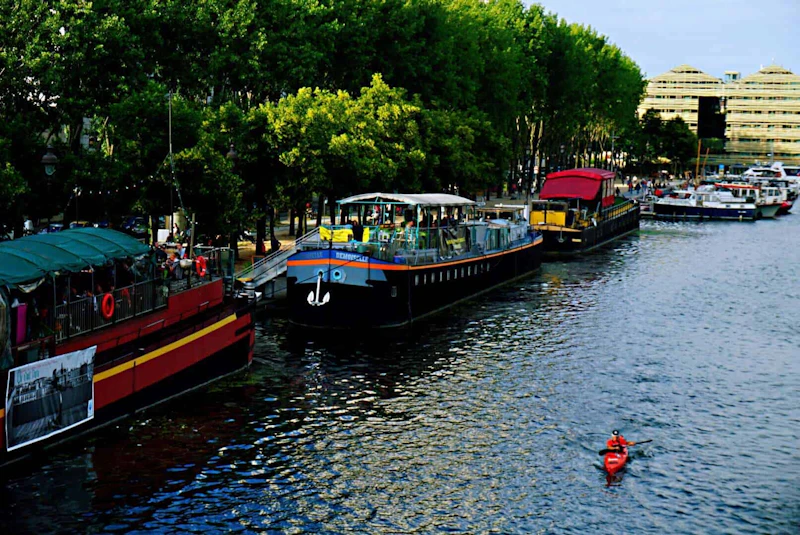
I walk to the park, do light exercise for about an hour, then walk back. The walk is pleasant, following the Canal St. Martin along the quay. The Canal St. Martin was built in the 19th century to transect Paris, facilitating the transfer of goods and where customs duty houses were set up. Now it’s a trendy place of cafés, bars, restaurants, and people strolling.
Today as I was walking back, I noticed three people walking in succession at intervals of a couple of yards. Each was seemingly unaware of the other, but all were doing the same thing. The first was an older Orthodox Jew, made obvious by his long gray beard, black suit and hat. The second was a fortysomething practicing African Muslim, evidenced by the long gown-like clothing he was wearing, called a thobe and a cap called a kufi. After them came a stunning young woman, around 25, who—it was a very warm day—was dressed very lightly and whose clothing perhaps designated her as a latter-day follower of Aphrodite.
What was curious was that they were all drinking Coca Cola out of bright red cans. I had the feeling that I’d entered a Twilight Zone Utopia where a common denominator had been revealed between ages, religions, and cultures—all the things which people use to differentiate themselves from each other.
Perhaps it’s only the products that we buy that represent any form of potential human unity. Whether Buddhist, Jew, Muslim, Christian, Hindu, atheist—all drink Coke on a hot day, and if not Coke, it’s certain they share other products in common. Fanta Orange? Dr. Pepper? Whirlpool washing machines? TV shows? McDonald’s hamburgers? The thought for buying and drinking a Coke is radically different than that used in other conscious decisions.
And as Coke is a socially neutral object, the only neutral social spaces are places like movie theaters, fast food restaurants and other capitalist establishments. You’re a member as soon as you walk through the door. I don’t go to McDonald’s often, but when I do, it always feels like I’ve entered the United Nations lobby. These people are all equal as far as the capitalist is concerned, they’re stomachs and wallets. People are willing to die for a patch of land, consider Israel/Palestine, but don’t get emotional about parking lots, Popeye Chicken restaurants, or airport lounges. In these places, they just come and go in peaceful cohabitation.
Within the world of capitalist products, there’s total equality. Whether you’re black, white, Asian, male, female, none-of-the-above, you can have “a Coke and a smile.” Money’s the only form of equality known to mankind. The question of having the available funds is secondary, it’s all about potential. I can’t currently afford to buy a mansion, a Ferrari or a gold-plated toilet, but if I had the money, I could, just like Jeff Bezos, Elon Musk or Bill Gates. This wasn’t always the case. One’s class determined what you could and couldn’t do, buy, wear, etc. If you don’t believe me, ask a Dalit (formerly known as an Untouchable) on the streets of Mumbai. Or look at the Sumptuary laws that once existed in Europe and Asia regulating clothing and consumption by class.
Like all Utopian fantasies, the moment’s revery passed. Not everyone’s satisfied with the products on the shelf. Coke, Pepsi and Canada Dry Ginger Ale don’t cut it. How is it that the most important thing is always missing from the shelf? That which meets the real needs of the most jaded consumer, one never to be replaced with a new model?
