
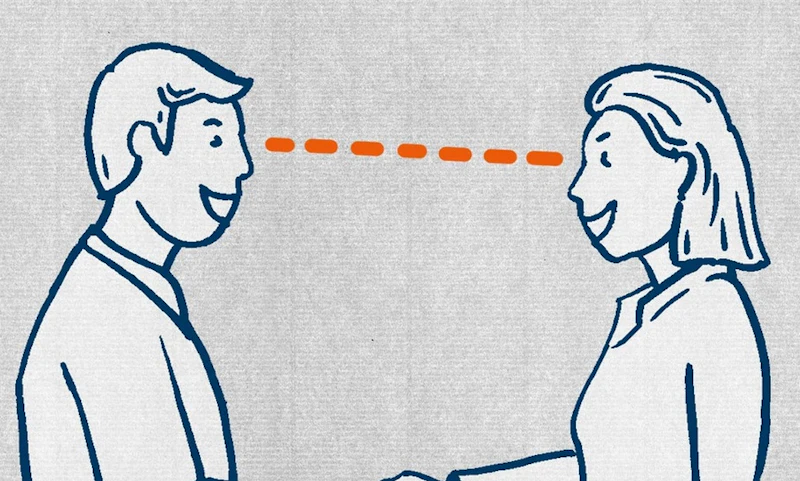
You may have noticed that Finns and the Japanese aren’t entirely alike. Here’s an example: Japanese register eye direction the same way whether they’re looking at somebody Japanese or somebody Finnish. Finns aren’t like that. If a Japanese person’s looking a few degrees off, the Finn will still count their gaze as eye contact. Whereas when a Finn’s looking at a fellow countryman, those few degrees make it feel like no eye contact’s taking place.
Devon Price wants you to think that this finding stands in for something else, something a lot bigger. Price is a self-styled advocate for the autistic and the author of Unmasking Autism: Discovering the New Faces of Neurodiversity. His book tells us that “a world where eye contact is not required is entirely possible (and, in fact, there are many cultures where avoiding eye contact is considered polite).” Next to this claim hangs a superscript 5, which leads us to the end notes and a citation of the study whose results I just described. I think the study’s being cited for its title: “Eye Contact Perception in the West and East: A Cross-Cultural Study.” Look at that title fast and you might think the study’s about eye contact as a thing whose status changes from culture to culture, that the report says people in the East have one opinion about eye contact and people in the West have another. But no.
Using the title’s a small piece of bluff to deflect scrutiny from a very big claim: that eye contact’s an arbitrary practice—“completely arbitrary”—imposed by society for mysterious reasons. This claim, in turn, is meant to bolster a claim that’s even bigger: that autistics have nothing wrong with them, really. The idea is that we’re disabled only because society decides to give us a hard time. “Each of us has been repeatedly overlooked and excluded because society views our differences as shameful defects rather than as basic human realities to accept,” Price says. Look at the deaf, he says, look at how they’re treated—“seen as less competent and less fully human,” they’re pushed aside by society’s refusal to make everybody learn sign language. The same sort of thing for blind people, he continues, the same for fat people and the same for autistics. Society doesn’t regear itself to suit our needs, so it’s the one that keeps us from being able to live our lives. The name given this outlook is the social model of disability, and Price tells us it’s been around since the 1980s. But he pretends the Finn-Japanese study’s all about how some cultures think eye contact isn’t polite, so who knows.
If the study did show that eye contact’s rude in some countries, Price would be dishonest for pretending that this state of things showed that eye contact was arbitrary and could be dispensed with. There are many, many cultures where sexual contact is considered wanton and undesirable unless it takes place under certain narrow conditions, such as marriage. The fact that some urge is curbed by society doesn’t show that the urge is in fact a contrivance. If “many countries” discouraged eye contact, that would indicate that eye contact is something that people, left to themselves, want to do.
That’s how eye contact has always seemed to me. I’m autistic and glitchy eye contact is one of the afflictions of my life. I’ve learned to aim my eyes just within range of what the other person will consider eye contact. But a few times now I’ve talked to people whose gaze was farther off-beam than mine. They bothered me. I didn’t like talking with them and it was nothing that they said. They weren’t looking where I was and it threw me off. I wondered if I mattered to this person, even the small amount of mattering that goes into basic civility. If some autistics are hardwired to find direct gaze arduous, other people—most people—are hardwired to find it necessary. Plus, that second group includes some or maybe all of the first.
Unlike Dr. Price (PhD in social psychology), I don’t claim to know the literature on eye contact. But the authors of his favorite study have taken a look and they appear to think my way. A section of “Eye Contact Perception in the West and East” reviews various relevant studies and tells us that “a direct gaze universally serves important social functions” and “eye contact plays a crucial role in regulating face-to-face interaction.” They allow that Japan and other countries in East Asia make less of a big deal about maintaining eye contact, and in Japan, they specify, kids are taught to go easy on eye contact. But they also say this: “Human infants prefer faces with a direct gaze over those with an averted gaze since birth” (syntax problem aside, the point comes through). This doesn’t mean that those of us who can’t hack eye contact should suffer. But Dr. Price, champion of the autistics, shouldn’t lie to us.