
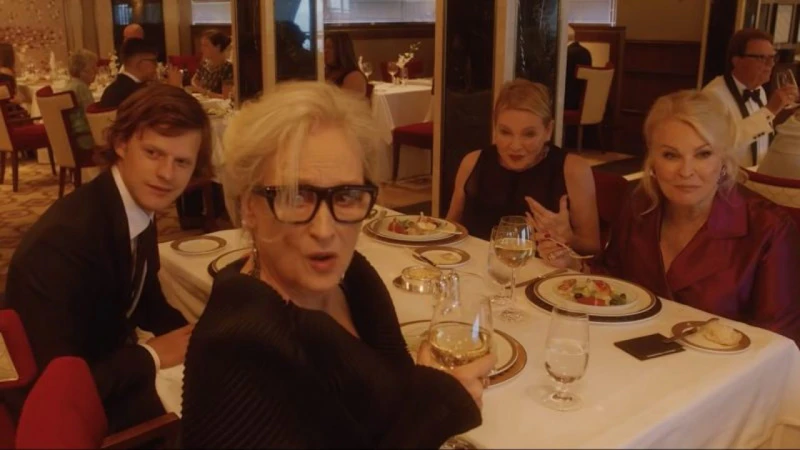
More than almost any latter-day Soderbergh film, Let Them All Talk (2020) channels his early indie approach. It’s a quiet, collaborative, low-stakes film about relationships and small transcendences, or lack of same. It’s perhaps no coincidence that it’s also about nostalgia and about the impossibility of recapturing the friendships, and the aesthetic goals, of your youth.
Shot from a screenplay by short-story writer Deborah Eisenberg, the movie’s mostly set on a cruise ship making its way from the US to the UK, where literary icon Alice Hughes (Meryl Streep) is set to receive a prestigious prize. Unable to travel by plane for health reasons, Alice decided to make the crossing with two old partially estranged friends, Susan (Dianne Wiest), a domestic violence advocate, and Roberta (Candice Bergen), a lingerie saleswoman.
Roberta was the inspiration for the main character of Alice’s big hit novel, You Always, You Never; she blames the book for destroying her marriage and her life and spends most of the trip trying to find a wealthy man to save her from her poverty and despair. Meanwhile, Alice’s literary agent (Gemma Chan) has secretly come aboard the ship in hopes of finding out more about Alice’s MS in progress. She enlists Tyler (Lucas Hedges), Alice’s young and charmingly doofy nephew and companion to help her. He does so in large part because he’s smitten.
The movie makes its way through its plot as unhurriedly as the ship travels across the miles, though with less gracefulness. Most of the dialogue is improvised, and Soderbergh’s brightly lit scenes become operating rooms of awkwardness on which his excellent ensemble players—now apologetically, now with more intent—abrade each other.
Bergen as Roberta is a marvel of bitter, desperate, absolutely unrepentant avarice—she hates her life and dead-end job in which she’s lorded over by customers and managers decades her junior, and she refuses to be ashamed at anything she has to do to try to get out.
Close, as Alice, matches Bergen’s egotism in a different vein, not-so-subtly lording her role as Great Author over everyone around her—everyone that is except for Tyler, who she’s rescued from the wreck of his own family, and treats with real care as if he’s her own son. Her affection for him is so great she even forgives Karen’s machinations for his sake, adding a deft grace note to the film’s abortive romance arc.
One of those who Alice sneers at, behind his back and then to his face, is Kelvin Kranz (Daniel Algrant), a prolific and humble thriller writer—he takes it in good part when Alice is surprised that it takes him a whole four months to finish one of his books.
The denigration of pulp is a nod to much of Soderbergh’s genre output, a kind of affectionate mix of self-parody, self-disgust, and self-aggrandizement. Similarly, Susan’s domestic violence work, and her references to an active and adventurous past sex life, point to other racier and perhaps more politically engaged parts of Soderbergh’s oeuvre, past and sometimes present. It’s not an accident that Susan and Kelvin hit it off and think about collaborating on a novel—working, perhaps, on an alternative Soderbergh script of which Alice would very much disapprove.
Alice herself during the course of the movie attempts a number of projects. She may be trying to write a sequel to her hit and may have invited Roberta on the trip to find out about her life so she can update the character based on her. Alice also takes a stab at a more experimental novel, though it’s never clear where that goes.
You could see this as a kind of validation of the stylistic range that Soderbergh has shown throughout his career, though the validation never exactly validates. Alice’s success and artistic ambition have made her a tedious jerk and have alienated her dearest friend. Yet the more successful Kelvin obviously values her work, as do various literary prize committees. Is she a hopeless disconnected snob? Is she a genius? Neither? Both?
Literary fiction—and its cinematic analogs—has its ow clichés, including lack of resolution, ambiguity, a refusal of climax and of definitive meaning. Like Alice wandering through the giant cruise ship, life and art seek out various pathways without ever getting any place in particular. Sometimes spending time with people, or even yourself, is as much of a point as you get. That’s not a bad metaphor for Soderbergh’s own diffuse, often frustrating, and occasionally not frustrating journey.
Let Them All Talk isn’t a hit pulp page turner, and it’s not an aesthetic tour de force. It doesn’t sum up his career so much as it looks back on it with a mix of uncertainty, regret, and occasional satisfaction. Despite its halting modesty, though, or perhaps because of it, it’s one of Soderbergh’s more distinctive achievements of imperfection.