

I’m lucky to reside in an area that’s still has retained some aspects of its rural past. A walk through the neighborhoods of the northern part of Queens College Point, Whitestone, even Bayside, will reward the urban enthusiast with glimpses of the small Long Island North Shore towns they used to be. The spaces between these town centers, once meadows or farmland, have been filled with block after block of one- and two-family homes and thoroughly “folded” into a bland Queens fabric: definitely not the dense, urban feel of a Soho or a Park Slope, but not the thoroughly suburban atmosphere of a Levittown or Hicksville.
The two “northeasternmost” of Queens’ neighborhoods, Douglaston and Little Neck, have a different tone: they’re carved out of the exclusive precincts of the Nassau County towns immediately to the east, Great Neck and Manhasset. Part of it is their compactness: both neighborhoods are served by a short shopping strip along Northern Blvd., and the area’s hilly topography doesn’t lend itself to blocks of similar-looking ranch houses.
Scotsman George Douglas purchased the peninsula from Wyant Van Zandt in 1835. The region was later developed as a suburban resort and exclusive enclave, and has pleasant views of Little Neck Bay and Long Island Sound. Streets were laid out in 1906 by the Rickert-Finlay realty company, who’d purchased the property from William Douglas, George’s son, and eclectic, individualistic homes were built in the area, which has always been among Queens’ most affluent.
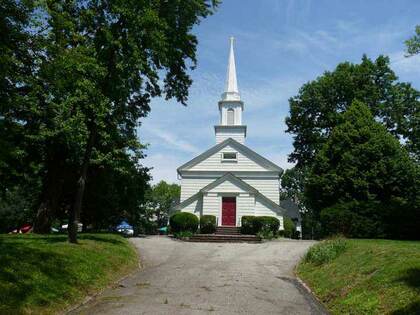
For me, Douglaston begins at Zion Church and its graveyard, on Northern Blvd. just east of Douglaston Parkway. Zion Church was completed in 1830 on plans from Trinity Church architect Richard Upjohn. The original church burned down in the 1920s, but was reconstructed by 1930 as a faithful copy of the original. Colonial-era Douglaston landowner Wynant Van Zandt is interred in the family vault beneath the cemetery; Van Zandt held local services in his home before the church was built. Bloodgood Cutter, who once owned large areas of property in Douglaston and Little Neck and fancied himself a poet of note (though he was actually a master of doggerel, parodied in Mark Twain’s Innocents Abroad as a ’Poet Lariat”) is interred here.
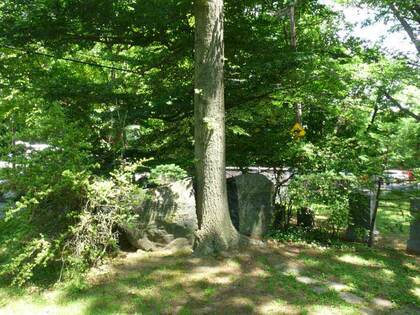
The Matinecock Indians, a branch of the Algonquin group, had occupied the lands of eastern Queens for centuries before Europeans arrived. While the Matinecock tribes gradually sold off their holdings to the Dutch and British in other parts of Long Island, giving the lands a peaceful transfer, Thomas Hicks (of the Hicks family that settled Hicksville) forcibly evicted many remaining Matinecocks from Little Neck.
Much later, when the Flushing and Hempstead Turnpike, also known as Broadway and presently, Northern Blvd., was graded and widened, the graves of the Matinecocks were located in a roadside cemetery. They were reinterred in the Zion Episcopal Church cemetery in 1931. A stone marker, designed in two pieces on either side of a tree, is marked “Here Rest the Last of the Matinecoc.”
Descendants of the Matinecocks, notably the Waters family, still reside in Little Neck, and the intersection of Northern Blvd. and Marathon Parkway was sub-named “Matinecock Way” in 2015.
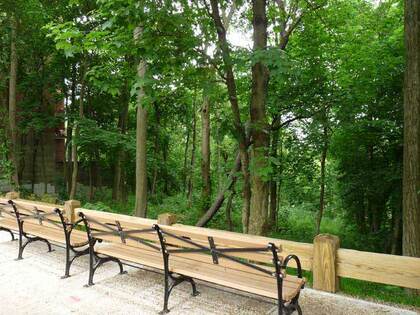
235th St. and Douglaston Parkway features some of Douglaston’s last tracts of natural forest. In 2012 the Parks Department built a couple of trails through the tract, west of Douglaston Parkway between the railroad and Northern Blvd., and cleared out the overlook which sits atop a rather steep hill for these parts and added new benches. It was named for the late Joseph Hellmann (1940-2010), an area writer and preservation activist, who successfully fought against a high-rise building that would’ve been plunked into the tract.
Deep into the woods here is a natural kettle pond called Old Oak Pond.
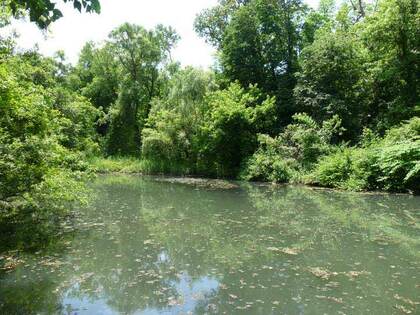
Aurora Pond is a small kettle pond in Udall’s Cove Park.
Udall’s Cove, accessible from the northern end of Little Neck Parkway at 255th St. north of the Long Island Rail Road, is a 30-acre park dedicated solely to wildlife and nature preservation. Udall’s contains salt marshes, a forest, meadow and a freshwater pond. The remains of Little Neck’s clamming past can be seen by the wood pilings at Virginia Point, the end of the parkway formerly known as Old House Landing Rd. The cove’s named for 19th-century settler Richard Udall, who owned a mill in the region; his family had the property until 1950 when the Nassau County portion of the property was sold to the Nassau County Historical Society. The Udall’s Cove Preservation Committee, which takes charge of the park’s upkeep, was formed in 1969 and the cove was opened to the public in 1972.
The pond, meanwhile, located on Sandhill Rd. between Douglas Rd. and Little Neck Parkway, was named for the co-founder of New York State Northeast Queens Nature and Historic Preserve Commission, Aurora Gareiss. A waterfront area at the north end of Little Neck Parkway is named Virginia Point for the other co-founder, Virginia Dent.
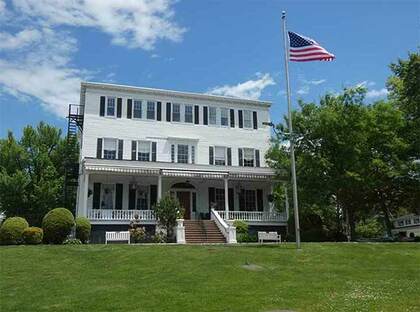
The Wynant Van Zandt residence at West Dr. and Beverly Rd. was built in 1819. It was William Douglas’ residence for many years, so it’s been occupied by the two men most responsible for the settling and development of the peninsula. The Douglas Manor Company purchased the house and grounds in 1906 and founded the Douglaston Country Club, which became the Douglaston Club in 1918. Along with the Douglaston Manor Association, the Club holds fairs, dinner dances, meetings and socials as well as weddings and celebrations. I’ve never been inside, though I know friends who have attended affairs here. Yelp has a few indoor shots.
The young John McEnroe honed his tennis game at the Club in the early-1970s. In 1977, McEnroe and fellow Douglaston resident Mary Carillo won the mixed doubles championships at the French Open; McEnroe went on to a fabulous and controversial career on and off the court.
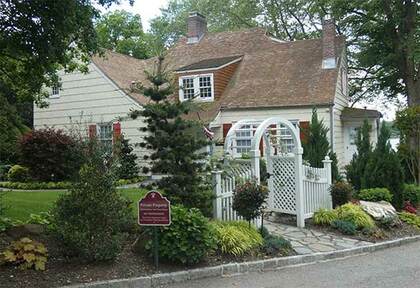
The Club isn’t the oldest building in Douglaston,. That honor goes to the Cornelius Van Wyck residence at West Dr. and Alston Pl., built in 1735, making it one of the few remaining Queens edifices from the 18th century. In 1819, the house and grounds were sold to Winant Van Zandt; over time, that land was subdivided and streets cut through that now support some of the finest homes in Queens County.
—Kevin Walsh is the webmaster of the award-winning website Forgotten NY, and the author of the books Forgotten New York (HarperCollins, 2006) and also, with the Greater Astoria Historical Society, Forgotten Queens (Arcadia, 2013)