

Aimlessly meandering through the East Village during the spring, wondering what was going to happen next, I was on lower 2nd Ave. near E. Houston St., and realized I hadn’t gotten a good photo of the New York Marble Cemetery gate and entranceway.
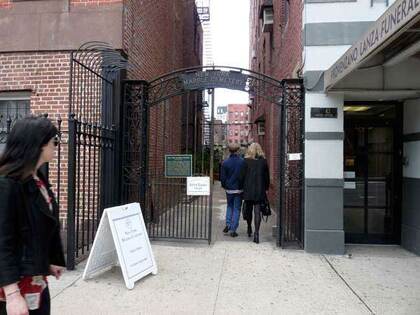
The entrance on 2nd Ave. is an obscure alleyway in New York, and is unnamed because I doubt it ever admits motorized traffic. I found that the gate was open, and the gate to its “competitor,” the New York City Marble Cemetery a block or so away, was also open to the public. The New York Marble Cemetery is open every fourth Sunday of each month during spring and summer, while the NYC Marble Cemetery is more strict, opening on several selected dates during the year.
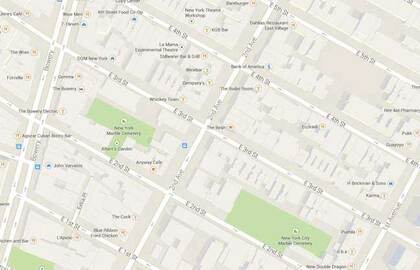
These are a pair of “neighborhood” cemeteries established by 1831, the first nonsectarian cemeteries in NYC. After the mid-1840s, the city, believing cemeteries would exacerbate disease epidemics like yellow fever and cholera, legislated against any burials south of midtown; St. Patrick’s parish then established Calvary Cemetery across the river in Queens, for example, and Brooklyn and Queens’ “cemetery belt” came into existence. In downtown Manhattan, though, there are still some small cemeteries scattered around, some dating to the 1600s, such as the Trinity Church yard at Broadway and Wall St.
The New York Marble Cemetery and New York City Marble Cemeteries were established in 1830 and 1831, respectively, and are considered separate entities, though both were built by the same individual.
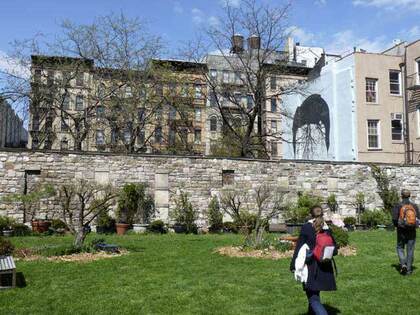
The NY Marble Cemetery (NYMC) is unique in New York City in that it contains no freestanding gravestones. The NYMC, along with the nearby New York City Marble Cemetery (NYCMC) were developed by Perkins Nichols, beginning in 1830, when E. 2nd St. was still considered uptown. Instead of earth graves with headstones, family vaults were built 10 feet underground. The relatively deep location was decided on because at that time there was still fear of contamination from deadly or debilitating diseases from fresh remains. The vaults are set in pairs and can be accessed by removal of stone slabs set beneath the “lawn.” The NYMC contains 156 vaults and 78 entrances.
Among the original internees were prominent businessmen, what today some would call the “one percent.” Uriah Scribner, a founder of the Scribner publishing and book-selling empire; Aaron Clark, NYC’s first Whig mayor (from 1837-1839); US Representative and President of Columbia University, James Tallmadge; Benjamin Wright, Chief Engineer for the Erie Canal; and Deys, Varicks and other prominent names found on NYC street signs.
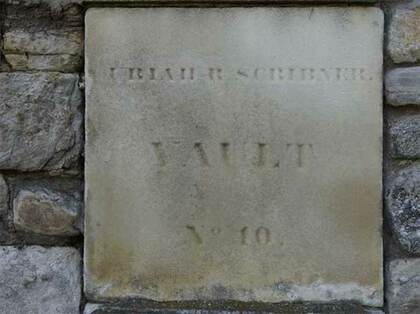
The roughly-hewn stone walls of the NYMC contain marble plaques, showing original owners and the precise location of each vault. Tuckahoe marble was employed for the aboveground plaques and lintels and also below ground for the vaults’ walls and arched ceilings, preventing “miasma,” or harmful vapors, from seeping to the surface. Unfortunately, marble doesn’t hold up well in wind and rain and many of the names, once chiseled deep into the stone, have suffered nearly 200 years of weathering.
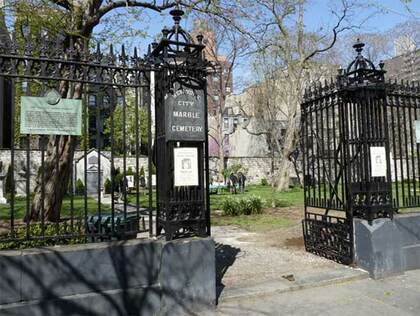
The “other” local cemetery, though trustees of each cemetery likely call NYMC or NYCMC the “other” one, is located via a more conventional entranceway on E. 2nd St. between 1st and 2nd Aves., though the NYCMC is open to the public less frequently than the NYMC. It’s interesting that the NYMC literature claims that Perkins Nichols built both cemeteries, but that NYCMC was “founded” in 1831 by a consortium consisting of wealthy New Yorkers Evert Bancker, Samuel Whittemore, Garret Storm, Henry Booraem and Thomas A. Emmet, without mentioning Nichols’ name. Land was purchased from Samuel Cowdrey.
Apparently in that now-remote era, 2nd Ave. was due to become a fashionable road lined on both sides with expensive housing and emporia. Instead, an el was eventually built on the avenue north of E. 23rd St. and 2nd Ave. was thrown into shadows punctuated by flaming sparks and belching smoke from the overhead tracks. 5th Ave., leading north from Washington Square, stole the glory. By the 1890s the NYCMC was faced by tenement housing on E. 2nd St. and many of the families with members interred here decided to reinter them upstate, away from the hoi polloi. Others held firm and instituted a trust that has helped maintain the NYCMC to this day. At length, it was declared a NYC Landmark in 1969.
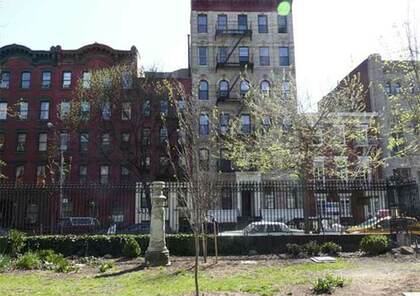
The NYCMC is also under the baleful glance of #67 E. 2nd (the six-story walkup in the center) where, NY Songlines‘ Jim Naureckas reports, domestic terrorist Sam Melville made his hideout in 1969 after bombing the U.S. Draft Induction Center on Whitehall Street, Criminal Courts Building at 100 Centre St., the RCA Building, the General Motors Building and the Chase Manhattan Bank and other places, all without killing anyone, not for lack of trying. He was sent to upstate Attica and died in the prison riots there in September 1971, which he helped instigate.
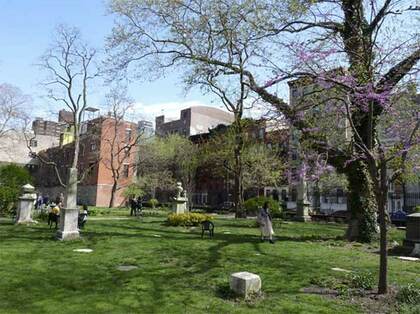
Much like the New York Marble Cemetery, the NYCMC burials are in vaults about 10 feet below ground and are accessed by opening stone slabs buried beneath. Unlike the NYMC, the NYCMC faces E. 2nd on one side and there isn’t a stone wall for marble monuments to be displayed. You’ll see them arrayed on the cemetery field, and many families have chosen to erect substantial monuments.
This cemetery in the past was the final resting place of President James Monroe from his death in 1831 until 1858, when the State of Virginia requested his remains be reburied in Richmond. The cemetery claims three NYC mayors, Marinus Willett (from 1807-1808), Isaac Varian (1849-1851) and Stephen Allen (see below). NYC Public Library founder James Lenox; John Lloyd Stephens, archeologist and Mayan expert; James Henry Roosevelt, founder of Roosevelt Hospital; and several other Roosevelt family members, are buried in NYCMC.
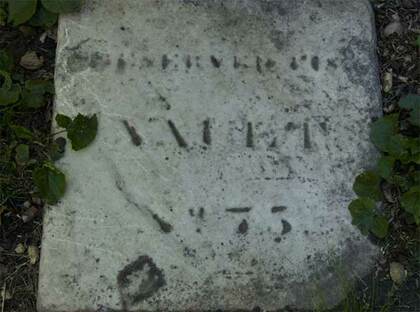
Preserved Fish (1766-1846), was a prominent shipping merchant. He was a member of the prominent political Fish family in New York, whose most famous member was Hamilton Fish (1806-1893) who became the 16th Governor of New York, a United States Senator and United States Secretary of State. Preserved Fish, however, was born in Portsmouth, RI, son of a father who gave him his name. It is not a pun or a play on words, as it’s pronounced in three syllables, “pre-SER-vid” and implies “preserved in God’s sight or God’s grace.” His monument can be found on the west end, or 2nd Ave. end, of the cemetery.
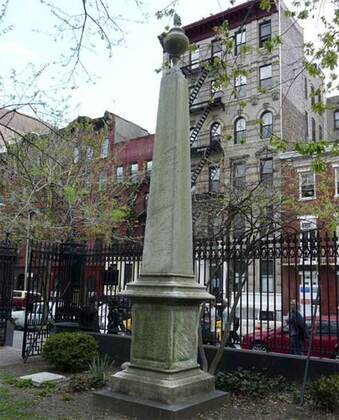
You can’t miss Stephen Allen (1767-1852), the 55th NYC mayor from 1821 to 1824 and a sailmaking entrepreneur before entering politics; his vault’s marked by a large tapering shaft topped by a globe just to the left of the cemetery entrance on E. 2nd St. Following his mayoralty he served as a New York State senator. He was aboard the steamship Henry Clay on July 28, 1852 when, during a race with another vessel, it caught fire and crashed in the Hudson River, killing dozens of passengers including Nathaniel Hawthorne’s sister, landscapist Andrew Jackson Downing, and himself.
—Kevin Walsh is the webmaster of the award-winning website Forgotten NY, and the author of the books Forgotten New York (HarperCollins, 2006) and also, with the Greater Astoria Historical Society, Forgotten Queens (Arcadia, 2013)