
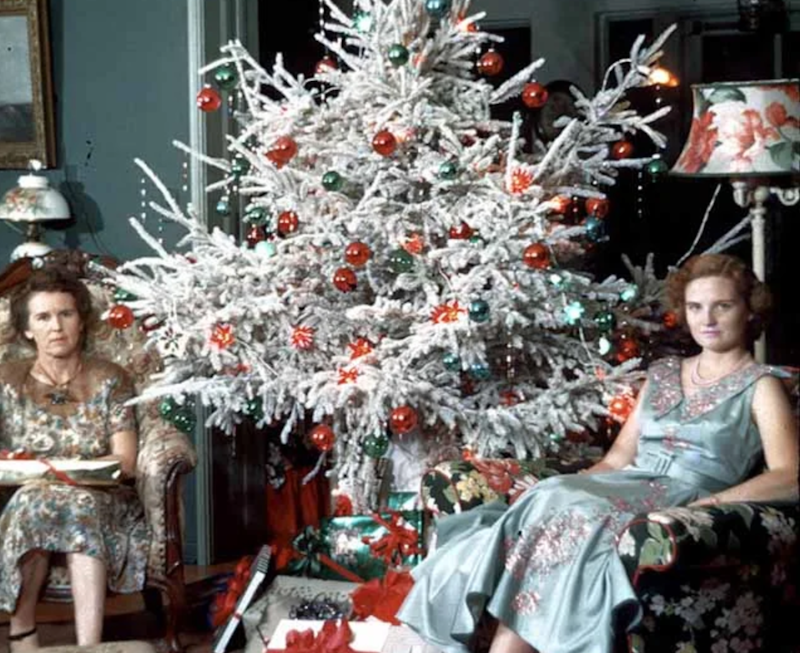
Last week I wrote about the gorgeous hand-blown ornaments’ arrival to the United States from Eastern Europe. But how did Christmas trees get here? At first, they looked more like fruit stands than holiday showpieces. In 19th-century America many of the earliest trees were decorated with what families had on hand: apples, nuts, paper flowers or simple lace bags filled with treats or tokens.
The roots go deeper—evergreens, wafers, sweets, and candles were part of early-Christmas traditions in Europe, and those ideas followed immigrants across the Atlantic.
For many families this was about practicality. Trees weren’t floor-to-ceiling spectacles, but modest, maybe a foot or two, perched on a table if you lived in a cramped city flat. But what they lacked in size, they made up in charm and a holiday scent of nuts, fruit and pine.
Everything changed in the mid-1800s when the tree decoration habits of German immigrants collided with new social trends. Imported decorations like glass ornaments, small tin angels, spun cotton stars and paper chains became available in toy shops and variety stores. Suddenly holiday decor was entering the marketplace with a splash.
Trees grew taller, decorations more elaborate. Popcorn strings, paper chains, cookies and nuts remained staples—often enough to keep the kids busy until the decorative treats came down on Twelfth Night. By the late-19th century the idea of a Christmas tree in the American home had spread beyond a few immigrant enclaves and was part of the national holiday fabric.
As we rolled into the 20th century, holiday decorating began to change fast. What once had been homemade and modest became increasingly commercial. Retailers saw a burgeoning holiday market, and before long clever businessmen were importing ornaments wholesale.
At the same time electricity made its way into homes, which meant: no more risky candles perched on tree branches. Instead, strings of lights started appearing and slowly made decorated trees safer, more practical and far more glamorous after sunset. By the 1930s and afterward, many American households were embracing store-bought glass ornaments—shining, colorful, often elegant—that stood in sharp contrast to the humble nuts and popcorn of previous generations.
Then came the post-war era, the 1950s and 1960s, and a new aesthetic for Christmas. The holiday got bolder, sometimes futuristic. The traditional evergreen wasn’t always enough. Artificial trees, aluminum trees, bristle-trees, plastic branches—all became popular alternatives.
Tinsel made a dramatic comeback with long straight strands, intended to look like icicles dripping off branches. Shiny ornaments, hard plastic shapes, bright lights, and more theatrical presentation defined this period.
These decades also saw the birth of the holiday village—little cardboard or ceramic houses, churches, figurines, holiday trains, and cotton “snow” laid under the tree. Once small and homemade, these villages became popular decorations in living rooms across the nation.
Suddenly, Christmas decor became less about subtle warmth and more about spectacle: lights blinking, silvery tinsel shimmering, plastic snow under tiny illuminated windows, maybe a miniature train running around it all.
The shift in decorating style wasn’t just aesthetic—it reflected changes in American life. As more families moved into suburbs, into houses with spare rooms, basements, and space for larger trees, the scale of decoration expanded. The post-war boom meant more mass production, more consumer goods, and more people with disposable income for non-essential seasonal sparkle. Technological advances like electric lights made decorating safer and more reliable.
At the same time, holiday decor resembled broader cultural shifts. The rise of bright, synthetic materials mirrored modernism, post-war optimism, and a fascination with newness. The fact that holiday villages went from handmade neighborhood tradition to mass-market retail commodity says a lot about mid-20th-century America.
There’s magic in that shift from homemade simplicity to full-on festive extravagance. Maybe a mid-century aluminum tree with silver tinsel looks gaudy now. Yet for many, that’s exactly the point: it’s loud, unmistakable, and a kind of joyful excess you don’t get from minimalistic LEDs or sterile, neutral-toned holiday setups.
Decorating trends evolve as our lives evolve—what matters is how each generation interprets “festive.” Sometimes that means modest and homemade, sometimes over-the-top sparkle. And much of what we consider “traditional Christmas décor” today came from those decades of reinvention and experimentation: the ornaments, lights, trees big enough to graze the ceiling, villages on the floor, tinsel showers.
If you still love tinsel, or set up a little holiday village under the tree, you’re taking part in a mid-century Americana tradition as valid and vibrant as any Victorian fruit-tree or colonial-style candle-lit fir. Whenever you fluff the branches, plug in the lights, and place that plastic snow under the scene, you’re participating in decades of holiday evolution.
—Stay tuned next week for the final part in the three-part vintage holiday décor series.