
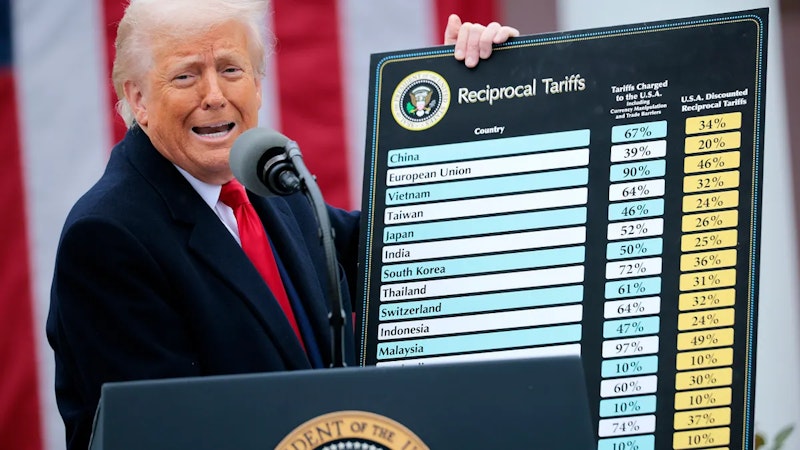
If Trump declared that no sadsack loser mathematician can tell him two plus two equals four once the President decides otherwise, would most Trumpists cheer the President for being a tough guy who’s finally standing up to the math establishment? Would a chorus of clicks-seeking podcasters, instead of calling the President a fucking idiot, rail against all the atheists and communists who have used math over the years?
You have to wonder, especially when you see some right-wingers—who until what seems like mere months ago supported free trade—now support the absolutely econ-ignorant madness that is tariffs, which are nothing more than massive penalties for engaging in trade, no matter on whom they’re imposed. Even if it’s literal foreign communists who were doing the trading, we should if anything be applauding them for buying and selling things instead of just seizing or regulating things. Hate the communism, not the commerce!
And don’t forget that the real intended beneficiaries of tariffs are the mostly-rich, mostly-well-connected, often not-coincidentally de facto bribe-paying domestic producers whose competitors get suppressed by the government’s tariffs. The beneficiaries aren’t innocent, lowly, forgotten customers like you, who get to pay higher prices as a result of decreased competition and decreased choice.
Punishing people who sell you stuff is no way to end up with more stuff or lower prices, not even with several extra steps thrown into the process. You’re never really the winner in a trade war.
I can understand the average sap falling for the scam that is tariffs, though, assuming the average sap thinks (or feels in some inchoate, pre-rational way) that products coming from far away must be bad and it’s always good to stop them because they might hurt us when they get here, even if we individually choose to buy and use them. Apparently, there are studies suggesting the “buy local” impulse—though rarely adhered to when there’s any price incentive to the contrary—is strong enough not just to make people averse to dealing with foreign nations but to make people in some U.S. states resentful of buying things from other U.S. states. (You sometimes hear environmental arguments for feeling essentially the same way.)
For example, some in the Midwest purportedly use words like “foreigners” so sweepingly that they apply to anyone visiting or moving in from out of state, even if they originated elsewhere in the U.S. Following that line of thinking leads eventually to a return to living in small, hostile roving bands in the woods.
Sadder, though, than the primitivist impulse, which at least has a certain logical (albeit possibly civilization-ending) consistency to it, is the pretense by full-blown intellectuals that they can rationalize the tariff-imposing impulses of politicians like Trump. Has ostensibly pro-market economist Arthur Laffer revised his view that Trump’s no real fan of tariffs but merely threatens to impose them to get all nations to agree to trade freely in the end? It’s hard to see how Trump was crafting any such comprehensible, consistent pro-trade incentives with his arbitrary and shifting tariffs before last week’s Supreme Court decision striking them down.
There’s a long tradition, I admit, of dissident economists defending “optimal tariffs,” which is to say the hypothetical perfect mix of legal penalties that miraculously boosts domestic production without significantly decreasing the influx of goods from abroad. Pursuing such a balance through real-world policy, though, is as absurd as seeking a “perfect tax level” that somehow gathers revenues without causing any avoidance behavior in the public such as moving, buying on the black market, or most likely buying less and just suffering the attendant decrease in standards of living.
The real world is full of incremental effects including economic tradeoffs, not all-or-nothing reactions—and it’s certainly not full of poorer people who magically become richer people for having engaged in sheer nationalism in order to stick it to people far away. A car that costs $5000 more still costs $5000 more even if you shout “Solidarity!” or “America!” while driving it off the lot.
But the welcome 6-to-3 smackdown Trump’s tariffs just received at the Court was ostensibly based not so much on econ considerations as on estimations of whether Trump, by imposing tariffs, was exceeding his constitutionally-limited emergency powers. The three Democrat-appointed justices, in voting against the Trump administration, didn’t suddenly learn econ or even develop a consistent fear of presidential power (I’m sure roughly the same tariffs could’ve been imposed by Biden without any self-proclaimed left-liberals on or off the Court blinking, and you know I’m correct). But maybe they’ll seize this opportunity to question the infinitude of other laws and regulations by which government hampers commerce.
The Supreme Court isn’t the simple partisan sport many of its critics take it to be, but it’s fair to think its members, right or left, have a great deal of wiggle room for engaging in “motivated reasoning,” which is a fancy way to say for engaging in slight bias in finding their way to preferred conclusions. Last week, that reasoning process, sound or not, led the (roughly speaking) three left-liberal members of the Court but, disturbingly, only three out of six of the conservative ones to side with freedom and markets and against the anti-capitalist autocrat in the Oval Office.
Thomas, Alito, and Kavanaugh, whatever their stated reasons, stuck with Trump instead of trade, and that likely bodes as ill for future attempts to rein in big government as did any past justices’ capitulations to Obama regulations or Biden spending. Would that the Court had been unanimous in picking markets over Trump’s sabotage of markets.
Trump’s already responded to the Court decision erasing his tariffs by imposing new, across-the-board tariffs higher than the selective, punitive old ones (aimed at places like China) that he preferred. Regardless, he thinks we’ll see tariffs vindicated a year from now when factories are built here instead of overseas. Some factories may well be, but that’s like saying that if you make it illegal for Americans to travel abroad, that onerous restriction will be “vindicated” when tourism increases in domestic locations. One’s goal should never be to create a mix of large harms and small benefits and then crow proudly and selectively over the benefits. That commonplace political sleight-of-hand doesn’t mean you’re doing net good things.
When you make it illegal for people to do the things they want to do, they’ll do other things to compensate. No shit. But the whole world gets a little less happy every time people have to make second-best plans instead of pursuing the things they originally wanted to do. Outlaw cranberry juice and there may be an increase in blueberry juice sales. That doesn’t mean it was the right move, even if beaming members of a compliant local council give you the Blueberry-Growers Annual Gratitude Plaque as a result. On balance, juice-drinkers suffer a loss.
Government shouldn’t be the means of deciding which losses are (somehow) worth it. That’s what markets are for.
Switching under tax, tariff, or regulatory pressure to another product or another supplier only confirms that people find ways to cope with the impositions of authoritarian regimes, whether those impositions were initially urged by regulators, labor unions, nativists, domestic manufacturers, communists, or fascists. Trade freely, humanity. Resist all of those trying to stop you, no matter what party, nation, or seat on a court they occupy.
—Todd Seavey is the author of Libertarianism for Beginners and is on X at @ToddSeavey