
“Libertarians Tried to Warn You About Trump,” an op-ed by Katherine Mangu-Ward, editor-in-chief of Reason, made me laugh, caustically. I came to it through the Facebook feed of Shikha Dalmia, editor of The UnPopulist, fired by Reason for her opposition to Trump, and who’s written about how, in response to the Republican Party’s embrace of populist authoritarianism that tramples civil liberties and violates principles of limited government and free markets, libertarians shrugged or enthused (with some exceptions).
I recently attended a Maryland party at the home of the Cato Institute’s Walter Olson and his husband Steve Pippin to celebrate The UnPopulist, a publication driven by disaffection from the Trump right, where I met Linda Chavez, Reagan White House official and longtime fixture of conservative circles. She’d been on the PBS show Finding Your Roots, where she’d discovered that her ancestry included Spanish Jews who’d converted to Catholicism under threat from the Inquisition but then secretly kept their original faith, passing it down through generations and carrying it to the New World. This explained her grandmother’s curious practice of turning a plaster saint toward the wall on Friday nights. Chavez has turned the story into a novel, The Silver Candlesticks, which I’m reading.
The titular silver candlesticks are passed down by a young woman whose marriage plans are derailed as she discovers she’s Jewish and who’s pressed into a different marriage aimed at obscuring the family heritage from suspicious authorities; this is in 1587, over a century after Jews have been expelled from Spain or forced to convert. I have an affinity for family heirlooms that carry echoes of political persecutions and escapes. I own an antique Indonesian tea-set, which my paternal grandparents got from a relative named Oskar, who lived in what was then the Dutch East Indies; he was part of the Goldenberg branch of my extended family, of which another member, Franz, as I’ve written, provided funds enabling my father and his family to flee from Nazi-ruled Austria to the Dominican Republic.
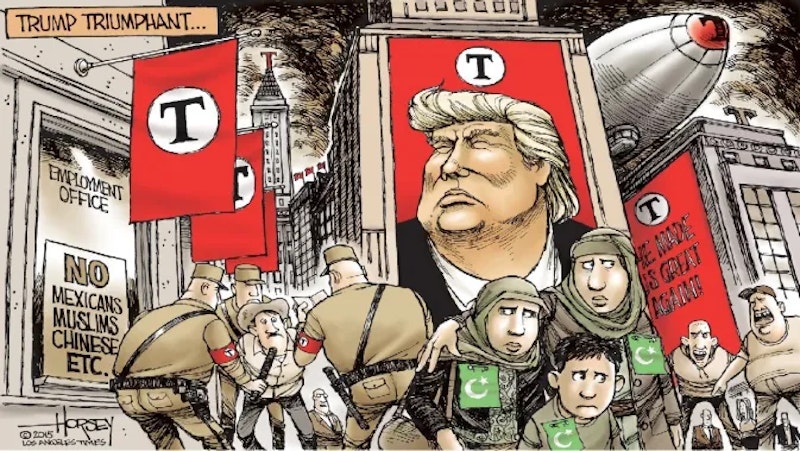
Do I worry too much about putative threats of fascism? Someone told me so early in Donald Trump’s first term, saying my family background bequeathed a hypersensitive tendency to exaggerate such concerns. Such dismissals are getting less likely, at a time when “We tried to warn you” is rising as an argument, along with a meme in which “You’re overreacting!” gets repeated from 2017 to 2025, followed by a defensive disclaimer in 2026: “Well, there was no way of knowing it would get this bad.” One can take solace in knowing that, if constitutional, legal and normative safeguards have been shored up by, say, 2030, a resurgent theme of commentary will be they were obviously never threatened.
I’m also reading a book mentioned recently, The First Fascist: The Sensational Life and Dark Legacy of the Marquis de Morès, by Sergio Luzzatto. It’s an enlightening biography in that Morès, a figure largely forgotten or noted merely as a friend and rival of Theodore Roosevelt when both ranched in North Dakota, was an early adopter of malign political ideas and techniques grimly relevant to our times. From an aristocratic background, Morès worked to build a coalition in France across socioeconomic lines, appealing to economic insecurities and fears of national decline, prone to conspiracy theories, and vehemently hostile to Jews.
“If anything happens to me, do not forget me,” Morès said in 1894. He was murdered in 1896, at 38, by Tuareg and Chaamba tribesmen in the Sahara, where he’d gone on an expedition aimed at furthering French colonialism and bolstering his business interests. Morès’ followers, saying Jews had masterminded his death, wrecked synagogues and Jewish properties in French cities. During World War II, after France’s fall, officials of the puppet Vichy regime evoked Morès’ memory as they ordered round-ups of Jews for deportation to the camps.

