
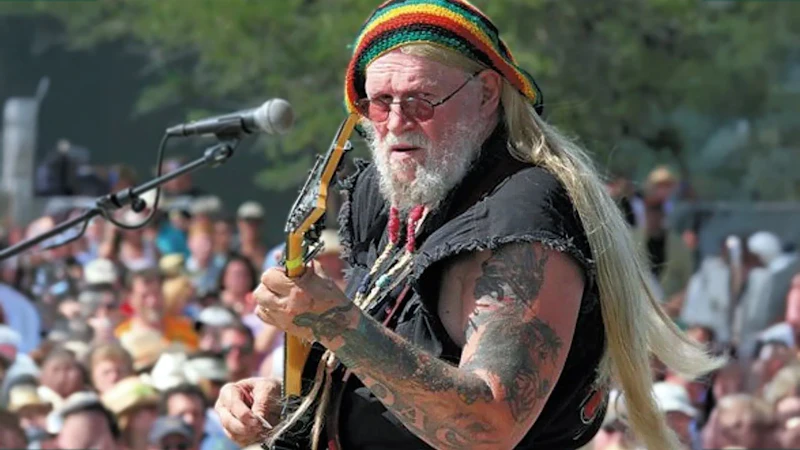
“David Allan Coe was always a difficult person to be close with, a difficult person to care about for several reasons," said his son Tyler Mahan Coe, host of the great podcast Cocaine and Rhinestones, after his death. "Nobody who ever knew him would disagree with that statement." It's the kind of thing you hear at the funerals of the most problematic people, the kind of people with regard to whom unadulterated praise would be insincere at best.
I saw him in a small club in Tuscaloosa in the early-1990s, perhaps at a nadir. He'd been one of my favorite artists for 20 years by then, always on my turntable. On the other hand, I'd given up on any new material, which got more and more bizarre or desperate as he went along. He was messed up at that gig (on what, who knows), though the voice—which I’ll always think of as a country paradigm on the level of George Jones and Merle Haggard—was relatively intact. I think his dealer was playing guitar; anyway, that was no guitar player. He was presenting the world's hardest-partying personality, but it just made me sad.
I first ran into Coe in some sort of documentary in the early-1970s when I was a lad. Could it have been on PBS? Seems unlikely, but I'm trying to place it. He was living in a decommissioned ambulance parked outside of the Ryman auditorium in Nashville, living by playing on the street. He'd been in jail most of his life, he said, beginning in juvenile facilities (somewhat like the contemporary singer Jelly Roll). He'd killed a man in prison who tried to rape him, he claimed. Johnny Cash helped him get out, he declared. As with everything in Coe, every sentence needed fact-checking.
But the name runs easily off the tongue, perhaps partly because it resembles “Edgar Allan Poe.” And the music, after Coe turned from the hard blues of his Nashville busking days to mainline and outlaw country, was intensely memorable. He wrote "Take the Job and Shove It." His song "Would You Lay With Me (In a Field of Stone)" sounds like it was written by the Ohio River in 1870 and was a #1 single for young Tanya Tucker. Longhaired Redneck and If That Ain't Country were anthems of a cultural transition in the 1970s in which young good old boys started looking like hippies and maybe listening to heavy metal.
He had his finger on the pulse of a segment of the culture, for awhile. But he also wrote beautiful songs, some of which emerged in his 1980s renaissance with the great producer Billy Sherrill: items like "The Ride" and "Mona Lisa Lost Her Smile." And though other people covered his songs fairly frequently, you'd rather hear him sing them than anyone, and no one has ever had better country timing, way behind the beat, reminiscent of his great contemporary Tammy Wynette, who was also shepherded by Sherrill.
On the other hand, he was always chasing trends and gimmicks in a way that was unnecessary and ridiculous, even if it was at times amusing. He studded his performances with impressions of the great country singers, though it had worked alright in his breakout song "You Never Even Called Me By My Name," in which he claimed, in the voice of Merle Haggard, to look like Merle Haggard. He was always dropping names as though he were trying out for other artists' entourages, as on songs like "Willie, Waylon, and Me" or Hank Williams Junior-Junior. It took on a certain desperation, and, famously, Waylon Jennings just got over him completely after awhile, even if he still loved some of the songs. Jimmy Buffett thought Coe ripped him off during Coe's "floating around the Caribbean drinking rum" phase, which featured such Buffett-approximations as Divers Do It Deeper.
Later, he tried rapping or spoken word (very early, but also based on the sort of recitatives of which he and, for example, Whispering Bill Anderson were masters) and also "working blue" with sexual or racial themes. It kind of pissed me off, really, because I wanted him singing straightforward country music. And after Tuscaloosa, I let him go on his merry way (as even Tyler Coe had to do after awhile), while every so often pulling out all the LPs and pouring them into a warm bath of nostalgia. Every so often I heard something about him and was vaguely happy again he wasn’t dead.
So I'm not surprised that David Allan Coe is deceased. That leaves only Willie, I think.
Early Coe Top Twenty (avoid all re-recordings).
(1) You Never Even Called Me By My Name
(2) Shine it On
(3) Fraulein
(4) Another Pretty Country Song
(5) Would You Lay With Me (in a Field of Stone) + Tanya's version
(6) Take this Job and Shove It + Paycheck's version
(7) Whole Lot of Lonesome
(8) Human Emotions
(9) Tennessee Whiskey + Stapleton's version
(10) Million Dollar Memories
(11) Longhaired Redneck
(12) If That Ain't Country
(13) Hank Williams Junior-Junior
(14) Divers Do it Deeper
(15) Love's Cheatin' Line
(16) This Bottle in My Hand (feat. George Jones)
(17) The Ride
(18) Mona Lisa Lost Her Smile
(19) Mary Go Round (About the Birth of Jesus)
(20) Piece of Wood and Steel
—Follow Crispin Sartwell on X: @CrispinSartwell