
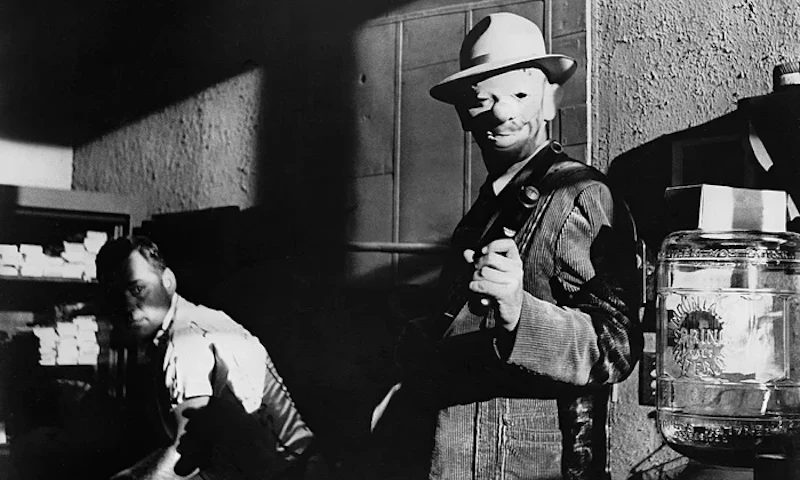
In noir, there’s often a thin line between “the little guy can’t get a break” and “crime doesn’t pay.” The subversive indictment of a rigged capitalist system is concealed in the karmic destruction of those who wander off the straight and narrow, and/or vice versa.
That’s the case in Stanley Kubrick’s heist film The Killing. Ex-con Johnny Clay (Sterling Hayden) plans the perfect racetrack heist to lift $2 million (about $24 million in today’s dollars). But a combination of human frailty and bad luck (including a misplaced horseshoe) leaves dead bodies bleeding out and cash billowing into the air on the airport runway.
The film emphasizes early that the robbers are in most respects just looking for a break. “None of these men are criminals in the usual sense,” Johnny tells his girlfriend Fay (Coleen Gray). Mike (Joe Sawyer) a track bartender, hopes to pay for doctors for his ill wife. Sharpshooter Nikki Arcane (Timothy Carey) wants to subsidize his farm. They all just want to get a little ahead, and there’s no way to do that if you don’t break a few rules.
Or that’s one perspective. But Johnny also says that his partners all have got “a little larceny in ‘em.” That refers primarily to their willingness to rob the track. But it also suggests that each has a certain flaw—something wrong in their character that has bent them and made them unfit for normality, and also for success.
The clearest example here, and the film’s most entertainingly twisted subplot, involves George Petty—a mousy beta male cashier at the track played with woebegone sweatiness by the consistently brilliant Elisha Cook, Jr. George is desperate to win the love, or at least the tolerance, of his philandering, scheming bombshell femme fatale wife, Sherry, played with poisonous va-va-voom by Marie Windsor.
Marie lusts for cash, but she also hates her husband—she just about vomits down her substantial bosom when George suggests she might call him “papa.” It’s not enough for Sherry to be rich; she has to be rich with her chiseled boy toy Val Cannon (Vince Edwards). She and Val plot a counter-scheme which dooms everyone—not least George, who spends the movie growing more and more unhinged, his eyes bugging bigger and bigger, until they swallow his face, and his character, in larceny and violence.
George’s failures as man and conspirator are the most combustible, but the others in on the scheme also have their own crookedness. Corrupt cop Randy Kennan (Ted de Corsia) has debts to the mob. Marvin Unger (Jay C. Flippen), an aging accountant financing the scheme, is desperate to impress Johnny; which leads him to get drunk on the day of the heist and wander around the racetrack—the last place he should be.
Even cool, focused Johnny has his lapses. He fails to realize how much of a threat Sherry is, letting her go with a warning when he catches her eavesdropping. And at the end of the film, when his girlfriend Fay is urging him to run, Johnny simply gives up—even though she’s begged him earlier to do everything he can to avoid getting caught because she can’t stand to have him go back to prison. His surrender is a bowing to fate. But it can also be seen as a betrayal of Fay—and the whole scheme, which puts him in trouble with the law again, seems like a failure to put her first, ahead of his passion for cash.
As often with Kubrick, the pleasure of the clockwork filmmaking is tinged with a certain sadism. The heist is shown from multiple perspectives, jumping back and forth in time, so it’s simultaneously suspenseful and preordained. Things go awry out of happenstance, but those happenstances (like the lucky horseshoe that damages Nikki’s tires and lead to his death) all seem carefully orchestrated by a higher, all-knowing power. That power might be seen as malevolent, if you root for the every-guy crooks. It might be seen as benevolent, if you don’t want crime to pay. But either way, you feel someone is plotting against those characters—not least when George finally shoots his wife, and he and she lie in their apartment together as a parrot blindly squawks, “It’s not fair.”
Sherry’s pathos is moving; George isn’t an attractive husband for a range of reasons, not least his final act of domestic abuse. But, like all femme fatale’s in classic noir, she also deserves her punishment for defying patriarchal norms and refusing to be the good mama to George’s good papa. Johnny, as the homme fatale, is her mirror image, refusing to seize the domestic bliss that Fay offers—a bliss which the film figures as normative and also as castrating.
So are you supposed to rail against the system in The Killing, or are you supposed to cheer for the reimposition of order? Classic noir rarely picks one or the other, preferring ambiguous deniability, if only to get past the code. The final shot of the movie though, perhaps tips Kubrick’s hands. The camera focuses on the glass exterior doors of the airport; two plainclothes cops walk thought two doors, in sync. It’s a ballet of order reimposed. That’s an ominous assertion of power. But Kubrick makes it a satisfying one as well.