
I’m pretty sure that Three Poplars in Plyushchikha first came on my radar by people pitching it as a kind of Soviet The Bridges of Madison County. I had a passing familiarity with the film’s co-star Oleg Yefremov from his portrayal as Dolokhov in Bondarchuk’s War and Peace and his role as a Soviet detective in Ryazanov’s underrated Beware of the Car; otherwise, I wasn’t aware of the lead actress Tatiana Doronina, nor the film’s director Tatyana Lioznova.
The film opens in a dream, the camera rushing laterally through birch trunks as the camera stays close to Doronina’s face. Lioznova opens Three Poplars in Plyushchikha with a rush of emotion immediately contrasted by the doldrums of everyday rural life that Doronina’s character, Nyura, wakes up to. She longs for her husband, not just because he works constantly on the river but because life has turned his heart cold and he’s become physically abusive to her. As a means of temporary reprieve she hitches a ride to Moscow, where she plans to stay with her sister-in-law and try to sell some homemade ham at the markets there.
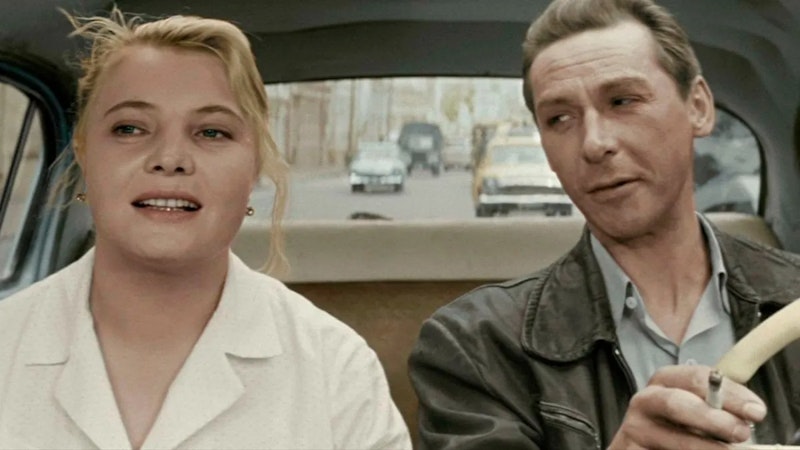
Once in the city, she grabs a ride with a taxi driver, and has cleverly planned to say she only has enough rubles for the proper fare so as not to get scammed as some country girl without any street smarts. The driver, Sasha (Yefremov), likes this about her. Nyura sees herself as having enough perspective, despite her situation, not to be a fool, while Sasha can see how green she is to the wider world, of which Moscow is the perfect encapsulation. Even on their taxi ride, Sasha’s also ferrying an elderly Uzbek man to his family in the city—the man doesn’t interact with the pair, but suggests the reaches of the Union far beyond the scope of Nyura’s little riverside valley. Around them are people from all corners of the USSR, coalescing at the hyper-modern center of their world. No matter how smart Nyura thinks she is, there’s so much that she’s never seen or experienced, and Sasha, from his cab, can show it to her.
After the pair get stuck in the taxi by a brief downpour, they agree to meet again later at the cinema—he’ll wait for her at the Three Poplars Cafe right by her sister-in-law’s apartment complex. Nyura’s nascent triste gets further put into perspective when she eventually links up with her in-law, Nina (the always great if so often under-utilized Alevtina Rumyantseva), who’s getting divorced and having an affair. Nyura is horrified by Nina’s city-girl cynicism, which is in sharp contrast to both the loyalty and nostalgia Nyura feels for her husband despite his current (often violent) disinterest in her.
Later, when Sasha returns, Nyura hesitates to go to him. When he looks up at the windows, she ducks down, waiting a beat before trying to grab another look. She watches as he turns down rider after rider, Nyura putting her hand over her face both in excitement and nervous embarrassment. She almost goes down, but then locks the door to her sister-in-law’s apartment when she hears footsteps in the hallway. She finally decides to go, but the lock on the door’s now stuck, and her indecision has left her trapped in the life she’s already living. The affair will never come to be.
This aspect of the narrative makes Three Poplars in Plyushchikha a more interesting comparison to The Bridges of Madison County than what some might be seeing as only surface-level parallels in plot. The point of the sacrifice that Meryl Streep’s character makes by choosing to stay with her family instead of running off with Clint Eastwood’s Nat Geo photographer is that she knows exactly what he can provide for her life—she thought she was going to see the world with her American G.I. husband but wound up in the middle of nowhere Iowa, and this photographer can fulfill that promise of romance.
Nyura, critically, never actualizes her relationship with Sasha so doesn’t know what it could possibly hold. Moreover, Nyura never dreamed of a life beyond the one she was living, having married a man who she thought wouldn’t give her a second thought, it's only that her small town dreams didn’t turn out to be the perfect image of rural life she grew up assuming it would be. Sasha’s so exciting to her not because he can bring her the life she always wanted, but because he offers the one she didn’t know she wanted. And it’s a life she’ll never get to know, either, taking the unselfish road back to her village to her kids and trapped knowing that there’s now a life that she could live but chooses not to. Like how Lioznova’s film came out in between the artistic explosion of Khrushchev’s Thaw and prolonged period of conservatism in the Brezhnev Era, Three Poplars in Plyushchikha has a certain tragic sense of responsibility even though life is now disillusioned by the knowledge that it could be even more.