
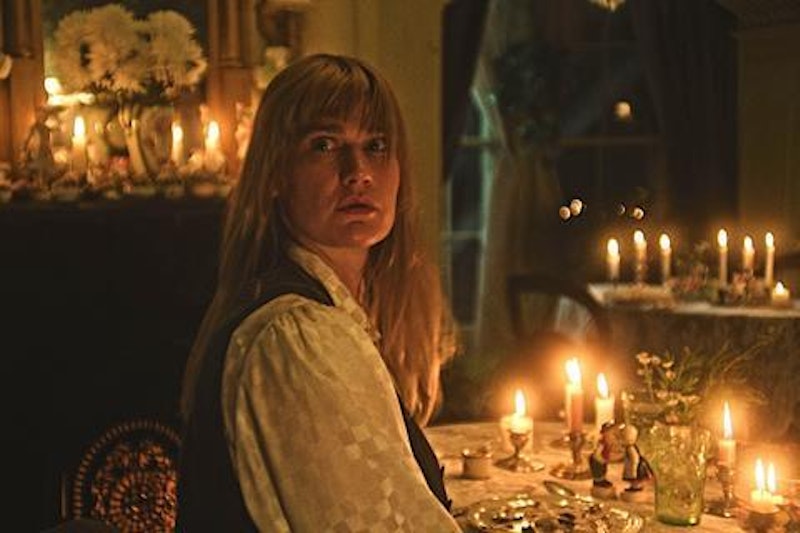
Madeleine Sims-Fewer and Dusty Mancinelli’s Honey Bunch, streaming on Shudder, is a strange multiple film about the multiple selves people bring to, and give birth to, in love and marriage. The conceit doesn’t turn into the Lynchian masterpiece that it seems at times to be creeping eerily towards. But it’s an intriguing effort.
The movie opens with Diana (Grace Glowicki) driven to a special medical treatment center by her nebbish academic husband Homer (Ben Petrie.) Diana’s had an accident she doesn’t remember, and the viewer is thrown with her into a confused fugue of gothic buildings and bad 1970s clothing without context or milestone.
The nurse Farah (Kate Dickie) and Homer are aggressively enthusiastic about some magical treatment by Dr. Trephine (Patricia Tulasne), but they also both seem to be withholding information, and Diana has terrifying visions of women who look disturbingly like her vomiting, retching, shrieking, and undergoing grotesque medical procedures. There are references to Daphne du Marier’s Rebecca, with its gothic intimations of spousal abuse and blurred identities—which appear more ominous as Diana remembers fights with her husband in which he comes across as a needy, controlling liar. Meanwhile, off to the side, Joseph (Jason Isaacs) is caring for his daughter Josephina (India Brown), whose symptoms are disturbingly similar to Diana’s.
This first half of the film is slow, dream-like, imagistic—an art film with horror film elements. Its meandering pace is likely to put off genre fans, but it builds a powerful sense of dread and dislocation which resonates with themes of spousal abuse and caretaker abuse. There are parallels with Olivia Wilde’s Don’t Worry, Baby—another film in which a fairytale marriage starts to fray at the edges, revealing beneath a constructed doll’s house in the shape of a skull.
As the film moves along, though, it puts pulpy flesh on that skull, turning into a more recognizable (if still impressively odd) horror offering. The mad scientist’s experiments are more or less explained, and the slow drift towards the self-recognition of self-effacement turns into a big fight scene in which various selves duke it out on the lip of an apocalyptic denouement. Everyone’s story arc is wrapped up with something like narrative coherence, and the protagonists escape from marriage-as-death-trap into a more conventional Hollywood clinch.
The film’s meant to illustrate, in part, the way that marriage, or relationships, aren’t a single moment of elevated joy, but instead consist of a long walk, and sometimes slog, through different emotions and different bodies—hate, love, lust, petty irritation, mastectomies, swollen limbs, catastrophic accidents, decay, age. The movie’s different modes are also marriage’s different modes, with paranoia and love, amnesia and memory, murder and resurrection, lies and half-lies and the occasional truth, selfishness and selflessness spinning round each other and leaping at each other’s throats by turns.
It's a lovely and queasy conceit, and almost works. But starting with high art and ending in genre flattens out the insights; when you go from more abstract and weirder to more conventional it makes it feel like you weren’t really committed to your most challenging moments. Starting with genre and going to art film could’ve worked perhaps, though that can feel like its own kind of cliché. What the filmmakers really needed was to find a way to mix high art and low art together throughout, as David Lynch does in Blue Velvet, or the Coen Brothers manage in Barton Fink.
Not many filmmakers can equal David Lynch or the Coen Brothers at the height of their powers; the fact that the comparison even comes to mind shows that Sims-Fewer and Mancinelli have created something worth seeing. Honey Bunch doesn’t deliver on its promise, but when you’ve got this much promise, even coming up a little short is an achievement.