
As we approach the 100th anniversary of the Oscars, let’s strut back to the late-1940s and take a look at the 20th Academy Awards, held on March 20, 1947. One or two movies usually collect most of the awards, but every few decades, Hollywood spreads the love: 1948 was the last ceremony in which no film won more than three awards for more than half a century; the phenomenon wouldn’t recur until 2005. Of the winners, let alone the nominees, few have endured in the public imagination: Miracle on 34th Street (Best Supporting Actor, Best Screenplay), Black Narcissus (Best Art Direction), Body and Soul (Best Film Editing), and—this one might be a stretch—Gentleman’s Agreement (Best Picture, Best Supporting Actress, Best Director). If that film’s overlooked, blame Elia Kazan for naming names so soon after its release; at the same time, it’s a fine movie, but it’s not On the Waterfront, a pro-informer film whose performances are so extraordinary that they outshine and rise above politics.
(There’s another 1948 Oscar winner that remains known but not widely seen anymore: Song of the South. “Zip-a-Dee-Doo-Dah” won Best Song and James Baskett received a “special Oscar” for his performance as Uncle Remus. Unlike On the Waterfront, Song of the South didn’t survive its battle with the overwhelmingly liberal media over the last 77 years.)
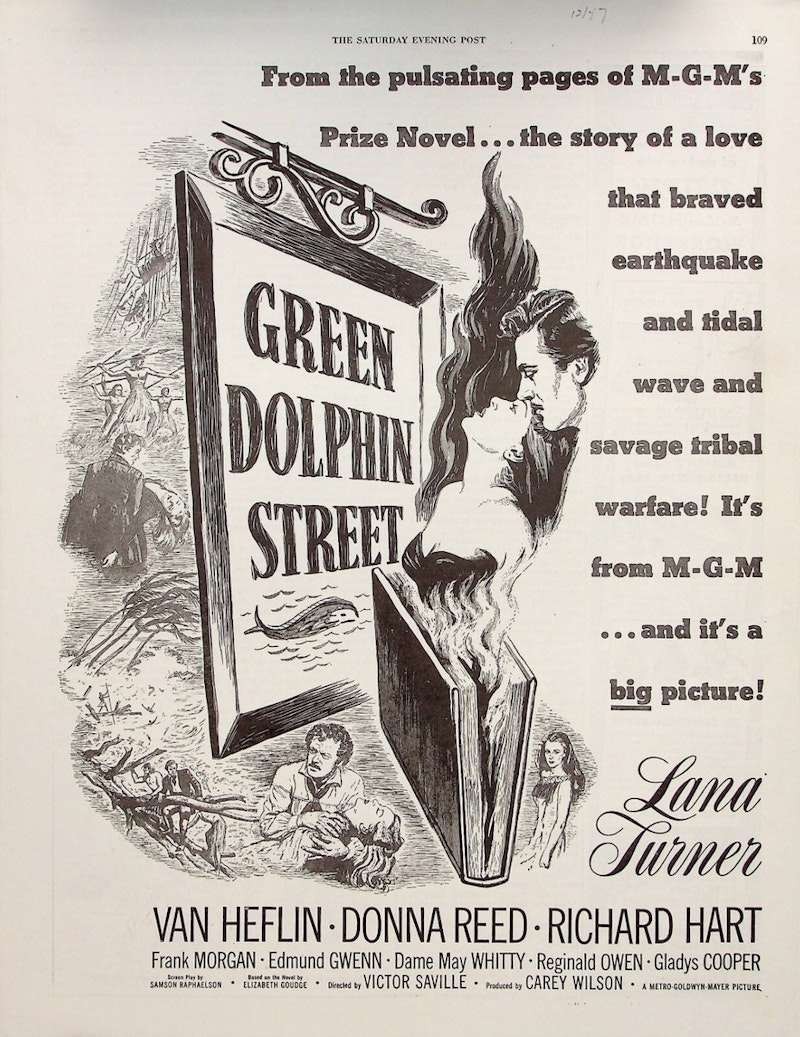
Rosalind Russell was favored that year to win Best Actress for Mourning Becomes Electra, but Loretta Young won in an upset for The Farmer’s Daughter—two movies and two movie stars who’ve faded out of a pop cultural firmament they once defined. You could say the same of Green Dolphin Street, that year’s Special Effects winner, but you can’t say Lana Turner and Donna Reed are unknown today. More than any single movie she did, Turner is remembered for the apocryphal story of her discovery in Schwab’s Drugstore. Brutalized by her lover Johnny Stompanato, Turner was scandalized when her daughter stabbed Stompanato to death in self-defense. She made one more major movie (1959’s Imitation of Life) and then laid low, continuing to work here and there, but mostly happy with just under two decades of megastardom.
Reed, on the other hand, was never a bombshell or a particularly distinctive character in the same way as Katharine Hepburn, Bette Davis, or Joan Crawford; indeed, she looks like the first woman you’d call when Olivia de Havilland was unavailable. But because It’s a Wonderful Life has such tremendous staying power (along with her popular series The Donna Reed Show), Reed’s never been unknown, even if most people can’t put a name to the face. Millions of people watch Reed every year as part of a tradition; Turner wasn’t so lucky. The Postman Always Rings Twice is a familiar title, but how many people on the street have seen the 1946 film? Soon, the 1981 remake will fade away, too, cast back into oblivion along with Green Dolphin Street and its author Elizabeth Goudge. The opening credits announce that the film is “BASED ON ELIZABETH GOUDGE’S PRIZE-WINNING NOVEL OF METRO-GOLDWYN-MAYER’S FIRST ANNUAL CONTEST”—the first and only contest, as Green Dolphin Street proved too expensive to turn much of a profit, despite being a considerable hit. Ross Lockridge Jr.’s Raintree County won the second annual contest, but the film wasn’t made for another decade, and Lockridge Jr. committed suicide before he’d ever see Elizabeth Taylor and Montgomery Clift bring his book to life.
Goudge and Green Dolphin Street may be obscure in America, but perhaps she’s still got more influence in England. J.K. Rowling has said that Goudge’s The Little White Horse was a “direct influence on the Harry Potter books. The author always included details of what her characters were eating and I remember liking that. You may have noticed that I always list the food being eaten at Hogwarts.” I haven’t, but well, I’m sure she’s right. Speaking of details and lists, the movie Green Dolphin Street, directed by Victor Saville and written for the screen by Samson Raphaelson, screams LITERARY ADAPTATION from the outset. Characters spew exposition and rush through the early and middle years too numerous to include in a standard theatrical film. At 141 minutes, Green Dolphin Street feels compressed, but ultimately succeeds because even though it’s a romantic period epic set in New Zealand, it’s really about four people: Turner, Reed, Richard Hart, and Van Heflin.
They are their own love square: Hart’s besotted with Reed, but drunkenly writes Turner’s name in a letter home. He’s technically a deserter from the navy, lured into an opium den and later missing his boat; he meets Heflin, mustachioed expat, permanent loner and another kind of “man with no name.” Heflin spends years around Hart and Turner as they all build a lumber business together, but Hart remains in love with Reed (now a novice in training), and Heflin, especially after a catastrophic earthquake that earned the film its Oscar, is in love with Turner. In the end, no one gets exactly what they want: Heflin chooses to continue roaming the Earth alone, while Hart and Turner reaffirm their marriage even after she discovers his long-harbored feelings for Reed. Earlier in the film, we watch Turner and Reed’s parents die one after the other, their father fine to go with their mother after she admits on her death bed that she was in love with another man—Hart’s father! “I knew all along,” he says, “and if I thought Edmond Ozanne would’ve been a better husband for you, then I never would’ve married you.”
It’s a riveting scene, but what struck me most about Green Dolphin Street was Van Heflin. A mid-century studio player, never mega-famous but never obscure, Heflin bowed out (or blew up) with 1970’s Airport. Winner of the 1943 Best Supporting Actor Oscar for Johnny Eager, Heflin hasn’t stuck around, with no immediately recognizable credits besides—another stretch—Shane and the original 3:10 to Yuma. He’s got qualities of Cagney, Lemmon, and Lorre, but he’s missing a Maltese Falcon or a Double Indemnity to keep his image distinct and present. I’ve seen him in plenty of junk and dreck, and while he’s always good, Green Dolphin Street is Van Heflin’s best performance. He plays the same longing loner that John Wayne would further brutalize with Ethan Edwards in The Searchers; it’s also not hard to imagine Heflin of Green Dolphin Street taking the place of Victor Mature in My Darling Clementine. He’s got the same rough-hewed yearning, along with the kempt-unkempt hair of Clint Eastwood.
Once Hart, Heflin, Turner, and Reed (who spends most of the movie off screen, “back home,” but still motivating everyone) get going, the punishing exposition and compression of the novel slips away. The movie zips by just like any soap opera should, and watching that earthquake, you wonder how the “native” extras could’ve possibly survived such falls, and such tight squeezes between gigantic pieces of earth. No worry: Saville was no Curtiz, and the cast and crew made it out of Green Dolphin Street alive. Fewer than 1000 people have logged Green Dolphin Street on Letterboxd, but with a recent Blu-Ray issued by the Warner Archive, there’s nothing stopping it from coming back in vogue. Heflin, like Wayne in The Searchers, is a wanderer, but not because of any bigotry or fear—he’s an individual, and he refuses to join Hart and Turner back home in business: “You don’t know me very well, Marianne. I find very little value in life beside my personal independence. When you and William joined me in my lumber business, that was one thing. But if I should follow along at the tail-end of your Biblical migration like a tamed tabby-cat, that is another…”
—Follow Nicky Otis Smith on Twitter: @NickyOtisSmith
