
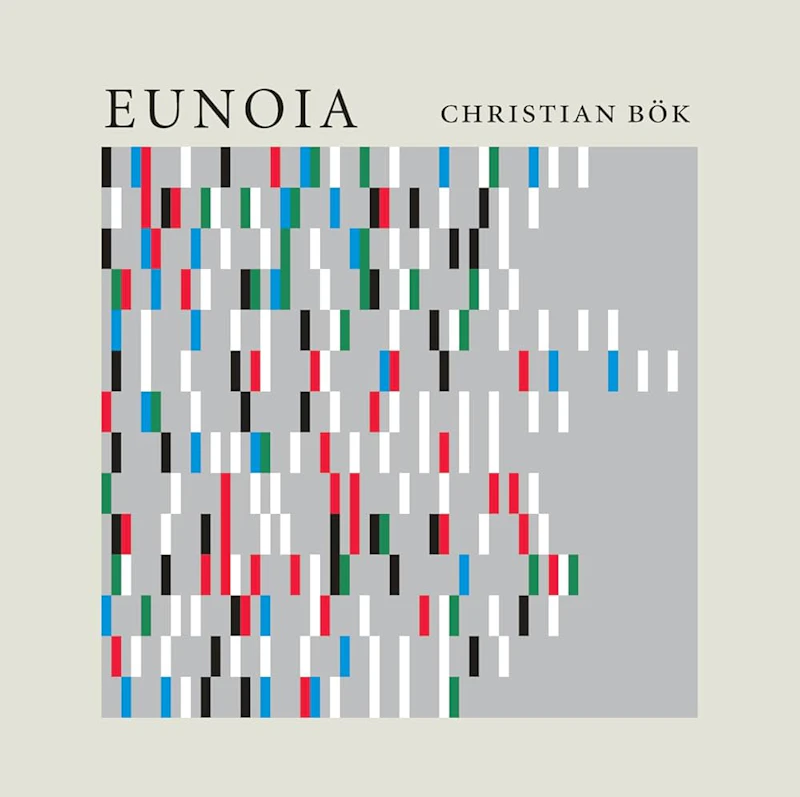
There’s no volume of 21st-century poetry more dazzling and none more gloriously ridiculous than Canadian Christian Bök’s 2001 masterpiece/anti-masterpiece Eunoia. The 81-page title poem, which takes up much of the work, is an exercise in avant-garde constraint; there are five chapters, in each of which Bök uses only a single vowel (and no use of “y” as a vowel; that would be cheating.)
Chapter A, dedicated to Hans Arp, begins:
Awkward grammar appals a craftsman. A Dada raftsman as daft as Tzara damns stagnant art and scrawls an alpha (a slapdash arc and a backward zag) that mars all stanzas and jams all ballads (what a scandal.)
The fact that Bök can make his a-and-only-a prose poem make sense is an achievement in itself. The fact that he can explicate his own influences and approach while dispensing with four of the five vowels is something close to a miracle. But even that doesn’t get at the full extent of his daft Dada craft.
At the end of the book, Bök explains that he embraced a number of what he calls “subsidiary rules.” First, every chapter has to “allude to the art of writing” (as, for example, the passage about “awkward grammar” already quoted).
All must also, he says, describe “a culinary banquet,”
I bid girls bring stiff drinks—gin fizz which I might sip whilst finishing this rich dish, nibbling its tidbits: ribs with wings in chili, figs with kiwis in icing.
“a prurient debauch,”
Ubu humps Lulu’s plump, upthrust rump. Ubu huffs. Ubu puffs.
“a pastoral tableau,”
Helen treks wherever herdsmen trek. She sees the vedlts, where ewes, when fleeced, chew the sedges.
“a nautical voyage.”
Moms who sob for lost sons blow conch horns to honor poor fools who, thrown from port bows, go down, down, down (oh no!) to drown—lost for good, now food for worms.
Bök also works to emphasize internal rhymes in every sentence (“down, down, down (oh no!) to drown”). And, perhaps most dazzlingly, he set out to include in each section every single word in the dictionary that uses only the given vowel—and to use each of those words only once. He doesn’t always succeed—“songs” shows up multiple times in Chapter O, for example, and he admits that he wasn’t able to find a spot for parallax or gingivitis. In general, though, the length of the sections are determined by the number of words that English (and sometimes French) offer that fit the rubric.
Even this doesn’t fully convey the preposterousness of the project, as Bök peppers his crossword anagrams with puns, in jokes, smut, and cleverness that, as he says, exceeds decent levels. He throws in a translation of Basho’s famous frog poem in Chapter O; Chapter I ends with a burst of Latin; Chapter E is, among other things, a retelling of The Iliad, complete with Trojan Horse (though of course, neither the words “Trojan” nor “horse” are used).
Bök insistently cites his avant-garde predecessors (especially if they are single-voweled like Yoko Ono). But part of what’s so exhilarating about Eunoia is that in many ways it’s a throwback to an older poetic style before free verse and Mary Oliver ruled the day, when moving gracefully within the straitjacket of rhyme and meter was the whole point of poetry in the first place.
Many of Bök’s sentences, with their dense vocabulary, alliteration, assonance, and rhyme, echo, not the garbled provocations of Tzara or Breton, but the ornate Victorian whorl and whelm of Hopkins and Swinburne. Form is form: you can “discipline signs with trifling gimmicks” by cutting out all vowels but “i,” or you can do it by writing a sonnet in blank verse. Bök has trussed himself so tightly in constraint he’s popped himself from the post-post-modern right back to the Elizabethans and maybe even (with the Iliad) beyond.
The book is rounded out with a handful of other related exercises—a list of every word in English that lacks vowels; a series of anagrams on the word “Vowels,” an additional section of e-only prose poems that didn’t fit in the tale of the Iliad. They’re all obsessive, maddening, and delightful. There’s nothing like Eunoia in this century or any other. The excellent verse excesses never end.