

Elk St. runs for just two blocks, from Chambers north to Duane west of Centre in the Municipal Building/City Hall area, but I’ve always found its evolution to be of interest. It’s had its present name for about 85 years, which is fairly young for a NYC street name.
Elk St.’s story begins uptown, with Lafayette Place, a one-block wide thoroughfare between Astor Pl. and Great Jones (E. 3rd) Streets, that even today has some of NYC’s finest architecture. When the Williamsburg Bridge opened in 1903, additional traffic flowed into Manhattan and traffic engineers (this was a couple of decades before Robert Moses began building his parkways and expressways) built two wide new streets; Kenmare, running east to west, and a southern extension of Lafayette Pl. that became Lafayette St.
The new Lafayette St. had its own right of way south to Prince St. At that point it took over the path of Marion Street (see this 1885 map) between Prince and Spring, and then Elm St. from Spring south to Foley Sq. This left a short piece of Elm St. “orphaned” between Worth and Reade St., the original southern limit of Elm.
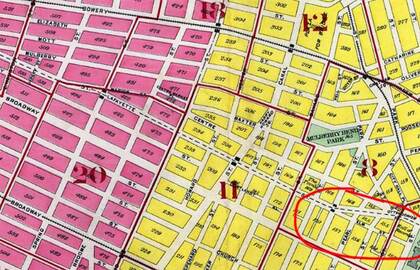
This map, drawn in 1912, shows then-new Lafayette St. and the remaining piece of Elm. There are no elk on Manhattan island except perhaps in the Central Park Zoo. But there’s the fraternal society the Benevolent and Protective Order of Elks, which evolved from a drinking club patronized by actors called the Jolly Corks which originated in the attic of an Elm St. boardinghouse in 1867, with the name change from Elm to Elk coming about in the late-1930s; it’s rumored that Mayor Fiorello LaGuardia was a member.
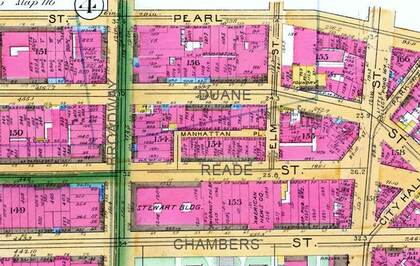
That’s not the end of the changes, though. Today, Elk St. runs in two noncontinuous sections from Chambers north to Duane. The section between Duane and Worth was eliminated decades ago, and today is occupied by the James Watson US Court of International Building. Only one block of the “original” Elm St. remains, between Duane and Reade.
A “new” section of Elm appeared between Reade and Chambers, perhaps because the back door of the US Surrogates Courthouse, formerly Hall of Records, had to empty out onto a thoroughfare. This bit of Elk St. likely was “cut through” in 1907, when that building was opened; the above map excerpt is from 1895.
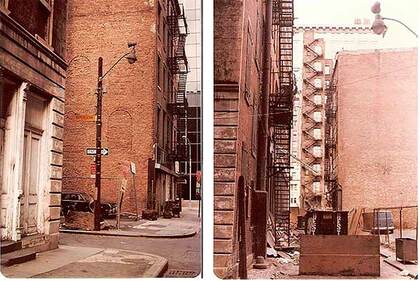
We see on the map a narrow alley west of Elk St. north of Reade St. labeled Manhattan Pl. It was later known as Republican Alley and was L-shaped, turning south to Reade. As far as I can determine, these are the only two photographs in existence, snapped by Bob Mulero in the early-1980s. The alley was de-mapped in 1990 for new construction; that didn’t happen for reasons mentioned below. And the alley still exists, as I’ll explain. As you can see by this time the alley was debris filled and more or less doomed.
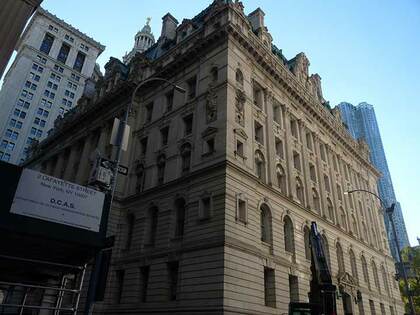
The “new” section of Elk St. between Chambers and Reade Sts. is dominated by a parking lot on its west side and the side entrance of the Surrogates’ Court. This is one of the most extravagant Beaux Arts buildings in NYC and one building I’d like to enter one day to see the fantastic interiors. It was constructed from 1899-1907 (Horgan and Slattery and John R. Thomas) and was originally the Hall of Records. The building’s frontage on Chambers St. features several historical figures associated with NYC, some household names, some not: David Pietersen de Vries, Caleb Heathcote, DeWitt Clinton, Abram S. Hewitt, Philip Hone, Peter Stuyvesant, Cadwallader D. Colden and James Duane. Surrogates’ courts hear cases involving the affairs of decedents, including the probate of wills, and the administration of estates and trust proceedings. The Elk St. side entrance has been used for outdoor shoots for a number of TV shows, including Law and Order. I’ve never been in its extravagant interior, but my Forgotten New York compatriot Sergey Kadinsky has. The building is now the New York City Hall of Records.
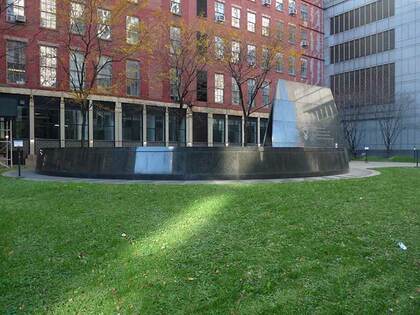
I’d mentioned that Republican Alley had survived. Its old pathway is now a walkway on the south end of the African Burial Grounds Memorial. In the 1990s, Manhattan gained its first new cemetery since the mid-1850s, although this one is hardly new, it’s just that its location was forgotten for centuries. Workmen excavating a construction site on Duane St. east of Broadway in the fall of 1991 found human remains interred in wooden boxes about 25 feet below street level. A search through property maps revealed that this area was a burial ground for enslaved African-Americans in the early-1700s.
The burial ground, when it originated, was just south of a body of water known as Little Collect Pond, a marshy area south of the much larger Collect Pond (a freshwater pond later made brackish by local industry; it was drained after 1816 by a canal that is now located in a sewer beneath Canal St.) Dwellings and businesses rose on the site, and over time the cemetery.
When the interred remains were discovered, the federal government was building what was going to be the US General Services Commission Building, and had every intention to go ahead with its construction. After public pressure led by Mayor David Dinkins was brought to bear, however, the Feds reversed course and, in 1993, declared a small patch of land at the corner of Elk and Duane Sts. a National Historic Landmark. The office building was modified to avoid the ground where the remains were discovered. More than 400 individual human remains were disinterred, along with artifacts also found there such as ceramics, animal bones and shells, and sent to Howard University in Washington, DC, for study. In October 2003, the remains were reinterred in the burial ground during a Rite of Ancestral Return ceremony. The site’s now The African Burial Ground National Monument.
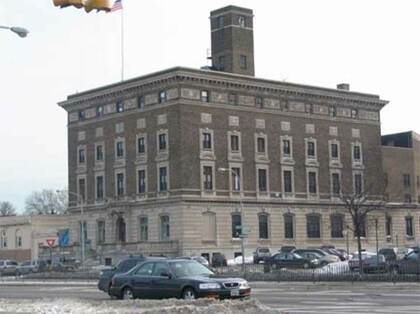
Speaking of Elks, Local 878, Queens Blvd. at Simonson St. in Elmhurst, Queens, was once the largest Elks Lodge on the East Coast with 60 rooms, bowling alleys, billiards, a “ladies’ lounge,” and a 50-foot bar, built during Prohibition in 1924. The Elks don’t own the old place anymore: it was sold to the New Life Fellowship, but the Elks remain as tenants. The Ballinger Company designed the granite, limestone and brick structure dominated by a now-verdigris-covered elk at the front entrance. For a couple of decades, Extreme Championship Wrestling (the old ECW, later folded into the WWE) bouts were held here featuring some of the legends of “sports entertainment” such as the Sandman and Mick Foley. The Elks Lodge is an official New York City Landmark.
—Kevin Walsh is the webmaster of the award-winning website Forgotten NY, and the author of the books Forgotten New York (HarperCollins, 2006) and also, with the Greater Astoria Historical Society, Forgotten Queens (Arcadia, 2013)