

Signs of spring when autumn is knocking on the door? In this case, the Spring is Spring St. in Soho, a key east-west route in this busy neighborhood in Manhattan. Spring, along with West, is one of the relatively few non-numbered Manhattan streets south of Central Park named for a geographical feature, not a person. Before Manhattan was built up beginning in the 1700s, it was forested and filled with natural ponds, creeks, rivulets and springs. In the 1800s, cartographer and urban planner Egbert Viele produced a map of Manhattan’s natural waterways overlaid on the current street grid. Most, if not all, have long ago been drained or diverted into the sewer system. Spring St. is named for one of these natural springs that was located in the position of the present W. Broadway.
Compared to locales like London, UK or Abu Dhabi, Saudi Arabia, New York City is staid, architecturally, but there are some modern gems to be found along Hudson River Park and the routes that border it, such as this Department of Sanitation salt shed at West and Spring Sts. It’s part of DSNY’s complex and by far is its most novel element. Designed by Dattner Architects with WXY Architecture + Urban Design and opened in 2016, it’s supposed to be reminiscent of a very large salt grain. It can store 5000 tons of salt, in a region that can have as much as six feet or snow or less than six inches over the course of a winter. An additional glass and steel complex was also built for New York’s Strongest on the other side of Spring St.
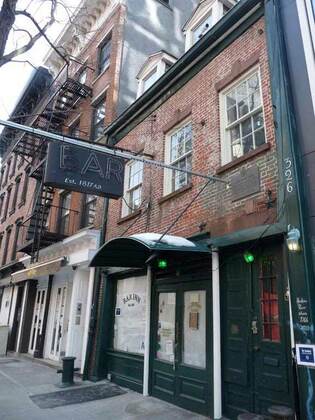
The Ear Inn’s located in a house built by tobacco trader James Brown, who, according to legend was the black man pictured in Emanuel Leutze’s picture of “Washington Crossing the Delaware”. By the 1850s the place was a brewery in which drinks were served to local stevedores and dock workers; it more or less filled that function for the next 150 years and counting.
In the 1890s Irish immigrant Thomas Cloke purchased 324 and 326 Spring Street and set up a liquor distributorship. Cloke and his brother Patrick bottled corn whisky in the basement and brewed beer in the back yard. He also set up a public house where food and drinks were served to passengers and crew of ships docking nearby on the Hudson River. Cloke’s sign hung above 326 Spring for nearly four decades.
When the 18th Amendment was passed, outlawing the sale of liquor in 1919, Cloke leased the business to a John Rolandi, who ostensibly ran the place as a restaurant, with a speakeasy in the back room behind a curtain. When the Holland Tunnel was built in the mid-1920s, 326 Spring did a handsome trade serving lunch, and beverages, to construction workers. They have an excellent hamburger. The neon sign dates to the 1940s; in the 1970s, owner Rip Hayman, rather than deal with the red tape required by the Landmarks Preservation Commission to alter the exterior, painted out half the “b” in “BAR” and presto, the Ear.
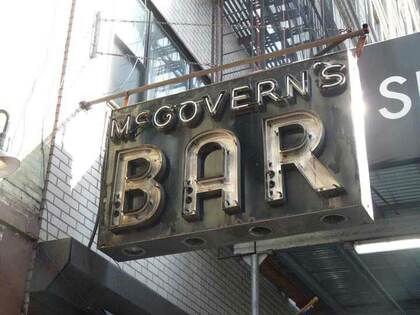
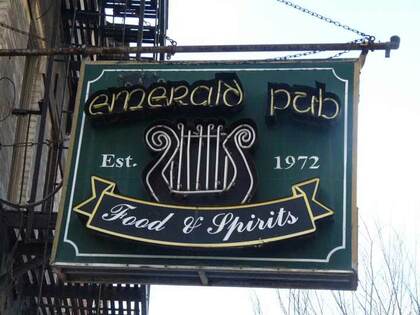
A pair of defunct bars face off across Spring St. at Renwick, and McGovern’s and the Emerald Inn still have non-functioning, but classic, neon signs. In 1985, the Emerald Inn served as the Terminal Bar (with the late great John Heard bartending) in Scorsese’s After Hours in which an office jockey played by Griffin Dunne has a night he’ll never forget in Soho.
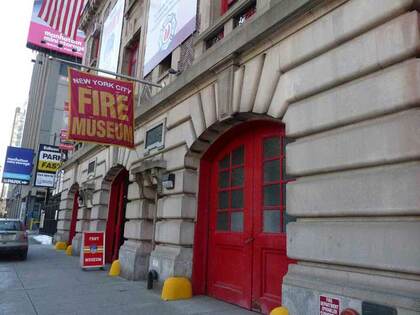
Just as the NYC Transit Museum is located in a disused subway station (the former Court St. shuttle station in Brooklyn) the NYC Fire Museum is located in a former firehouse, Engine 30, built in 1904. The museum’s roots go back to 1870, and it has occupied many locales before settling here in 1987.
According to the Museum, “Displays illustrate the evolution of firefighting from the bucket brigades of Peter Stuyvesant’s New Amsterdam through the colorful history of volunteer firefighters to modern firefighting techniques and equipment. The Museum houses a special memorial to the 343 members of the FDNY who made the Supreme Sacrifice on 9/11 and features a number of firefighting artifacts recovered from the World Trade Center site. A video room and a mock apartment with an artificial smoke machine and black-lighted fire hazards are used in the museum’s fire education program for school children ages K through 12.”
After a period of closure, trustees are attempting to get the NYC Fire Museum reopened as it is a vital resource.
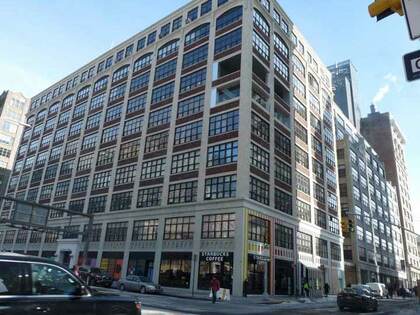
#150 Varick, at the NE corner of Spring, is one of many large loft buildings constructed along Varick from the 1920s through the 1940s. Here, half of Varick is taken up by Holland Tunnel approach lanes. The 10-story building has been home to warehousing, manufacturing, and recently, residences. For years it was home to Club Shelter, a music/dance venue purported to be the loudest in the city. This part of town was once known as the Printing District, but in recent years has been refashioned into Hudson Square, a media and communications hub.
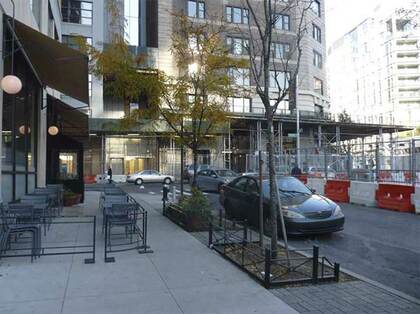
West of 6th Ave. between Broome and Spring (two blocks) there’s an unusual public plaza with a narrow street on its west side—also named 6th Ave. This is the former Clark St. When 6th Ave. was extended south in 1928 to accommodate the 8th Ave. IND, it went just barely to the east of Clark, which was retained in a physical sense, but its identity was stripped and it became an extra western lane of 6th Ave. for two blocks. The space between 6th Ave. and 6th Ave. (formerly Clark) is now occupied by an open space formerly called SoHo Square but now referred to as Spring Street Park.
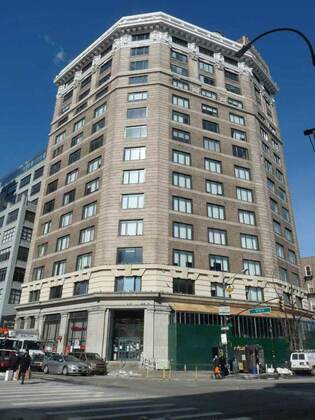
The Butterick Building at the NW corner of 6th Ave. and Spring was built in 1903, before 6th Ave. was built south; then, this was the NW corner of Spring and McDougal. Butterick is a sewing pattern company founded in 1863 by Ebenezer Butterick in an era when people sewed their own clothing according to patterns, which were to clothing as blueprints are to buildings. The 15-story tower was designed by Hogan & Slattery. The building was the HQ of Butterick’s publishing company; at one time Butterick’s fashion magazines, containing fashion tips as well as patterns, were some of the most-read periodicals in the USA. The company’s Delineator was a precursor of more recent magazines such as Woman’s Day. Butterick moved uptown to 2 Penn Plaza in 2001.
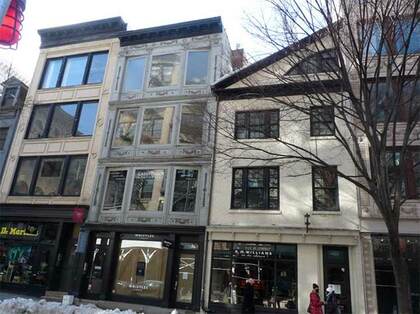
Half is better than none: #152 Spring, on the right, is a building constructed in 1819-1820 by a George Wragg, who also built the adjoining brick buildings seen above. Guidebooks, and the Landmarks designation report, call it a “building that has been cut in half” but the reliable Tom Miller, the Daytonian in Manhattan, demurs, saying the gable roof had another half that was shared by #154, which was the building on the right; #154 was razed in 1911 with the present four-story building taking its place. Like many older buildings in south Manhattan, it has a colorful history; it was once home to the sororal organization “Ancient Order of the Grand and Cordial Daughters of Ruth.”
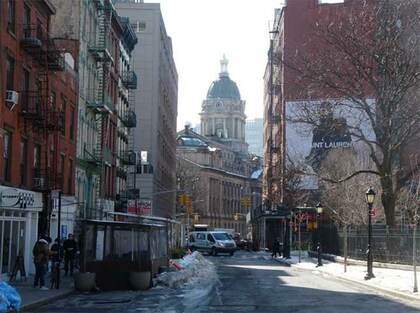
Looking south on Cleveland Pl. from Spring St.. It’s hard to fathom today, but NYPD Police HQ, constructed from 1905-1909, was empty for about a decade from 1973-1983 after the new NYPD HQ in the Foley Square area was built. The building with its distinctive dome, now a NYC Landmark, was converted to luxury housing in 1984.
While not all Beaux-Arts buildings were public buildings, Beaux-Arts structures embody the philosophy popular in the early-20th century that public buildings, and even public utilities, should be beautiful; and so they’re covered with ornamentation and some archaic elements that modern-day architects would find wasteful and hardly cost-effective.
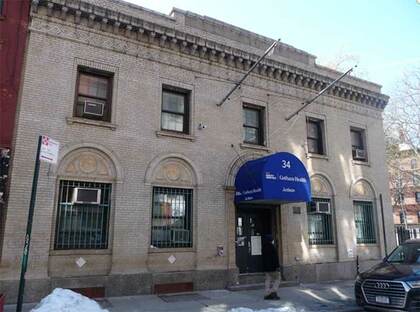
The Judson Health Center, providing care for neighborhood residents, is affiliated with Judson Memorial Church on Washington Square South. It was founded in 1921 and moved into this handsome brick building on #34 Spring, east of Mulberry, in 1950, and keeps its signage inconspicuous. The building was originally the New York Dispensary, built in 1912, a medical clinic that fulfilled the same purpose as the Northern Dispensary in Greenwich Village.
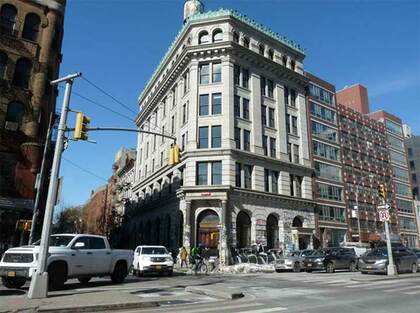
Spring St. lurches to a halt at the Bowery (or begins: its house numbering runs east to west) where high-rise condo buildings are now outpacing the walkup buildings that formerly hosted flophouses and cheap hostels. The Germania Bank Building, at Bowery and Spring, was constructed in 1896 and beginning in 1966, was the longtime home of photographer Jay Maisel and his family, who occupied the entire building’s 72 rooms. Maisel tolerated the graffitists and street artists who scrawled on the building’s exterior. Maisel had purchased the building for a little over $100,000 in 1966, and sold it in 2015 for $55 million.
—Kevin Walsh is the webmaster of the award-winning website Forgotten NY, and the author of the books Forgotten New York (HarperCollins, 2006) and also, with the Greater Astoria Historical Society, Forgotten Queens (Arcadia, 2013).