

Hanson Pl., which runs from the confluence of Flatbush and 4th Aves. to the confluence of Fulton St. and Greene Ave.—some of Brooklyn’s longest streets. Hanson Pl., though, runs only four blocks.
Hanson Pl. first turns up on maps before 1850, though its namesake, abolitionist Dr. Samuel Hanson Cox, born in 1793, lived until 1880. Cox was pastor of the First Presbyterian Church on Henry St. for 17 years and built a house, formerly at Fulton and S, Oxford Sts., that he named Rusurban (short for the Latin rus in urbe, or “country in city”). Though Hanson Pl. is among Brooklyn’s shorter through streets, it claimed Brooklyn’s tallest tower for decades, One Hanson Pl., the Williamsburg Bank Tower.
The 34-story, 512-foot tall tower, which can be seen from western Queens, southern Brooklyn, and eastern Manhattan as well as the Bronx (from the Whitestone Bridge) was built from 1927-1928 by architects Halsey, McCormack and Helmer. The firm’s Robert Helmer wrote at the time that he was seeking to build a “cathedral dedicated to the furtherance of thrift and prosperity.” It was constructed in a style architectural experts call Byzantine Romanesque, with Art Deco touches, and has one of the largest four-faced clocks in the USA. For most of its existence it was home to offices of the Williamsburg Savings Bank, but also a large collection of dentists and oral surgeons.
The vaulted marble banking hall on the ground floor with 63-foot vaulted ceilings, 40-foot windows and elaborate mosaics is a must-see experience for every NYer. The hall’s open to the public during the cold months when it’s occupied by the Brooklyn Flea, the upscale rummage sale with several locations around town. A couple of good images of the banking hall can be seen at Skylight NYC One Hanson, which developed the building’s apartments—it was largely converted to condominiums in the early-2000s.
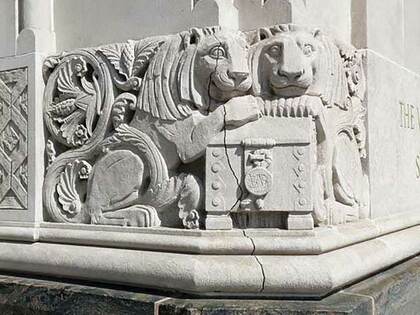
1928 was the tail end of the era when ostentatious ornamentation were added to architecture. Today these are considered pretentious and extraneous by many architects, especially since the streamlined International Style first started taking hold in the 1940s. A stroll past the Willie’s front entrance and especially the interior limestone banking room will reveal dozens of “Easter eggs” depicting symbols of saving such as beehives; squirrels who hoard nuts; Mercury the god of commerce; wise owls; lions guarding a lockbox; and even a burglar who’d be defeated by the 60-ton vault doors in the basement.
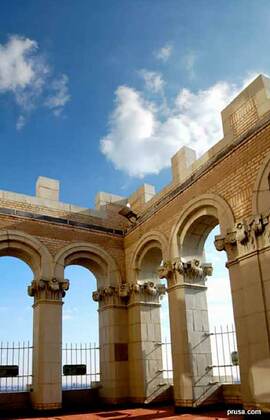
One of the Tower’s now little-known features is a pair of observation decks near the top of the building that offer unobstructed views for miles in every direction. The decks are now part of private penthouses, and have been closed to the public since 1977; maintenance costs have caused many skyscrapers to close their observation decks to the public long before the 9/11 terrorist massacre.
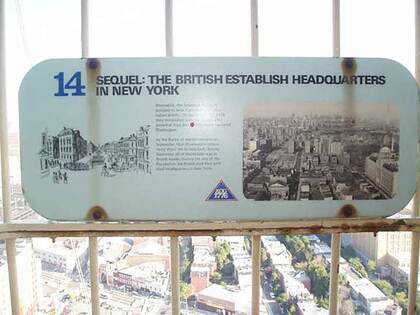
In 2005 my friend, urban explorer Moses Gates, author of Hidden Cities (now Vice President for Housing and Neighborhood Planning in the Regional Planning Association) who liked to ascend tall places most people aren’t admitted, got a series of pictures from the observation deck that show an exhibit placed there in 1976 to celebrate the American Bicentennial and the Battle of Brooklyn, which was fought near where the tower was built in 1776. In the 20 years since it’s a good bet that these have been removed.
It’s hard to get a decent shot of the Hanson Place Methodist Church, because the sidewalk in front of it is perpetually covered by a scaffold. Matt Green of the I’m Just Walkin’ website got the decent picture shown here by simply shooting above it.
For a long time I thought this was the Church of St. Felix, as it adjoins St. Felix St. It’s also the only church I’ve ever seen that leased space to a pizzeria on the ground floor. It quickly followed One Hanson, which it adjoins, in 1931 and can be seen as a companion piece, since the architects were the same. Francis Morrone, one of NYC’s foremost architectural observers, says it’s reminiscent of the Liverpool Cathedral in the UK, built in 1903. This is the third church to occupy the site.
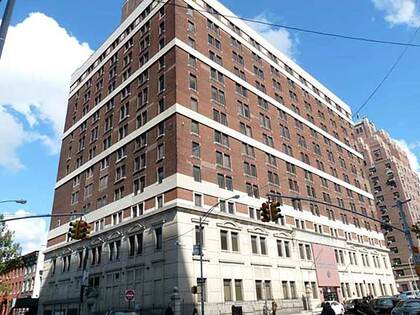
55 Hanson Pl., at Fort Greene Pl., home to a variety of state offices, is the Shirley Chisholm Building, named for the first Black woman elected to Congress, representing Brooklyn’s 12th District from 1969-1983. In the spring of 1972 she ran for president, becoming the first major party African-American presidential candidate, and first female Democratic candidate. Rep. Chisholm has a state park named after her, on a former landfill in East New York several miles east.
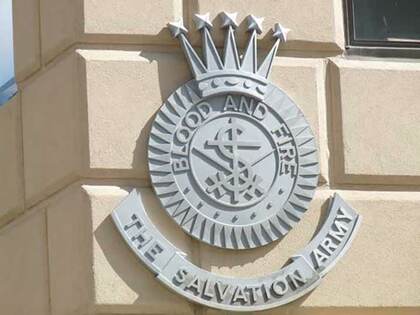
The southeast corner of Hanson and South Elliott is a bland building, but one of many Salvation Army centers around town. The Christian church known for its philanthropy and charity work was founded by a former Methodist minister, William Booth, and wife Catherine in 1865; Booth is remembered by Booth Memorial Avenue (formerly North Hempstead Turnpike) in Flushing and Fresh Meadows, Queens. The building displays the Army’s crest with the slogan “Blood and Fire.” The S and the cross signify “Salvation” and the cross of Christ; the swords, spiritual warfare; the rays, the fire of the Holy Spirit; the dots, the truth of the gospel; and the crown of God’s glory.
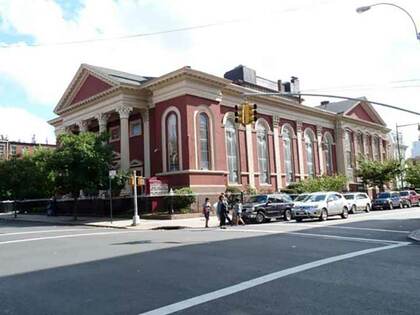
Moving on to S. Portland Ave., the Romanesque style, Corinthian columned Hanson Place 7th-Day Adventist Church is a NYC Landmarked building that was first built as the Hanson Place Baptist Church from 1857-1860. The Adventists, who worship on Saturdays and differ in other practices from other Christian churches (including virulent anti-Catholicism), were founded in 1860 by Ellen Gould White. An interesting sidelight is that health food enthusiast John Harvey Kellogg, whose brother William founded the cereal empire, was an Adventist and the faith’s teachings informed his early work.
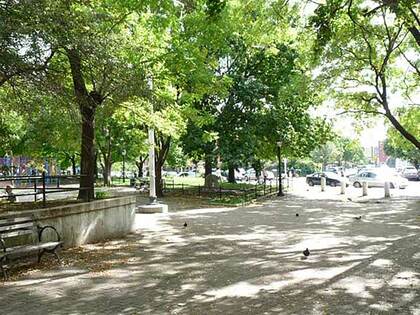
Hanson Pl. ends at Fulton St., where Greene Ave. begins. The green space at the Fulton-Greene-Carlton Ave. confluence is redundantly called “Cuyler Gore Park” when “Cuyler Gore” would’ve sufficed, as “gore” already means a triangular park. According to NYC Parks, the site was named for a prominent local minister, Dr. Theodore Ledyard Cuyler (1822-1909).
Kevin Walsh is the webmaster of the award-winning website Forgotten NY, and the author of the books Forgotten New York (HarperCollins, 2006) and also, with the Greater Astoria Historical Society, Forgotten Queens (Arcadia, 2013).