

On the outskirts of Chinatown, Cortlandt Alley north of Franklin, in what was once a freight elevator in a paper warehouse fronting on Broadway, is the city’s smallest and likely most unusual museum, called simply “Museum.” Much like Brooklyn’s City Reliquary, its mission is to display found objects and unusual collections, doing so in a welcoming, well-lit space. Exhibits have included mislabeled food containers collected by sous-chef Lulu Kalman, global toothpaste collection of industrial designer Tucker Viermeister, Polaroid photos discovered by artist Andy Spade, lost objects found on the bottom of the Pacific by deep-sea diver Mark Cunningham, and more. There are also two video screens playing works by filmmakers Richard Sandler and by the late NYC documentarian Joey Boots.
Other eclectic objects from around the globe have included Russian watches, matchboxes, paperweights, nameplates from the UN General Assembly, magazines, food labels, a cap worn by someone pretending to be a surgeon in a hospital and witnessing an operation, business cards, and an assortment of weird hammers and saws. Admission is by appointment.
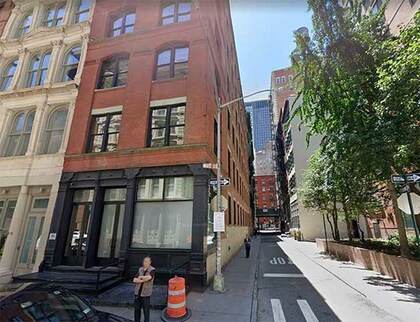
Its name was Mudd. #77 White, on the SE corner of Cortlandt Alley, was built in 1888 for real estate developer John Dodd. Its more recent claim to fame was the presence of rock venue The Mudd Club between 1978 and 1983. Georgia band the B-52s made their NYC debut here, and it’s memorialized in the lyrics of the Talking Heads classic “Life During Wartime” (and also by The Ramones, Nina Hagen, and Frank Zappa, the latter of whom viewed the NYC scene with bemusement). The club was named for Dr. Samuel Mudd, who treated John Wilkes Booth, who’s injured himself while escaping Ford’s Theatre in Washington, DC, where he had assassinated Abraham Lincoln. The long stick he used to set Booth’s broken leg bone came to be called “Mudd’s Club.” Longtime news anchor and interviewer Roger Mudd was a descendant of the doctor.
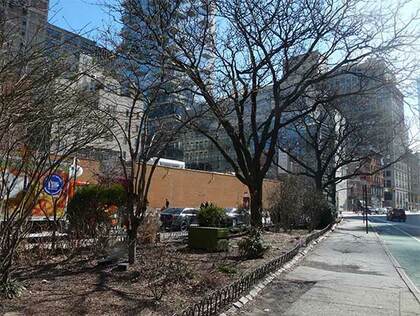
Finn Square honors two Finns. The first was a Tammany Hall politician, Daniel E. Finn (1845-1910), known as “Battery Dan” for his success as an assemblyman in the First District for helping block a plan to build piers along the west shore on Manhattan in Battery Park. The piers weren’t built and Battery Park remains an open space relief from the beetling towers of lower Manhattan. As a judge, Finn was known for protecting the public against Police Department excesses.
Although Finn Square was named for “Battery Dan,” officially it’s named for his son, Philip Schuyler Finn, a member of NY’s Fighting 69th Regiment, who perished in World War I. The square itself was created shortly after the war, when Varick St. was given a southern extension past Franklin St. to meet W. Broadway.
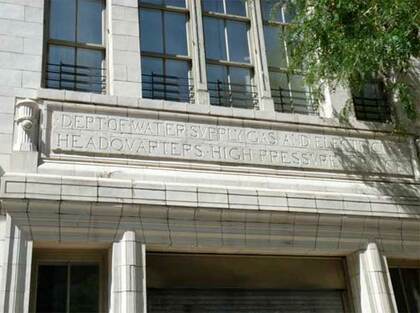
#226 W. Broadway, north of the square, is a notable 1912 building featuring a gleaming white terra cotta front. Formerly the FDNY High Pressure Service Headquarters, it was later transferred to the Dept. of Water Supply, Gas and Electricity. This sort of letter chiseling, rarely done today, must’ve been very difficult. Notice the little triangles between the words, done as just an added fillip or decoration. Early mosaic subway signage from 1908-1928 feature them as well.
According to the Landmarks Preservation Commission, #226 “was erected in 1912 for the Department of Water Supply, Gas, and Electricity as a headquarters for the repair company of the high pressure fire service system. It was designed by Augustus D. Shepard, Jr., an architect who spent much of his career working in the Adirondacks. The building, faced in cream-colored glazed terra cotta, has characteristics of an industrial workshop and an office building.
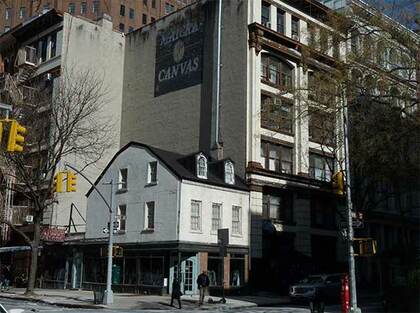
Number 2 White St., on the corner of W. Broadway. Because of the miracle of landmarks preservation, the designated #2 White St., at the northeast corner of W. Broadway, has survived since 1809. It was constructed that year for a Gideon Tucker, owner of the Tucker & Ludlam plaster factory. It’s one of the few Federal Style row houses remaining in lower Manhattan. A few others that were moved from their original location during construction of Independence Plaza can be seen on Harrison St. west of Greenwich. Its former life as a liquor store is still represented by a neon sign; not sure if it lights up at night.
Above it is a painted ad for Matera Canvas, which distributed boat covers, tarpaulins, tote bags, awnings, aprons at 5 Lispenard St., originated in 1907 and was still in business as late as 1990.
—Kevin Walsh is the webmaster of the award-winning website Forgotten NY, and the author of the books Forgotten New York (HarperCollins, 2006) and also, with the Greater Astoria Historical Society, Forgotten Queens (Arcadia, 2013)