
The internet makes it so easy to find out about the terrible things people do to others—e.g. road rage attacks. Only a relative few behave like this, but because of the destructive power of their violence and cruelty, they exert a disproportionate influence on society. The vast majority are good people who provide for their families and contribute to GoFundMe accounts, but an alarming number of them are afflicted with the scourge of pettiness.
Pettiness is a destructive trait that doesn't get enough attention, perhaps because some think it's normal behavior, or because so few are aware of how pettiness can erode the trust and empathy required for a healthy society.
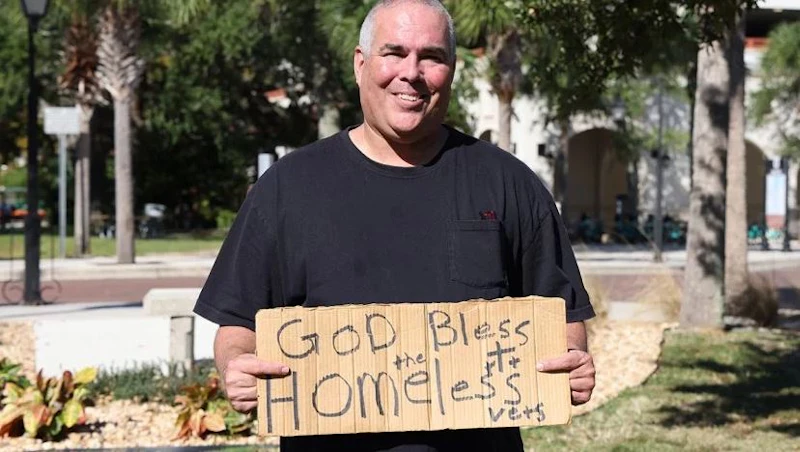
Jeff Gray, who runs the “HonorYourOath Civil Rights Investigations” YouTube channel (330k subscribers) could be called a “pettiness buster.” His tool is a handwritten cardboard sign that says, “God Bless the Homeless Vets,” and those empathetic words act to flush out the smallness. When he holds up his sign, in public places like the sidewalk in front of city hall or in front of the public library in the cities he travels to, and says, “Please pray for the homeless vets,” it sends people into a frenzy as if a major crime were underway. He's not even asking for money, although panhandling is a constitutionally protected right, under the First Amendment, that many local ordinances outlaw.
A confused worker inside invariably tells Gray he has to leave, and when he refuses they call 911, the “emergency” number. Almost without fail, they say a homeless man—Gray isn’t homeless—is panhandling and that harassing people, which he doesn't do.
Gray documents this misuse of the emergency line by accessing and publishing transcripts of these 911 calls. He's trying to get passersby to pray for the most downtrodden, neglected people in the nation, but those who consider themselves good citizens—and this includes church ministers—are too blinded by their small-mindedness to see this and just leave the guy alone.
Then the police arrive and often—but not always—waste their time on the petty activity of trying to make a harmless, law-abiding guy leave while displaying their ignorance of the law for the entertainment of thousands of YouTube viewers. What Gray knows, and these officious nitpickers lack the self-awareness to understand, is that pettiness is often ego in disguise. These enforcers are trying to protect a self-image so fragile that the trivial pose a threat to it. That self-image is one of being in control as a minor authority figure whose job title has bestowed that status upon them. These petty tyrants flatter themselves by pretending to be do-gooders.
The fact that Gray's involved in a constitutionally-protected activity in a nation that values individual rights more than any other nation doesn't even enter their minds.
Petty people are weak. Secure people aren’t petty because they don't need to always feel in control. They don't call the cops just because they're annoyed. Pettiness is the manifestation of insecurity with one's own power, however limited that power may be, as in the case of a beat cop, a head librarian, or small-business owner.
The beat cop gets petty in this situation because they're used to being tyrants and pushing people like Gray around, but when Gray flexes his power—i.e. knowledge of the law that they don't have—their insecurity flares. He often makes them pay for their character flaw by getting them to slink away on camera. If they persist and take illegal action against him, he takes them to court. His lawsuits have gotten cops suspended, overturned unconstitutional local ordinances, forced police departments to run training programs, and prompted apologies from city officials.
Pettiness is also associated with snobbery. The snob, who’s protecting an ego that’s wrapped up in signs of status such as education, neighborhood, clothing, or taste in one of the arts, polices those markers with vigor. The snob and the minor authority figure calling 911 on Jeff Gray are fighting for a pecking order that flatters them. One does it with derision and dismissiveness, the other does it with an unnecessary assertion of power that often backfires. “Starring” in one of Gray’s videos is something that nobody wants.
Donald Trump isn't helping the situation. He's as petty as a man can get. Other petty people living in HOAs, which are major hotbeds of pettiness, call the hotline when their neighbor’s grass is an inch over regulation without bothering to ask if there are extenuating circumstances. When people see their neighbors policing them, community trust gets eroded. Workers rat out their colleagues for minor offenses, creating an organizational culture in which productivity is compromised. Public services, such as local police forces and municipal courts, are designed to protect citizens and maintain order, but petty, self-centered individuals exploit these systems to settle trivial scores.
Literature offers warnings. In Charles Dickens' novel, David Copperfield, Uriah Heep is a petty villain fixated on small-minded malice. In Ken Kesey’s One Flew Over the Cuckoo’ Nest, Nurse Ratched uses bureaucratic fine print to crush any inmate threatening her authority. Dostoevsky’s Notes From The Underground is an exploration of pettiness.
No number of warnings from brilliant authors will do much of anything about pettiness in the world. It's a flaw that lies somewhere in the human DNA as a malignant force working against the maximization of joy and progress.