
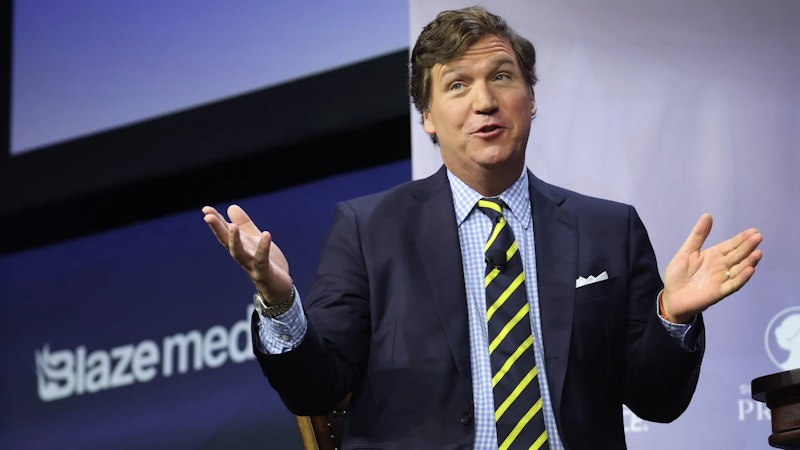
If this were 2016, the plan might’ve worked. Back when Tucker Carlson was still on Fox, still operating inside a corporate newsroom, exposed to advertiser pressure and executive panic, a coordinated effort to sideline him could’ve done damage. Within a carefully managed media ecosystem, controversy was a liability. Enough complaints, enough pressure behind the scenes, and a host could be disciplined, diluted, or swiftly removed. Those days are gone, but try telling that to Jonathan Greenblatt.
Speaking recently in Los Angeles, the Anti-Defamation League’s chief executive revealed that he’s working with figures such as Sen. Ted Cruz to combat what he describes as antisemitism on the right. Greenblatt’s remarks reveal far more about institutional anxiety than any imminent extremist threat. His proposal is straightforward: antisemitism on the right, he argues, must be defeated from within the right itself. The method involves “good people” like Cruz, Ben Shapiro, and Mark Levin quietly nudging platforms to crack down on figures deemed revolting. The targets include Carlson, Nick Fuentes, and Candace Owens. The approach is familiar. Control the channels of communication. Restore order.
But it’s 2026. And the people now circling Carlson, are hunting something that no longer exists in the old terrain. The gatekeepers no longer matter. Carlson isn’t a cable host clinging to a studio lease. He’s not dependent on advertisers who panic at coordinated outrage. He doesn’t need access to institutional approval or political favor. He operates in the open, funded directly by an audience that understands precisely who he is and why he speaks the way he does. That audience isn’t confused. It’s not waiting to be rescued by responsible conservatives in Washington.
It’s there because no one else talks like this. This is the central failure of Greenblatt’s strategy. It assumes a media environment that no longer exists, one in which reputational pressure still works and access can be rapidly revoked. Today, independent reporters answer to one authority only: their audience. Not donors, senators, or advocacy groups holding discreet meetings and sending carefully-worded requests to platforms that already fear their own shadows.
The effort is almost touching in its sincerity.
Ted Cruz, cast here as a moral counterweight, is an especially rich choice. This is the same Cruz who stood silently while Donald Trump publicly mocked his wife, then campaigned enthusiastically for the man who did it. A man who taught an entire generation of voters that principle is flexible, dignity optional, and spine a luxury item. If Cruz is now the standard-bearer for seriousness on the right, the cupboard is bare.
Cruz has mastered a particular art form. He speaks in complete sentences. He references the Constitution. He loves God. He sounds like a man auditioning for relevance rather than exercising it. His power lies not in persuasion but in proximity. He’s always near the action, rarely shaping it, and perpetually available for the next panel, the next letter, the next symbolic gesture. The idea that he’ll lead a cultural correction is funny in an absurd way.
Carlson thrives precisely because he’s treated as untouchable by institutions that no longer inspire trust. Every attempt to sideline him confirms his message. Every backroom effort reinforces the sense that speech is managed, not debated. The more coordinated the push becomes, the more organic his appeal appears. He doesn’t need to be right about everything. He only needs to be visibly opposed by the right people.
What Greenblatt and his allies misunderstand is that this audience isn’t seeking validation from legacy organizations whose authority has been spent on causes that aged badly. It’s seeking friction and conflict. Voices willing to say aloud what polite society insists must remain unsaid. You don’t defeat that appetite with calls to platforms or carefully-curated lists of acceptable conservatives.
There’s also a category error at work. Lumping Carlson together with overt extremists might feel satisfying, but it convinces no one who listens to him. It signals not vigilance but laziness. It replaces argument with labeling, which is the behavior that pushed millions of people away from institutional media in the first place.
Part of Carlson’s appeal rests on chaos. But it rests just as firmly on consistency. He says what he thinks. He says it again. He doesn’t retreat when attacked. His audience doesn’t admire him because he’s safe. They admire him because he’s costly. Costly to defend. Costly to align with. That cost is the point.
The attempt to neutralize Carlson using figures like Cruz only sharpens the contrast. One man speaks freely and pays the price in real time. The other calculates carefully, ducks instinctively, and survives every political weather system like a career cockroach. Audiences notice the difference.
This isn’t a defense of everything Carlson says. It’s an explanation of why this strategy will fail. You can’t dismantle a decentralized media figure using centralized pressure. You can’t restore credibility by borrowing it from politicians who burned through theirs years ago. And you can’t persuade an audience that prides itself on independence by telling it who the responsible voices are.

