
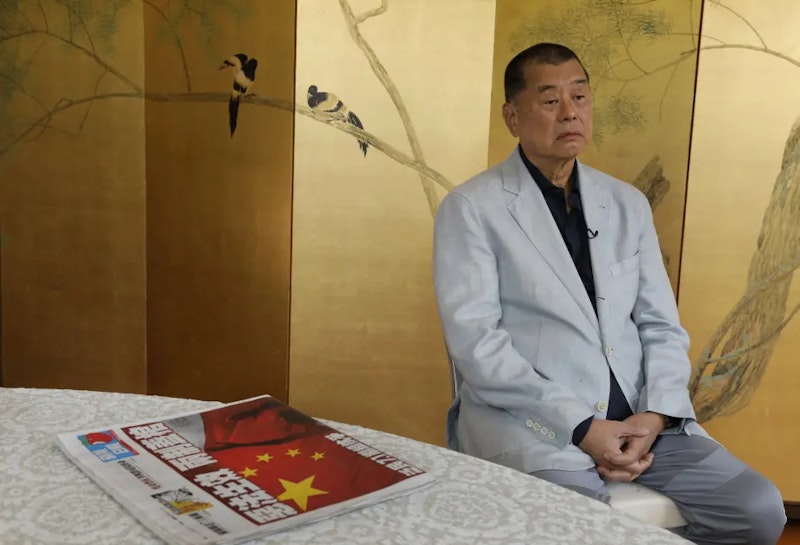
The Hong Kong pipedream—“one country, two systems”—China’s Communist Party invented as a PR move is going up in smoke. On February 9, China sentenced the 78-year-old former media tycoon, Jimmy Lai, to 20 years in prison, meaning the free press, long under siege in Hong Kong, is gone as an independent force inside the city. Before the 2020 National Security Law (NSL), Hong Kong still operated under a legal system that provided protections for journalists, but no longer. Now, vaguely defined crimes such as “collusion with foreign forces” and “sedition” give authorities wide latitude to prosecute speech. In Lai's case, the charges referred to him urging foreign governments to impose sanctions on Hong Kong and Chinese officials after the 2019 protests, and using his newspaper, Apple Daily, to call for international pressure on Beijing.
Lai’s sentencing has outsized symbolic weight. He’s not just a publisher; he’s a high-profile Catholic businessman, a longtime Beijing critic, and an international figure. His imprisonment communicates that political dissent framed through media will be treated as a national security issue, and international scrutiny won’t deter enforcement.
Lai’s sentence—probably death—is close to an obituary for the Hong Kong press model that existed through the mid-2010s. When the United Kingdom handed over the city long known as one of the purest modern examples of a laissez-faire capitalism to the People's Republic of China in 1997, Beijing pushed the “one country, two systems” narrative to facilitate the handover and reassure international investors of Hong Kong’s ongoing stability. Plenty of outsiders, including former U.K. Prime Minister Margaret Thatcher—who negotiated the handover terms—bought into that cynical promise even after the vicious 1989 Tiananmen Square crackdown had broadcast to the world how the Chinese Communist Party (CCP) dealt with dissent. Hongkongers, long aware of communist power next door, weren’t so naive.
The billionaire founded the clothing brand Giordano and, in 1995, launched the pro-democracy newspaper Apple Daily. The paper became an independent and popular tabloid, known for its mix of sensational reporting, celebrity coverage, and criticism of both the Hong Kong and Beijing governments. It fused profitable populism with political crusade: critics dismissed it as sensationalist, admirers saw it as fearless. Both were right.
Apple Daily operated in a Hong Kong that, under the “one country, two systems” framework, still retained an independent judiciary, civil liberties, and press freedom unknown on the mainland. That environment created a space for dissent that Lai moved into with gusto. Exposing state abuse was one of his life’s missions. He fled mainland China in 1961 at 12 as a stowaway during the turmoil of Mao Zedong’s rule, an experience that shaped his lifelong hostility to Chinese Communist authoritarianism.
Hong Kong’s long had a unique, rough-and-tumble press culture that was loud, competitive, and commercial. With freedoms that were intertwined with its capitalism, its media barons have operated far from the model of high-minded publications like The New York Times.
Rupert Murdoch, who bought Hong Kong’s “newspaper of record,” the South China Morning Post in 1987, is a close comparison, with his focus on scandal, celebrity, and confrontation. Apple Daily embraced that regular tabloid fare as well, with a dash of political crusade.
That synthesis is what made Lai uniquely Hong Kong. Unlike literary dissidents such as Václav Havel, Lai was a street fighter—but a rich one with the means and the machinery to expose state abuse. Havel succeeded because the Communist Soviet bloc system he opposed was collapsing. Jimmy Lai failed because the Communist system he opposed is adapting and consolidating. Hong Kong, in 2019–2020, experienced massive protests. Sometimes crowds surged to over a million, but after months of protests, Beijing imposed the National Security Law in 2020, criminalizing broad categories of dissent. Authorities used surveillance, arrests, and online censorship to reduce coordination. Lai was first arrested under the NSL in 2020, and detained in custody since late-December 2020 while his cases proceeded through the courts.
Lai’s sentencing puts to rest the already tenuous hope that Hong Kong remains meaningfully distinct from mainland China. The problem that the popular Apple Daily caused for the publisher (and Beijing) was that it was unapologetically rooted in the belief that Hongkongers had a right to speak freely about their own government. Such moral clarity is anathema to authoritarian systems. Public resistance lowers inhibitions for speaking out while carrying the additional risk of triggering a cascade of copycat dissent such as the demonstrations that expanded exponentially and brought about the fall of the East German government in 1989.
Jimmy Lai is a hero along the lines of Alexei Navalny, the Russian dissident who died in prison in 2024 under circumstances widely blamed on the Kremlin. Lai and Navalny knew the personal risks associated with standing up to dictators and refused exile when they had opportunities.
A gambler, Lai rolled the dice and lost in wagering that Hong Kong’s semi-autonomy and global visibility would protect him—that being a billionaire publisher with international connections made him untouchable. What his sentence makes plain is that Beijing no longer feels the need to preserve even the appearance of the old bargain. Stability and control now trump optics and investor reassurance. Lai’s imprisonment marks the end of an era in which Hong Kong could plausibly claim exceptionalism within China.
Western nations can be naive about planting seeds of democracy and expecting to watch them grow in soil that the ruling elite, knowing full well that liberalization comes with loss of control, won't let happen. Hong Kong was supposed to be the bridge case—the proof of the concept “engagement theory,” pushed so hard by Bill Clinton and Tony Blair that capitalism would make China look more Western. Instead, the CCP used the wealth generated by market reforms to strengthen party control. The Chinese government is doing this to Jimmy Lai, an old man, to send one clear message: China is one country, one system, enforced without apology.