
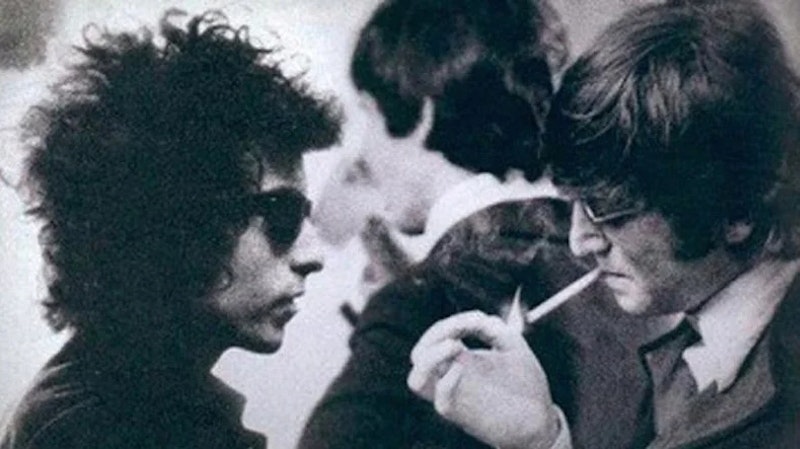
"Rock 'n roll is here to stay; it will never die," sang Danny and the Juniors in 1958. By the time Neil Young recapitulated the declaration some 20 years later on "Hey Hey, My My" he and the form sounded exhausted. Young may have blamed Johnny Rotten. But Johnny, in his addled way, was trying to steer a sinking ship back to harbor. I don't blame Young, per se, for the death of rock, though he had his role. I blame the Beatles and Bob Dylan.
Rock has died many times. The 1970s, on the pop charts, take you all the way from Led Zeppelin to Fleetwood Mac, all the way from James Brown to the Bee Gees. (Or indeed, listen to the Fleetwood Mac catalogue to hear crunching electric blues become smooth-as-silk, perfectly produced pop music.) I think the real last gasp was the early-2000s, when excellent rock bands like the White Stripes, the Strokes, and the Black Keys sold a lot of compact discs as they bashed their guitars through bluesy riffs. Since then, it's all auto-tuned cyborgs pretending that they have emotions.
So you might blame Fleetwood Mac or will.i.am's chrome toupee for the Rock Apocalypse. But I blame Dylan and the Beatles. Rock music, to define it historically, is a flowing-together of black and white popular forms that emerged in the South: blues, R&B, rockabilly, country. It's strongly based in the 12-bar form and chord progressions of the blues, which likewise underpin these other forms. It’s rough-hewn, immediate, urgent, direct: a context for dancing and experiencing and expressing love, sex, rage, joy, pain, and pleasure. Its power is its simplicity, its sincerity.
It’s art, but of a completely different kind than the symphonies of Bruckner, the paintings of Picasso or the poetry of Dylan Thomas. And initially, it had a completely different audience: teenagers and working-class people, black and white, who consumed it on the radio, in the jukebox in the diner or bar, or at the hop. The moment of breakthrough was the moment of Elvis, in whom all those Southern forms flowed together straight out of the Mississippi Delta to Memphis in a crystallization that every young person of every race could understand. The form is summarized by tracks by Chuck Berry, Bo Diddley, Little Richard: cranking blues with a big beat, accessible and unpretentious. A true form of popular art.
By the time the British Invasion arrived around 1964 to revivify the form, which had largely lost its initial momentum, the bands were issuing tributes to the American originators. The Beatles and the Stones covered and emulating Chuck Berry and Little Richard, re-interpreting American R&B. Soon they were writing catchy songs in the same vein. The early Beatles delivered some of the most delightful and propulsive versions of early rock, and even then they were revivalists of a certain kind, like the White Stripes 40 years later.
But unlike the Stones, the Beatles mutated through the 1960s. Greeted not as an excellent pop band but some sort of gods and emblems for the emerging "counter-culture," as somehow representing the very essence of an era and a generation, they moved away from rock 'n’ roll quickly. By 1967, their music was influenced more by British dance halls of the 1940s and poppish classical music than Little Richard. It wound up, in my opinion, childish or pretentious twaddle.
By the time you get to Sgt. Pepper's Lonely Hearts Club Band, they’re messing about with sitars, classical-style string sections and lyrics (as illustrated by the title cut) about nothing in particular (in particular, not about love, sex, partying, dancing and the like). Maybe "Being for the Benefit of Mr. Kite" isn’t art, or maybe it's bad art.
They were greeted like prophets, messiahs. This was bad for them, personally and artistically. Also, the assessment was arbitrary and indefensible. They’d been a fun rock band. They ended up as the most mediocre surrealists the art world ever produced. 1960s kids greeted the later Beatles ecstatically, as a kind of vindication of their generation, which they took to be producing artists as great as those of earlier eras, as great as Mahler or James Joyce. But it was the so-called Bob Dylan who fully embodied the first great death-of-rock moment, and who got the really ecstatic aesthetic response, or the full "here is the poet of our epoch" treatment: our own Shakespeare. Here was an artist of our generation that our parents should really take as seriously as they took Shostakovich and T.S. Eliot. Combined.
It's hard to know where to start peeling back the problems: the internal problems with the quality of the music, and the external problems with what it all supposedly meant as it blew in the wind. The idea that popular music or rock 'n’ roll could be art like the great high modernist super-geniuses hit older boomers hard, as a vindication of their culture and their selves. That's why when Greil Marcus or Sean Wilentz saw how people were greeting Dylan, they felt the whole world had been transformed.
The works of Bob Dylan are absurdly inadequate when evaluated in this style, and that this is entirely the wrong way to think about or evaluate rock music. (I do sort of plan to demonstrate this more fully than I already have, in the fullness of time. I'll write some refutations by quotation here at Splice Today.) Rock music isn’t an avant-garde art of high modern geniuses, the first of whom, Ludwig Beethoven, was explicitly pictured by Chuck Berry and the early-Beatles as rolling over in his grave. But Marcus and a million other white boys wanted Dylan to be Beethoven. It would’ve been a lot better for him to have been a decent blues singer, writer and harmonica player, which he was not.
The white kids who melted before Dylan wanted their music recognized as avant-garde genius art of the pre-postmodern variety: art that remade the world by a few super-genius gestures. Ever since, they've produced absurd and merely-wishful evaluations of his work. But the attempt to read Bob Dylan as Dylan Thomas was the end of rock ‘n’ roll, as it mutated from a delightful, democratic popular art to a pseudo-art music unable to pay off on its pretensions.
Rock kept on going too, despite the insane reception of Dylan and the Beatles, which I regard as a mass or collective delusion. Creedence Clearwater Revival, for example, made wonderful propulsive rock through the whole decade. The Stones kept right on going, pretty true to their blues roots even as they expanded the pallet. Early-metal like Zep and even Black Sabbath might’ve had certain pretensions, but it also had a fundamental connection to fundamentals. Punk music was a direct response to disco and Fleetwood-Mac pop, and a beautiful return to fundamentals.
But rock also ran off the rails in pursuit of "art" or to try to garner their artists the kind of reception obtained by Dylan and the Beatles. Pretty soon there was art rock, concept albums, sprawling rock operas. When I think of the opposite of rock music, I think of Tarkus, by Emerson, Lake, and Palmer. It's neither rock music nor art music, neither traditional nor avant-garde, just a kind of extremely ambitious mistake. In a way you might admire it on that basis, as long as you don't have to listen to it. But it never happens without the Beatles and the destruction of rock music they performed.
Also, ELP's work was extremely bourgeois, extremely white, and extremely mediocre art: like Dylan's lyrics, or the later Beatles. Anyway, I'd like to begin to write the history of rock 'n’ roll rather differently: not as an amazing new avant-garde form, but an urgent popular art boiling up from below.
—Follow Crispin Sartwell on X: @CrispinSartwell

