
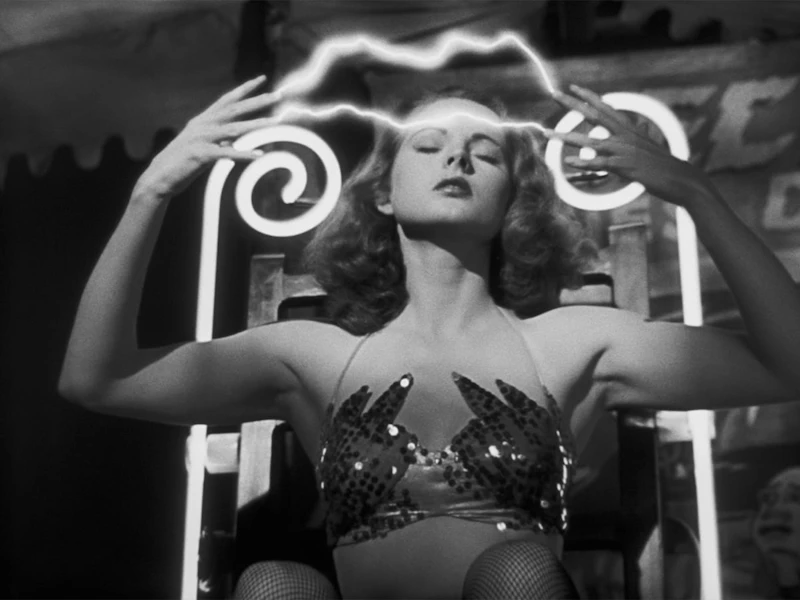
Edmund Goulding’s Nightmare Alley (1947) was a relatively high-budget noir with some A-list actors—most notably Tyrone Power, a romantic heartthrob lead who developed the film specifically so he could stretch himself. The classy trappings are somewhat at odds with the narrative’s seething undercurrent of doom and debasement; as a result the 2021 Guillermo del Toro remake is a more fully-realized adaptation of the William Lindsay Gresham’s bleak novel. Still, the original film retains a queasy kick, not least in its oscillating uncertainty about whether to love or despise its smooth, beautiful leading man for his smoothness, his beauty, and his ambition.
Stanton “Stan” Carlisle (Power) is a carnival barker with dreams of scoring big. He thinks his ticket might be the mentalist act that took Zeena (Joan Blondell) and Pete (Ian Keith) to stardom once upon a time before Pete’s alcoholism overtook him. Zeena won’t share the acts secrets with Stan, though—until he accidentally gives Pete bad alcohol, killing him. With no choice, Zeena brings Stan into the act, and soon he and electric girl Molly (Colleen Gray) are married and a hit in Chicago. Stan wants more though; he starts working with psychoanalyst and dish Lilith (Helen Walker) to fleece her clients using information they’ve confessed in sessions. The sky’s the limit… until the mud is.
The film plays up Power’s movie-star looks; in the first scene in the carnival, women in the background are giggling and pointing to him, letting us know that we too are supposed to gape at him. He seduces nearly everyone he comes across, from Zeena to Molly to Lillith to the local lawman to the film viewer.
Hollywood films of the era typically (per Laura Mulvey) urge you to identify with the male lead, but in Nightmare Alley, Stan’s less action hero than object of desire. The film takes every opportunity to zoom in so you can see his cleft chin, or to watch with his audience as he stands in his trim immaculate suits, giving you a smooth line of patter and pulling rabbits out of hats, or, more accurately, money out of purses. He’s raffish Tom Cruise or Brad Pitt, always with a scheme and an angle and that perfect smile. He’s even got a tragic orphan backstory. Of course you’ve got to root for him.
The film’s more than half in with Stan and wants you to be more than half in love with him as well. But it’s also committed to Teaching Him a Lesson, with capital letters. The mentalist act—fooling rubes who want to be fooled—is one thing. But the spirits get riled when Stan starts to encroach on the domain of the other world. Pretending to talk to the dead and provide spiritual counseling is crossing a line—as is cheating on his wife with the psychoanalyst. As her name suggests, Lilith can’t be trusted; she games Stan just as he games his own clients. The film frames Stan’s quick descent as divine retribution; in the name of God it crushes him for speaking in the name of God.
Scuzzier noirs of the period, like Born To Kill and The Postman Always Rings Twice, are clear on their mission of funneling the bad people to a bad death. Nightmare Alley is less certain, both about how bad it wants Stan to be and about how badly he should suffer for it. You’re never sure, for example, how much he loves Molly and how much he’s shamelessly stringing her along. You’re never told whether he cheats on her with Lilith either—it’s strongly implied, but the one time you see her proposition him, he turns her down for logistical rather than moral reasons. The movie’s careful to let you know that Pete’s death was an accident, and careful not to let you know whether a client that Stan knocks down when his plans to go awry is dead or just merely unconscious.
Similarly, Stan’s ultimate fate pulls its punches. On the run from the law, he spirals into alcoholism, and ends up back at a carnival, only able to get work as a geek—the lowest of low performers, who bites live chickens in exchange for a bottle of booze a day. Sam ruefully says he was “born for” geekdom. But he’s only on the job less than a day when Molly finds and rescues him. The love of a good woman doesn’t save him, but it seems like it may at least keep him from the absolute bottom.
The 2021 film version is a lot less wishy-washy and a whole lot more vindictive in its sadism and its masochism. Studio interference, and the Code, is all over the 1947 version. For that very reason, though, the parallels between Hollywood and the carnival feel clearer. The mentalist tells you what you want to hear, and so does Hollywood. Stan doesn’t kill anyone; he doesn’t cheat on his wife; things sort of work out for him. The alley doesn’t really lead to nightmare—unless maybe the real nightmare is that we want to believe the lies that liars tell us, whether those liars be Stan or Hollywood or that most grotesque carny geek, Donald Trump.