
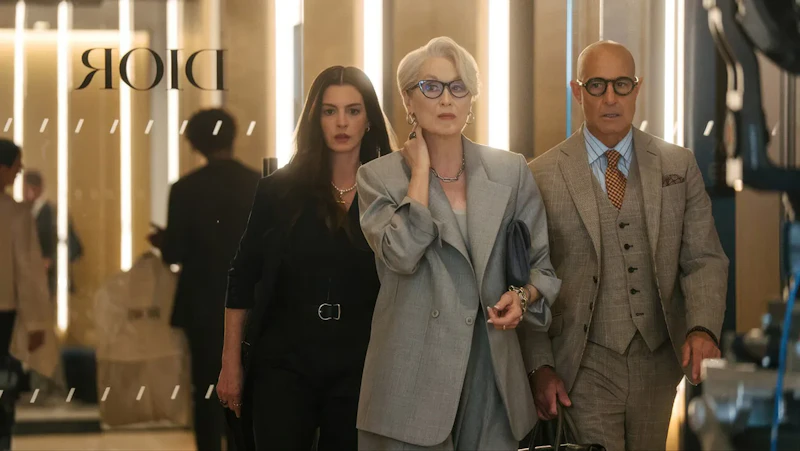
The sequel to The Devil Wears Prada’s making the same kind of money as its beloved predecessor. I believe that’s due to nostalgia, not real performance. The new movie suffers from a terrible case of the reheats. It’s such a flat-footed sequel, so determined to be flimsy, that a decent set-up turns to crud. Same director as the first time (David Frankel), same screenwriter (Aline Brosh McKenna), same cinematographer, composer, and production designer, but it doesn’t matter. The lady sitting next to me looked at her watch three times and she was right.
The set-up is this. Meryl Streep’s Miranda Priestly is now a lion in winter. She’s still editor of Runway (meaning Vogue), but being editor of Runway isn’t what it used to be. Magazines are sinking and coats no longer get flung at subordinates (“We heard from HR”). Then comes Miranda’s big misstep: Runway falls for a company’s whitewashing of factory conditions, gets shown up on the Internet, and suffers an avalanche of abuse. Meanwhile, Anne Hathaway’s Andy Sachs is enjoying the career she always wanted. She’s a hard-news reporter, a serious journalist—an award-winning serious journalist, since the film opens with her accepting an award. But at the awards ceremony Andy and her table of coworkers are laid off by text. Andy goes viral for her enraged response (“Journalism still fucking matters”) even as social media’s ripping Miranda up and down. Runway’s owner has the idea of plugging Miranda’s credibility with Andy’s notoriety, so now she’s features editor and the two have to work together.
A better movie would’ve asked why Miranda committed her screw-up and how she feels about it. Miranda has always terrorized her staff by implying they’re incompetent, and now here she’s the one who’s incompetent and it’s happened when she’s very old. Quite a moment, one would think. But once the plot’s been shoved into place, the film never mentions her blunder again. I think this dooms the film. Like so many sequels, Devil 2 brings together old properties to duplicate the fun provided by the original. The first movie was shoddy enough, in that the story’s emotional stakes and plot stakes didn’t match. The first movie’s point, the show we were there to watch, was Miranda’s supreme nastiness. The nastiness set up a story for Andy, who had to discover her inner steel and weather Miranda’s nastiness to keep her job. But the movie’s climax, the third-act suspense bit, was all about Miranda’s job security. Would the magazine’s owner kick out Miranda and put in someone new? Andy was frantic about this question; she ran down Paris streets in her high heels so she could warn Miranda. She wanted very much for the office bully to stay on the job; the rest of us had to go along.
Really the old movie’s third act was filler. The main story concerned Andy’s catching on to the game as played at Runway and learning to outdo the other girls. Andy prevailed at this, a third-act flurry intervened, and then Andy quit Runway because her values reasserted themselves. The flurry had to set up the quitting and it did so in solid fashion, so Andy’s bogus agitation could be shrugged at. Now here’s the new movie and it’s all flurry and all shrug. Andy’s the same at the film’s start and finish, and so is Miranda. In between old bits get repeated in dinkier form. Nigel (Stanely Tucci) has a brief pep-up speech echoing his big pep-up speech in 1. Andy found an advance copy of Harry Potter in the old film, here she has a generic substitute: landing an interview with somebody made-up who’s supposed to be a big deal (“Sasha Barnes? I love Sasha Barnes!”). Miranda froze your urine last time and she does it this time. But last time she could do it with a sigh (“Why is no one rea-dy?”), this time we get standard-issue bitch elegance (“May my suicide be brief and painless”). At the same time no one’s supposed to remember that in the first film Miranda shafted Nigel—that’s gone. Instead a subplot’s whipped up where Nigel wants some of the limelight so Miranda lets him read a speech.
With nothing to play, the cast falls back on tricks. Streep does her fluty twists and turns, Hathaway pushes her rampaging smile. Her Andy starts to seem dumb. She grins and burbles at chilly Miranda and sneering Emily (Emily Blunt) because the film wants the stars together. A straight line’s the shortest route, so Andy just loves the other two and shows it by smiling like a goon. Blunt at least doesn’t get wrongfooted by the script, but only one performance here’s a genuine pleasure. Justin Theroux plays her character’s new boyfriend, a billionaire who’s a chortling, giggling, overgrown child. Not dogmatic and touchy like Elon Musk, not prone to staging scenes or barking at people, he’s dreadful because he assumes he’s the center of attention. Everybody’s stuck with him bouncing in his seat and yelping out his opinions because he thinks he’s as interesting as his money.
The film’s ending has the Theroux character trying to buy Runway and losing out to the beloved Sasha Barnes (Lucy Liu). Sasha’s a billionaire but she’s a good billionaire, and we know this because she’s a mellow-mannered Asian woman with awesome cheekbones and honest, unashamed crow’s-feet. During the film we’re shown everyone being a plaything of capitalist forces. Layoffs by texts, an economy drive from nowhere, a job offer from nowhere, a sudden acquisition offer—these things hurl the story in one direction or another and the characters get hurled along with it. When the movie’s love interest meets Andy, the point gets underlined. He says he takes old buildings and revamps them to suit the rich, “and that’s what they’re doing to your magazine.” Then the movie pins its happy ending to a good billionaire. Devil 2’s a souvenir shop for moments from the first movie, but at the same time you’re not supposed to have a memory. Schlock wins.