

Newtown in Queens was founded in the mid-1600s after its colonists fled from Native-American attacks further west in Maspeth—and building a “new town,” mocks NYC’s preservationists, who seemingly prefer to recognize only buildings and artifacts in Manhattan and prefer to lavish designations and titles on buildings in that borough while ignoring treasures in what are considered the outer boroughs. In Queens, along with Jamaica and Flushing, Newtown (renamed ‘Elmhurst’ by developer Cord Meyer in the 1890s) retains several edifices and locales that existed in the first decades after its founding.
St. James Church, Broadway and 51st Ave, is the oldest building in Elmhurst and among the oldest in Queens; only two buildings in Flushing, the Quaker Meetinghouse and John Bowne House, are older. It’s a relic of colonial rule, chartered by George III and erected in 1734: it’s Elmhurst’s oldest remaining building. It formerly supported a clock tower that a storm blew down in 1882. Last used as a church in 1848, it’s now a community center and Sunday school. In recent years the over-260-year-old building has received some help. A “new” St. James, built in 1848, also burnt down; its replacement is an A-frame brick building on Broadway and the NE corner of Corona Ave.
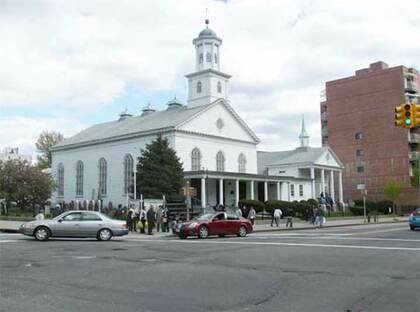
On Broadway between 51st and Corona Aves. is the Reformed Dutch Church of Newtown, built in 1831, enlarged in 1851 with stained glass added in 1874. It replaced an older structure built in 1733. On the Corona Ave. side is an ancient graveyard with some Dutch stones. Some go back to the first days of the congregation; the older stones are brownstone with uneven tops, and the lettering in most cases is much more readable than younger marble stones, which deteriorated faster.
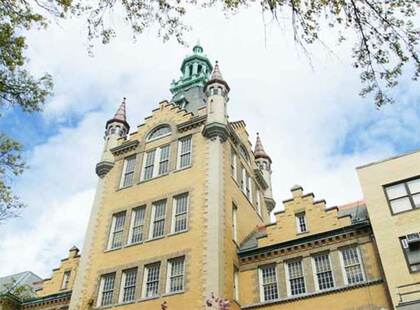
One of the most distinctive buildings in Queens is the 169-foot tall, five-spire-tower Newtown High School at Corona Ave. and 90th St. It was designed in a Flemish Renaissance style by C.B. J. Snyder and completed in 1921. Newtown High’s first graduating class in 1894 was one student; today over 4000 students attend.
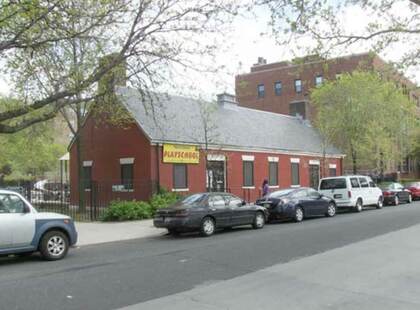
A playground at 56th Ave. and 92nd St. contains the remnants of a Newtown burying ground, with the remains of several prominent families such as the Moores (who produced Clement Clarke, credited with writing the classic “‘Twas the Night Before Christmas”) and the Fish family, which has produced several statesmen including a NY State Governor and a US Representative. The burying ground was converted into a park in 1935, though the dead weren’t disinterred: they still lie beneath a portion of the park that was left empty but for a grass covering with cherry and beech trees.
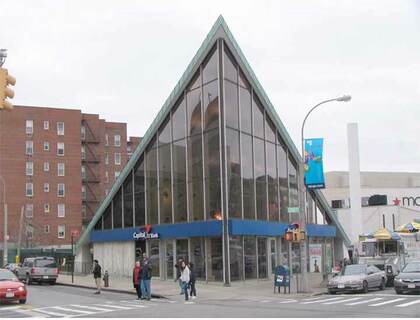
The former Jamaica Savings Bank on Queens Blvd. and 56th Ave. exhibits phases, like the moon, depending on where you view it. From 56th Ave. it resembles a verdigri’ed Stealth bomber, while its glassy triangle is unmistakable from other angles across the Boulevard of Death. Currently, it’s home to a branch of Capitol One: it has always been a bank.
The arrival of the World’s Fair in Flushing Meadows in 1964 was symbolic of the era, space-race go-go attitude the country had at the time; the war in Vietnam hadn’t yet become an albatross and there was a boundless enthusiasm about the future and the wonders it would produce. Architects got the message as well and it was then that several extraordinary buildings were produced along Queens Blvd.
Local philistines in the City Council overturned the Landmarks Preservation Commission’s decision to designate it. Rumor has it that some neighborhood loons would like it torn down in favor of a more conventionally-designed building. I hope it stands there forever.
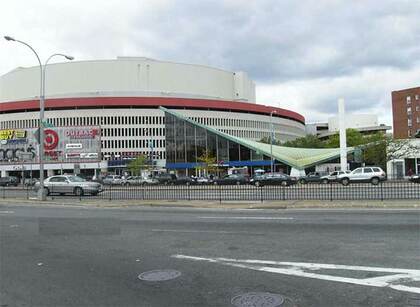
Yet another innovative architectural Queens Blvd. piece is the circular R.H. Macy branch, seen here behind the Jamaica Savings Bank. This was the site of an epic struggle between The World’s Biggest Store and a local homeowner, Mary Sendek (some accounts spell it Sondek). Mary and husband Joseph had purchased property at Queens Blvd. and 55th Ave. in 1922 and built a modest home there, raising a family; when Macy’s arrived after Joseph Sendek’s death and offered to buy the property, Mary refused to budge, even after Macy’s offered her five times what the Sendeks spent when they purchased the property. Macy’s eventually cut a notch in the circular structure to evade the property line.
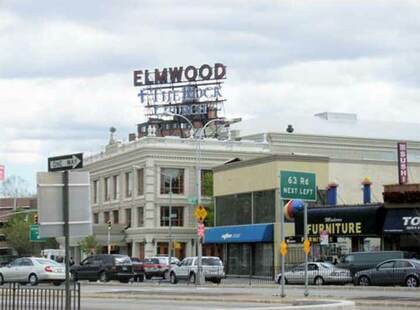
The former Elmwood Theater, Hoffman Dr. and 57th Ave., is at the former Newtown junction of Hempstead Plank Rd. and Hoffman Blvd. The plank road is now 57th Ave. and Hoffman Blvd. was expanded in 1910 to a behemoth, Queens Blvd., connecting the Queensboro Bridge and the town of Jamaica. The Elmwood was built in 1928 by architect John Schladitz as the Queensboro, and offered vaudeville stage shows and moving pictures. After closing off and on during the Depression and WWII, it was reopened as the Elmwood in 1949 and prospered in the postwar years, until it closed as a theater in 2002 and was purchased by the Rock Community Church, which renovated the exterior.
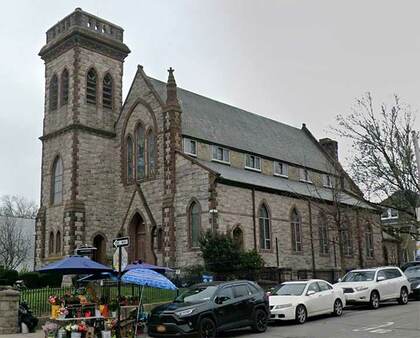
The brownstone and granite Gothic First Presbyterian Church of Newtown at 54th Ave. and Queens Blvd. was constructed in 1895 by architect Frank Collins with $70,000 donated to the church in the will of one of its elders. When Queens Blvd. was expanded in 1920s the church had to be moved back several feet. The congregation of the church goes back to Newtown’s earliest era—founded in 1695 with first minister Rev. John Moore, of the famed Moore local family. Several congregants signed the Flushing Remonstrance, a 17th-century demand for religious tolerance by Flushing’s Quakers. There’s a time capsule in the cornerstone.
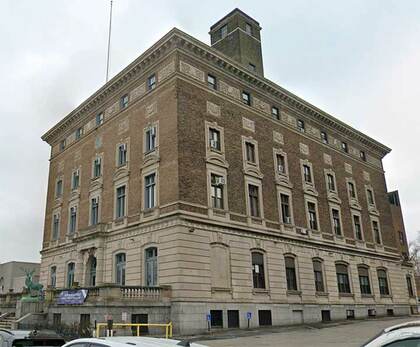
Local 878 was once the largest Elks Lodge on the East Coast with 60 rooms, bowling alleys, billiards, a ladies’ lounge, and a 50-foot bar, built in the teeth of Prohibition in 1924. The Elks don’t own it any more: it’s been sold to the New Life Fellowship, but the Elks remain as tenants. The Ballinger Company designed the granite, limestone and brick structure dominated by a now-verdigris-covered elk at the front entrance. For a couple of decades, Extreme Championship Wrestling (the old ECW, folded into the WWE) bouts were held here featuring some of the legends of “sports entertainment” such as the Sandman and Mick Foley. The Elks Lodge is an official New York City Landmark.
—Kevin Walsh is the webmaster of the award-winning website Forgotten NY, and the author of the books Forgotten New York (HarperCollins, 2006) and also, with the Greater Astoria Historical Society, Forgotten Queens (Arcadia, 2013)